
A sports car feels precise through corners when its steering inputs produce predictable changes in direction, its tyres maintain consistent grip, and its chassis communicates how the available traction is being used. The defining quality is not simply how quickly the car turns, but how confidently the driver can anticipate and control its response.
Steering accuracy, suspension damping, wheel alignment and tyre condition all shape this relationship. A car can have exceptionally quick steering yet feel nervous on uneven roads. Another may have a relatively comfortable suspension but deliver remarkably clear feedback because its geometry and tyre behaviour remain consistent under load.
Driver technique is equally important. Braking before a bend, introducing steering progressively and avoiding unnecessary corrections can make the same vehicle feel substantially more settled without modifying a single component.
Understanding these interactions helps distinguish genuine chassis shortcomings from maintenance problems, unsuitable modifications and driving inputs that disturb the vehicle’s balance. It also provides a practical basis for deciding which improvements are worthwhile and which may compromise everyday safety.
What determines cornering precision?
- Steering predictability: Accurate alignment, controlled suspension compliance and consistent assistance help the car respond naturally to small inputs.
- Tyre and chassis balance: Suitable tyres, correct inflation and well-matched damping influence cornering stability more than engine output.
- Driver control: Appropriate entry speed, progressive steering and smooth braking preserve traction and make the vehicle’s behaviour easier to interpret.
- Why Does Steering Feel Vague in Some Performance Cars?
- How to Recognise Understeer Without Taking Road Risks?
- Adaptive or Fixed Suspension for Occasional Track Days?
- Why Extreme Wheel Alignment Settings Can Hurt Road Handling
- How to Improve Cornering Stability Without Increasing Engine Power?
- When Should You Check Wheel Alignment After Hitting a Pothole?
- Front-Wheel Drive or All-Wheel Drive for Mixed Everyday Routes?
- How to Achieve Even Tyre Wear and Avoid Premature Replacement?
Why Does Steering Feel Vague in Some Performance Cars?
Steering feels vague when the connection between steering-wheel movement and the vehicle’s directional response becomes difficult to interpret. Common causes include worn suspension bushings, incorrect alignment, steering-system play, tyre characteristics and excessive electronic power assistance. Identifying whether the uncertainty occurs around the straight-ahead position or during cornering is essential before considering modifications.
The first distinction concerns mechanical precision versus perceived feedback. Mechanical precision describes how consistently steering inputs change the front wheels’ direction. Feedback describes how clearly the steering system communicates the forces acting on those wheels.
A worn control-arm bushing, for example, can allow wheel geometry to change under braking or lateral load. Steering-column joints and rack components can also introduce free play. By contrast, a healthy steering system may feel disconnected because its electric assistance filters out road forces.
Steering ratio affects how much wheel movement is required to turn, but a slower ratio is not necessarily imprecise. Similarly, caster influences steering self-centring and effort, while inappropriate caster settings or excessive caster differences between sides can contribute to undesirable behaviour.
Another frequently misunderstood characteristic is on-centre feel: how clearly a vehicle responds to small corrections near the straight-ahead position. A sports car can turn into bends rapidly yet feel ambiguous during motorway cruising. Increasing steering weight through software does not automatically correct that ambiguity.
To distinguish these symptoms, observe the car in controlled, ordinary driving conditions:
- At very low speed: In a flat, empty car park, note any unusual free play, knocking or delayed response without attempting abrupt manoeuvres.
- On a straight road: With both hands on the wheel, observe whether the car tracks consistently or requires repeated corrections. Crosswinds and road camber can affect this impression.
- During normal cornering: Notice whether uncertainty increases as lateral load builds or when the road surface becomes uneven.
These observations are diagnostic clues, not definitive tests. Uncertainty near the centre may suggest assistance characteristics, tyre behaviour or alignment. A response that changes under load may warrant closer inspection of suspension joints and bushings. Oscillation after bumps can indicate inadequate damping or another suspension fault.
Wider tyres, thicker steering-wheel grips and additional chassis braces are not universal solutions. Wider tyres may increase tramlining, while a heavier steering sensation can disguise rather than eliminate mechanical looseness.
Once steering behaviour is predictable, the next challenge is recognising when the tyres can no longer deliver the turning force requested by the driver.
How to Recognise Understeer Without Taking Road Risks?
Understeer occurs when the front tyres cannot generate enough lateral grip to follow the driver’s intended cornering path. The car travels wider than expected despite steering input. Drivers can recognise warning signs during ordinary driving, but deliberately provoking a loss of traction should be reserved for properly supervised, controlled environments.
The clearest indication is a mismatch between steering angle and actual direction. The steering wheel may turn further while the vehicle continues towards the outside of a bend. Front-tyre scrubbing or squealing can accompany this behaviour, although noise alone does not prove that the tyres have reached their grip limit.
A widening cornering radius is another possible signal. However, road camber, changing bend geometry and surface conditions also affect the vehicle’s path, making it inappropriate to diagnose understeer from a single sensation.
As explained in Continental‘s explanation of understeer and oversteer, front-axle traction and the driver’s steering and speed choices determine whether the car can follow the requested turn.
Two situations deserve separate consideration:
- Excessive entry speed: The front tyres are asked to generate more lateral force than the available grip permits. Choosing a lower corner-entry speed is the fundamental preventive correction.
- Abrupt steering or throttle inputs: Sudden changes can disturb vehicle balance or overload the available traction. Progressive inputs help the tyres develop forces more predictably.
When understeer occurs unexpectedly, looking towards a safe exit, easing excessive steering lock and avoiding abrupt braking or throttle changes generally supports recovery. The appropriate response still depends on the vehicle, its stability-control system and the available road space.
A common misconception is that understeer belongs exclusively to front-wheel-drive cars. Rear-wheel-drive and all-wheel-drive vehicles can also exceed their front tyres’ grip. Conversely, losing rear-axle grip primarily produces oversteer, not understeer, although rapid transitions between different handling states are possible.
For practical experience, a supervised skid-pan session or advanced driver-training course offers controlled conditions and professional instruction. A quiet public roundabout, even when wet or apparently empty, is not a suitable place to manufacture traction loss. Other road users, changing surface friction and limited escape space make such experiments unpredictable.
Recognising the onset of front-tyre saturation is more useful than learning how to provoke it.
Tyre grip establishes the fundamental limit, but suspension calibration influences how clearly the driver senses the approach to that limit.
Adaptive or Fixed Suspension for Occasional Track Days?
Adaptive suspension is often a practical choice for a sports car driven daily and used occasionally on circuit because adjustable damping can accommodate different road conditions. Fixed suspension remains attractive for drivers seeking straightforward maintenance, consistent settings and a carefully selected mechanical setup. Neither design is inherently superior for every vehicle or track-day schedule.
Suspension damping controls the speed of body and wheel movement. Springs support vehicle weight and contribute to roll and pitch resistance, while dampers regulate how rapidly those movements develop and settle.
Adaptive dampers can change their characteristics in response to selected modes or vehicle operating conditions. ZF‘s adaptive damping technology overview describes Continuous Damping Control, including the ability to select firmer sporting characteristics or softer comfort-oriented behaviour.
The advantage is flexibility rather than a guaranteed increase in ultimate cornering grip. A softer setting can help the wheels follow imperfect road surfaces, while a firmer setting may improve control of body movement during demanding manoeuvres. The result depends on the car’s overall suspension design and calibration.
For a meaningful comparison, consider the actual driving profile rather than assuming that a track-oriented suspension must be better everywhere.
| Decision factor | Adaptive suspension | Fixed suspension |
|---|---|---|
| Occasional circuit sessions | Selectable characteristics offer useful flexibility | Well-matched sport dampers can be effective |
| Rough everyday roads | Comfort settings may improve compliance | Comfort depends entirely on component selection |
| Repeated demanding track use | Performance depends on calibration and heat management | Specialised dampers may offer greater tuning flexibility |
| Maintenance and repairs | Electronic controls add diagnostic and replacement complexity | Conventional designs are generally simpler to service |
| Aftermarket modification | Compatibility with electronic controls requires verification | Often easier to modify, subject to vehicle compatibility |
For someone attending only a handful of track days each year, replacing a functioning adaptive system with a permanently firm suspension can create an unnecessary compromise. The car may become less comfortable, less compliant on broken surfaces and harder to exploit in wet conditions.
However, adaptive components can be expensive to replace outside warranty coverage. Changing springs or dampers may also require compatible electronics, recalibration or specialist equipment. Repair costs and upgrade feasibility should be checked for the specific vehicle rather than assumed.
Fixed dampers have their own limitations. A setting chosen for smooth circuits can prove excessively firm on irregular roads. Predictable calibration is a genuine advantage, but fixed damping forces are not perfectly identical under all operating temperatures and velocities. Likewise, adaptive electronics should not be assumed to change calibration because of heat without evidence for the particular system.
The best arrangement is one that maintains consistent wheel contact and allows the driver to anticipate chassis movement in the environments actually encountered.
Even well-selected dampers cannot compensate for inappropriate wheel geometry, particularly when circuit alignment settings are carried over to everyday roads.
Why Extreme Wheel Alignment Settings Can Hurt Road Handling
Extreme alignment settings can reduce road-handling precision because geometry optimised for sustained circuit cornering may behave poorly on uneven or crowned public roads. Excessive negative camber, unsuitable toe settings and poorly balanced caster can compromise straight-line stability, tyre wear and braking consistency. A sensible road setup balances cornering response with predictable behaviour across changing surfaces.
Wheel alignment primarily concerns camber, toe and caster. Camber describes wheel inclination relative to vertical. Toe describes whether the wheels point slightly inward or outward when viewed from above. Caster concerns the steering axis and influences self-centring behaviour.
Negative camber can help maintain a favourable tyre contact orientation when the outside suspension compresses and the body rolls during cornering. However, an extreme setting may reduce the effective contact area during straight-line travel and braking, depending on tyre construction, load and suspension geometry.
Public roads create additional complications. Surface crowns, ruts and irregular camber generate forces that differ from those encountered on a comparatively smooth circuit. Aggressive toe-out can make initial steering feel sharper while increasing sensitivity to road imperfections and causing additional tyre scrub.
Camber and toe should never be adjusted independently of their effects on the wider suspension geometry. Caster also interacts with steering feel, camber gain and self-centring. Changing one parameter without measuring the others can create an unbalanced setup.
A particularly important warning concerns inner-shoulder tyre wear. Excessive negative camber, especially when combined with unfavourable toe, can concentrate wear on the inside of the tread. This region is difficult to see when looking casually at a parked car, allowing severe deterioration to develop unnoticed.
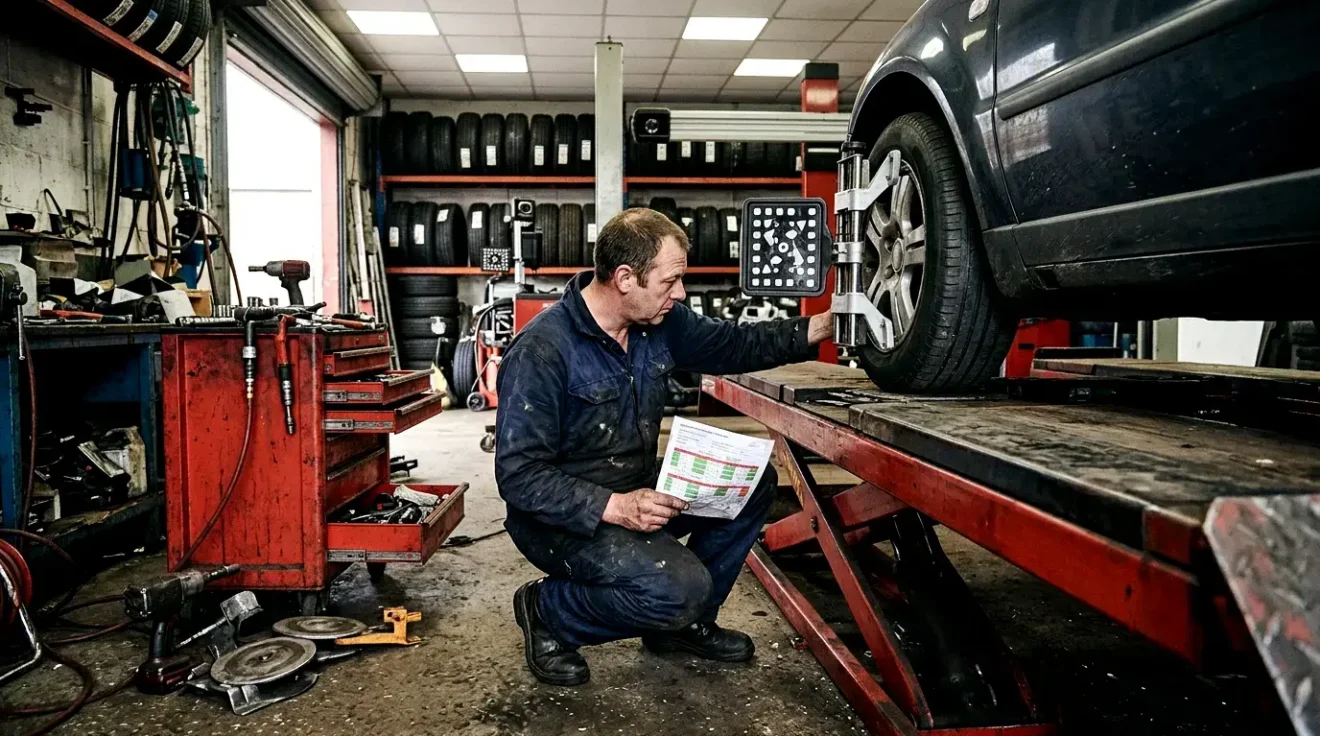
A road-focused alignment should normally remain within the vehicle manufacturer’s approved specifications unless a qualified specialist has established an appropriate alternative. For dual-purpose cars, a moderate compromise may be more effective than an aggressive circuit setup that sacrifices stability during daily driving.
Dedicated track tyres and wheels can help separate road and circuit requirements, but swapping wheels does not independently change suspension alignment. If different geometry is necessary, it must be adjusted and checked appropriately.
Request a written before-and-after alignment report showing the measured settings for each wheel. This provides a reference for future diagnosis and makes previous adjustments traceable. If a vehicle develops pulling, tramlining or accelerated tyre wear after a modification, the report can help identify what changed.
Once geometry is appropriate, improvements to tyres, braking consistency and driver inputs often deliver more useful cornering gains than additional chassis hardware.
How to Improve Cornering Stability Without Increasing Engine Power?
Cornering stability can often be improved without increasing power by optimising tyre condition and inflation, correcting wheel alignment, maintaining consistent braking performance and developing smoother driving inputs. These measures influence how reliably the tyres generate grip and how progressively the chassis transfers load. Additional power rarely resolves vague steering, poor balance or unpredictable cornering behaviour.
For a typical road-driven sports car, the most sensible hardware priorities are tyres first, alignment second, braking-system condition third and targeted chassis modifications only where a genuine weakness has been identified.
Tyres deserve priority because they provide the contact between the car and the road. Their compound, construction, tread condition and operating temperature influence steering response, braking and lateral traction.
Inflation pressure is especially important. Excessive pressure can alter the shape and loading of the contact patch, reduce compliance and change cornering balance. Underinflation increases deformation and heat generation, potentially degrading steering response and tyre durability.
However, pressure effects are not universal. A particular increase does not always produce understeer, and the relationship between pressure and contact-patch area depends on tyre and load conditions.
For public roads, start with the vehicle manufacturer’s specified cold tyre pressures, including any separate recommendations for heavier loads or sustained high-speed travel. Do not use arbitrary pressure reductions to chase additional grip.
Track driving introduces different operating temperatures. Hot-pressure targets should come from the applicable tyre and vehicle guidance, supported by appropriately supervised measurement. A track pressure setting should not automatically become the normal road setting.
Alignment is the next priority. Correct toe and camber help the vehicle track consistently and prevent unnecessary tyre scrub. Braking consistency also matters: appropriate pads, sound discs and correctly maintained brake fluid help deliver predictable deceleration before corner entry.
Chassis braces can improve rigidity where measurable structural compliance exists, but their effect is vehicle-dependent. They cannot replace faulty dampers, worn bushes or unsuitable tyres.
Driver behaviour can produce immediate benefits without any mechanical modification. Braking progressively while travelling straight, looking through the bend and applying one measured steering input can reduce unnecessary corrections and abrupt load transfers.
Weight management is another useful consideration. Removing unnecessary luggage reduces total mass and inertia, although its effect on handling balance depends on where that mass was located. Removing substantial weight from the rear can change axle loading in ways that are not automatically beneficial. Safety equipment and manufacturer-required components must remain in place.
Five practical actions to improve cornering consistency
- Inspect the condition and specification of all four tyres, then record visible damage, wear patterns and tyre identification details.
- Measure cold tyre pressures against the vehicle’s published recommendations and produce a dated pressure log.
- Arrange a professional alignment inspection where symptoms or maintenance history justify it, keeping the measurement report.
- Have the braking system assessed for wear, fluid condition and consistent operation, retaining the inspection findings.
- Attend a supervised driving session focused on braking, vision and steering smoothness, and record two specific techniques to practise during normal, lawful driving.
That baseline can change after an impact, even when the car appears undamaged. Recognising when wheel alignment needs attention protects both steering precision and tyre life.
When Should You Check Wheel Alignment After Hitting a Pothole?
Wheel alignment should be checked promptly after a substantial pothole impact if the steering wheel becomes off-centre, the vehicle consistently pulls to one side or unusual tyre wear develops. A strong impact also warrants inspection for tyre, wheel and suspension damage, even when no external defect is obvious. Not every pothole strike causes misalignment.
The severity of an impact depends on several factors: the pothole’s depth, the sharpness of its edge, vehicle speed, tyre condition and the direction of contact. An impact transmitted strongly through the suspension or body deserves particular attention.
Begin with the tyre and wheel rather than assuming that alignment has changed. A bent wheel rim, damaged tyre sidewall or pressure loss can create symptoms similar to those of incorrect geometry.
The NHTSA‘s TireWise tyre safety information explains that potholes can cause sudden tyre-pressure loss. It also identifies correct wheel alignment as important for reducing directional pulling and unnecessary tyre wear.
The following symptoms justify closer investigation:
- Off-centre steering: The steering wheel no longer sits in its usual position when travelling straight on a level road.
- Consistent directional pull: The vehicle tends towards one side under comparable road conditions.
- New vibration: Steering or body vibration appears at particular speeds, potentially indicating wheel, tyre or suspension damage.
- Unusual tyre wear: One shoulder begins wearing faster than expected or develops an abnormal pattern.
- Visible damage or pressure loss: A tyre bulge, cut, bent rim or persistent pressure reduction indicates a potentially more urgent safety concern.
A sudden vibration or pulling sensation should not be attributed to alignment without diagnosis. Wheel imbalance, tyre damage and braking faults can produce overlapping symptoms.
If a tyre has a bulge, serious cut, rapid pressure loss or another suspected structural defect, avoid driving the vehicle until it has been assessed. A visibly damaged tyre may require replacement rather than repair.
Alignment changes may be small enough to escape immediate notice. Uneven wear can emerge only after continued mileage, so an apparently straight-tracking car is not conclusive proof that its suspension geometry remains unchanged.
After a significant strike, a workshop can inspect suspension arms, joints, wheel bearings, tyres and wheels before measuring alignment. Adjusting geometry without identifying a bent or loose component may conceal the underlying problem.
A follow-up inspection can be useful if symptoms persist or return after repairs, but there is no universal requirement to repeat an alignment check after a fixed number of weeks.
With the suspension and tyres in sound condition, drivetrain configuration becomes another factor in how a sports car behaves on wet, winter and mixed everyday routes.
Front-Wheel Drive or All-Wheel Drive for Mixed Everyday Routes?
Front-wheel drive is generally attractive for mixed everyday driving because of its relative mechanical simplicity and potential efficiency advantages. All-wheel drive can provide better acceleration traction on slippery surfaces, but it adds drivetrain complexity and does not inherently improve braking or cornering grip. Tyres, suspension tuning and driving conditions remain decisive.
The distinction begins with how engine torque reaches the road. Front-wheel-drive vehicles transmit propulsion through the front wheels, which must also generate steering forces. This combined demand can increase the likelihood of power-on understeer in certain conditions.
All-wheel-drive systems distribute propulsion between both axles, potentially improving traction when accelerating on wet, snowy or otherwise low-grip surfaces. However, the amount of torque sent to each axle varies widely between different systems.
All-wheel drive should not be confused with additional tyre-road friction. Under braking, every vehicle still depends fundamentally on its tyres and braking system. During cornering, available lateral grip remains limited by the tyres, surface and axle loading.
Tyre selection can therefore matter more than drivetrain layout in challenging weather. Appropriate winter tyres can significantly change winter performance, while worn or unsuitable tyres can undermine the benefits of an advanced all-wheel-drive system.
Michelin‘s comparison of AWD and winter tyres emphasises that all-wheel drive assists acceleration traction but does not replace winter-appropriate tyres for steering and braking. It also recommends fitting four suitable winter tyres rather than mixing winter and non-winter tyres between axles.
For mixed everyday use, the practical comparison extends beyond acceleration:
| Consideration | Front-wheel drive | All-wheel drive |
|---|---|---|
| Wet and winter acceleration | Limited by available front-axle traction | Can distribute propulsion across both axles |
| Fuel consumption | May benefit from lower mass and simpler driveline | Additional components can increase mass and losses |
| Maintenance | Generally fewer driven-axle components | May require additional differential, coupling or fluid servicing |
| Tyre management | Front tyres may experience greater combined steering and drive wear | Matched tyre condition and circumference may be especially important |
| Cornering behaviour | Power-on understeer can be a characteristic | Behaviour depends strongly on torque distribution and chassis tuning |
Some all-wheel-drive systems add substantial hardware and mass, although the amount and distribution vary by vehicle. Added mass does not necessarily sit over the front axle, and an all-wheel-drive model is not automatically less agile than its front-wheel-drive counterpart.
Similarly, front-wheel drive is not guaranteed to produce progressive, easily managed understeer. Stability-control calibration, tyre selection, suspension geometry and driver inputs can alter the behaviour considerably.
All-wheel drive may also disguise excessive throttle demand by improving acceleration traction before a driver notices the available grip diminishing. This does not establish that its handling limit is necessarily more abrupt.
For routes dominated by urban roads, motorways and occasional wet conditions, a front-wheel-drive car with suitable tyres can be a sensible choice. Frequent travel on steep, snowy or poorly maintained surfaces may strengthen the case for all-wheel drive, provided the tyres match those conditions.
Whichever drivetrain is chosen, tyre condition remains central to the consistency of steering feedback and the predictable use of available grip.
Key takeaways before checking tyre wear
- Investigate directional pulling or altered steering response before assuming a new tyre set will solve the problem.
- Consider drivetrain-specific tyre matching and rotation requirements when planning maintenance.
- Use tread wear patterns as diagnostic evidence, not simply as an indication that replacement is due.
How to Achieve Even Tyre Wear and Avoid Premature Replacement?
Even tyre wear depends on maintaining correct cold inflation pressures, sound wheel alignment, healthy suspension components and appropriate tyre rotation where permitted. Regularly examining the entire tread surface helps reveal problems before replacement becomes necessary. Uneven wear should be diagnosed rather than simply concealed by moving tyres between wheel positions.
Tyre wear provides useful clues about vehicle condition, although individual patterns rarely identify a single cause with certainty.
Wear concentrated on both shoulders can suggest prolonged underinflation or excessive loading. Predominantly central wear may indicate overinflation under some operating conditions. Feathering across tread-block edges often points towards toe-related scrub, while pronounced wear on one shoulder may involve camber, toe, cornering habits or suspension faults.
The distinction matters because replacing tyres without correcting the underlying cause allows the problem to continue. A car with excessive front toe, for example, may wear a replacement set prematurely while developing the same steering instability that prompted the original inspection.
A closer examination is particularly important when negative camber is present. Inner-shoulder wear can develop beyond the owner’s normal line of sight, so checking only the outer tread blocks is insufficient.
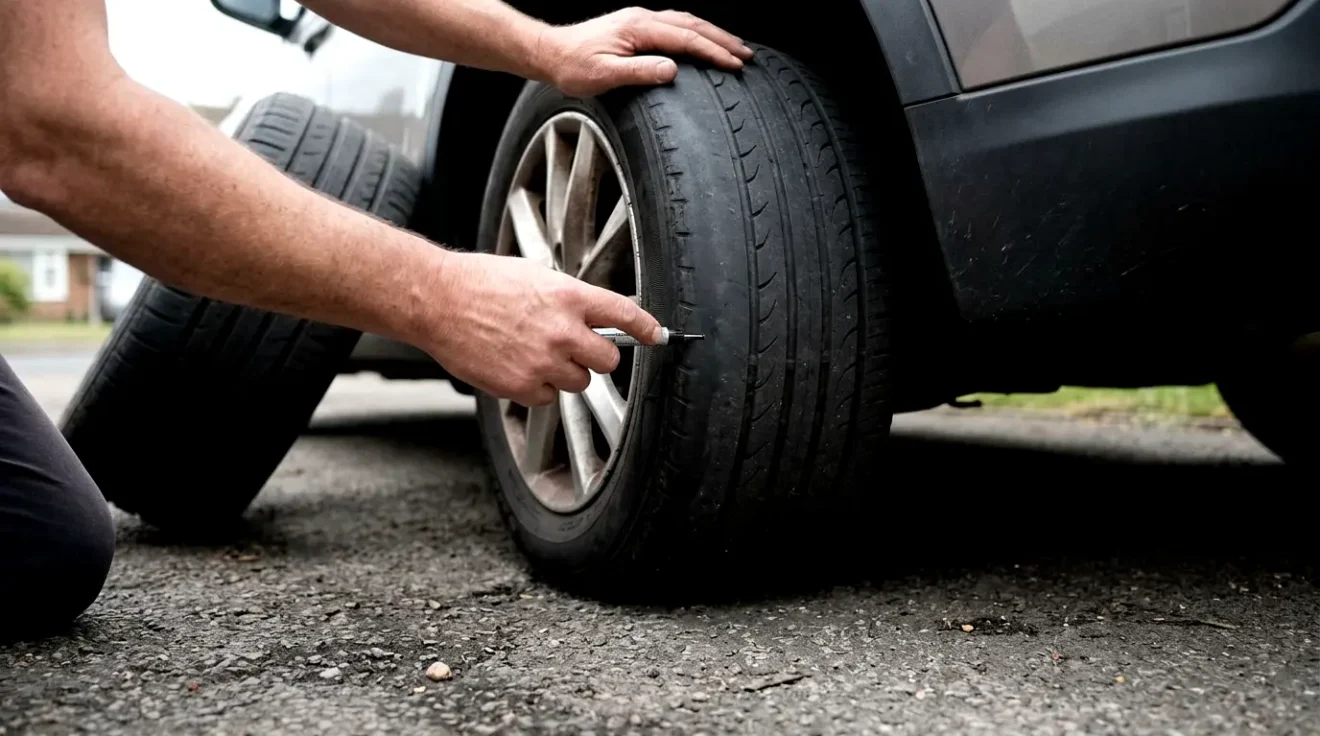
A tread-depth gauge allows measurements across the inner, central and outer sections of each tyre. Recording these readings at successive inspections helps reveal whether wear is progressing evenly or becoming concentrated in a particular area.
Rotation can distribute wear more evenly, but the correct method depends on tyre construction, directional requirements, wheel dimensions and drivetrain configuration. Some sports cars use staggered front and rear tyre sizes, making conventional front-to-rear rotation impossible.
All-wheel-drive vehicles may also require particularly close matching of tyre circumference and condition. Significant differences can affect drivetrain operation, depending on the manufacturer and system design. Always follow the vehicle’s tyre replacement and rotation guidance.
Pressure measurements should be taken when tyres are cold, using the manufacturer’s specified conditions. Pressures naturally rise as tyres warm during motorway travel; releasing air solely because a hot measurement exceeds the cold recommendation can leave the tyre underinflated once it cools.
For sustained high-speed or heavily loaded driving, consult any separate inflation recommendations published for the vehicle. Heat accumulation alone does not establish that the alignment is wrong or that the tyre will necessarily wear its shoulders more rapidly.
Correct inflation, periodic measurements and professional inspection when abnormal patterns appear help maintain the consistent steering characteristics expected from a well-maintained sports car.
Tyre replacement decisions must also consider visible damage, tyre age, manufacturer guidance and the applicable tread-depth laws in the country where the vehicle is used. Legal limits differ across English-speaking markets, and a tyre may become unsuitable for particular weather conditions before reaching the legal minimum.
As a practical next step, record cold tyre pressures and tread-depth readings across all four tyres, then compare them with the vehicle’s specifications. If the measurements show significant asymmetry, or if steering behaviour has changed, arrange a professional tyre and suspension inspection before considering performance upgrades.
Does heavier steering mean a sports car has better handling?
No. Steering effort and steering accuracy are different qualities. A heavily assisted or electronically weighted steering system can feel substantial without communicating useful information about front-tyre grip. Predictable on-centre response, consistent steering geometry and clear feedback are more useful indicators of precision.
Can a sports car feel more precise with softer suspension?
Yes. On irregular roads, more compliant suspension can help the wheels maintain contact with the surface and reduce unwanted body disturbances. Excessively soft damping can also impair body control, however. The ideal calibration balances wheel compliance, pitch and roll control, and predictable transient response.
Does electronic stability control reduce cornering precision?
Not inherently. Electronic stability control monitors vehicle motion and can intervene when it detects a developing loss of directional stability. Its calibration varies between vehicles, and interventions may affect the sensations perceived by the driver. On public roads, keeping the system enabled provides an important safety benefit and is generally the appropriate choice.
Should tyre pressures be changed before every spirited drive?
Not as a routine response to enthusiastic road driving. Use the manufacturer’s recommended cold pressures for the vehicle’s load and operating conditions. Track-specific pressure management is different and should follow suitable tyre guidance and supervised measurement. Arbitrary changes can compromise handling, braking and tyre durability.
Can new tyres immediately restore lost steering precision?
New, correctly specified tyres may improve response when the previous set was worn, damaged or unsuitable for the conditions. They cannot repair suspension play, incorrect wheel geometry or a defective steering component. If vague steering persists after replacement, a mechanical inspection is the appropriate next step.