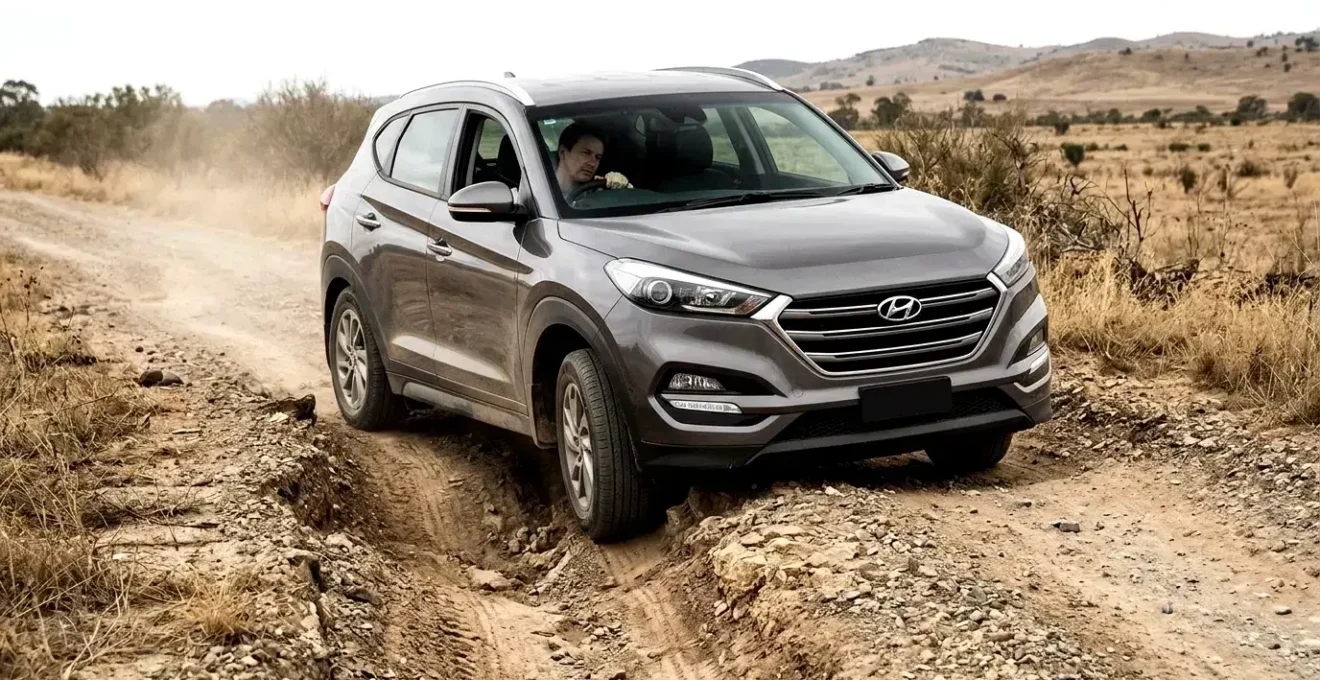
A regular SUV can handle many maintained gravel roads and firm rural access tracks, but its raised body does not make it a dedicated off-road vehicle. Deep ruts, loose stones, sharp crests and waterlogged ground can expose limitations that remain invisible during everyday driving.
Before taking an SUV onto rough terrain, assess three things: the vehicle’s actual clearance and traction capabilities, the condition of the entire route, and the consequences of getting stuck or making contact with an obstacle. Good tyres, appropriate inflation pressures and careful driving can reduce risks, but none can compensate for a route that exceeds the vehicle’s mechanical limits.
The safest preparation is often inexpensive. Knowing where the underside sits lowest, checking tyre condition, inspecting uncertain obstacles on foot and choosing a conservative driving line can prevent damage before upgrades become necessary. The objective is not to make a family SUV behave like a specialist 4×4, but to identify which unpaved routes it can reasonably manage without accumulating damage.
Preparing an SUV for rough terrain: the essentials
- Assess capability before appearance: ground clearance, vehicle geometry, tyres and drivetrain limitations determine whether an obstacle is manageable.
- Inspect unfamiliar tracks before committing: check rut depth, ground firmness, hidden hazards and whether a safe retreat remains possible.
- Protect the vehicle through technique and maintenance: use suitable tyres and pressures, drive slowly over obstacles, and inspect the underbody, brakes and suspension afterwards.
- Why Do High-Riding SUVs Still Get Stuck on Uneven Tracks?
- How to Check a Gravel or Rutted Track Before Driving Through?
- Underbody Protection or Better Tyres: Which Upgrade Comes First?
- The Mistakes That Damage Suspension Components on Rocky Trails
- What Should You Check After Driving Through Mud and Gravel?
- Front-Wheel Drive or All-Wheel Drive for Mixed Everyday Routes?
- Normal or Fully Loaded Tyre Pressure: Which Setting Should You Use?
- How to Build a Preventive Vehicle Maintenance Routine?
Why Do High-Riding SUVs Still Get Stuck on Uneven Tracks?
High-riding SUVs get stuck because ground clearance is only one part of off-road capability. Long wheelbases, low bumpers, road-oriented tyres and limited wheel articulation can prevent a vehicle from crossing uneven ground. Even an all-wheel-drive SUV may lose traction or become stranded when its underside rests on a raised section of track.
Four geometric characteristics influence whether a vehicle can clear an obstacle:
- Ground clearance: the space between the ground and the vehicle’s lowest relevant components.
- Approach angle: how steeply the vehicle can climb towards an obstacle without its front bumper contacting it.
- Departure angle: the equivalent limit at the rear when leaving an obstacle.
- Break-over angle: the ability to cross a crest without the centre of the underside becoming grounded.
A long-wheelbase SUV may have respectable clearance on level ground but still become high-centred when its front and rear wheels straddle a raised ridge. Running boards, exhaust components and unprotected mechanical parts can make the practical limitation even greater.
The National Park Service guidance on off-pavement vehicle safety highlights how wheelbase, tyre construction, bumper geometry and drivetrain suitability influence progress on rough routes. Its observations concern demanding terrain in Mojave National Preserve, rather than a universal classification of SUV capability.
Mechanical equipment matters just as much. Many road-focused SUVs lack low-range gearing, have relatively limited suspension articulation and use tyres optimised for paved roads. Their electronic traction systems vary considerably: some distribute torque effectively, while others may allow noticeable wheelspin before intervention.
Driving technique introduces another risk. Stopping on loose ground can make restarting difficult, but accelerating aggressively to maintain momentum may cause the suspension to compress into an obstacle. The better approach is a controlled, steady pace that preserves traction without relying on speed.
Before attempting an uneven route, record whether your SUV has suitable tyres, adequate clearance at its lowest points, AWD or FWD, and protection for vulnerable underbody components. Consult its owner’s manual for any restrictions on off-pavement use. Unknown specifications should count as unresolved risks, not assumed capabilities.
Vehicle capability sets the boundary; the condition of the track determines whether approaching that boundary is sensible. The next decision is therefore about the ground itself.
How to Check a Gravel or Rutted Track Before Driving Through?
Check an unfamiliar gravel or rutted track by stopping in a safe location and inspecting uncertain sections on foot. Compare rut depth and raised ground with your SUV’s actual clearance, assess whether the surface is firm enough to support the vehicle, and confirm that you can safely retreat if conditions deteriorate.
Start with the deepest visible ruts, prominent stones and raised centre sections. Measure or estimate obstacles against the vehicle’s lowest components, allowing a conservative margin for suspension movement and additional load. There is no universal rut-depth threshold that makes every SUV safe: vehicle geometry, driving line and ground conditions affect the result.
Where it is safe to approach on foot, a sturdy stick can help investigate a suspicious soft patch without stepping into it. This is only a basic indication of surface condition, not proof that the ground will carry the vehicle’s weight. Avoid unstable edges, flowing water and any section where inspection itself would be hazardous.
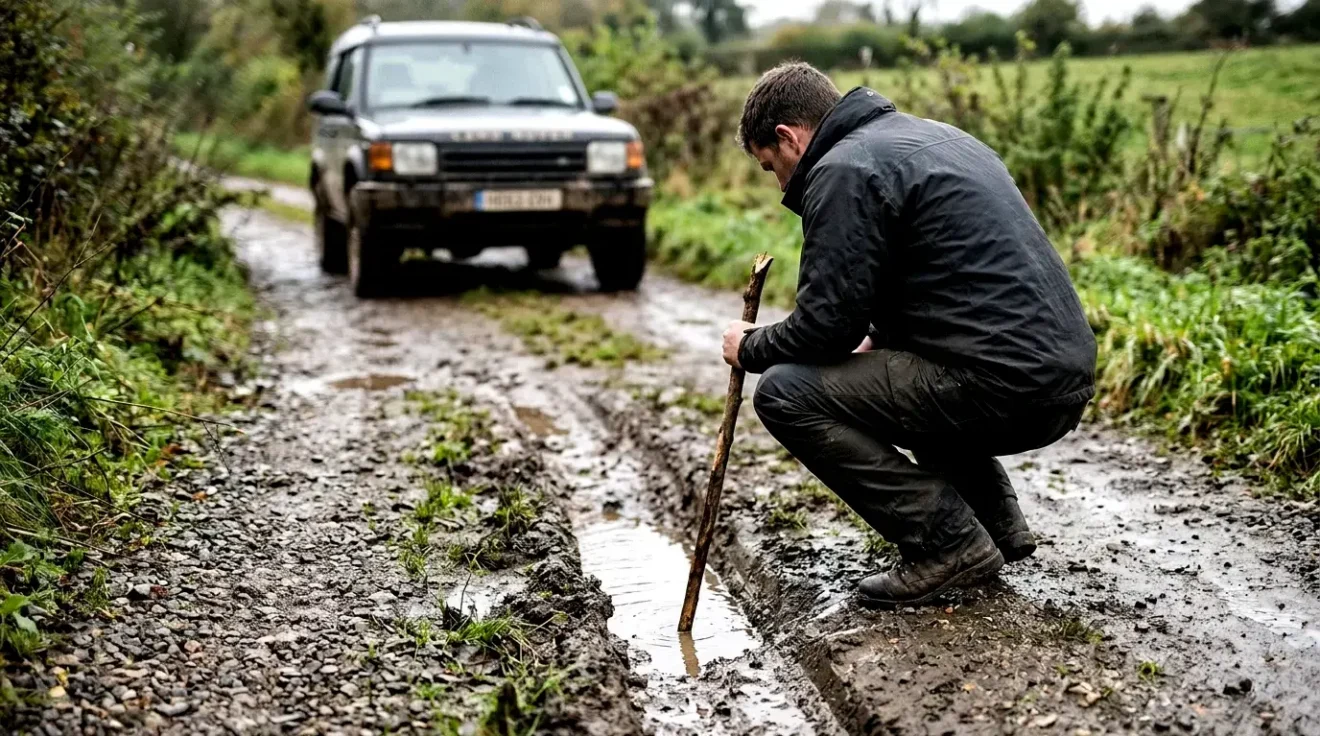
Environmental clues provide useful context. Fresh, deep tyre impressions suggest that previous vehicles displaced the surface, although their weight and equipment may differ from yours. Vegetation growing along the centre may conceal rocks or raised ground. Water collecting in depressions can indicate poor drainage, while recent rainfall can turn an otherwise manageable track into slippery mud.
Use the following conservative decision framework before continuing:
| Assessment | Continue only after checking | Stop or turn back when |
|---|---|---|
| Rut depth and clearance | Obstacles are visibly clear of vulnerable components, with allowance for vehicle movement. | Clearance is inadequate, uncertain or likely to disappear as the suspension moves. |
| Surface firmness | The ground appears stable, with no significant signs of deep sinking or washouts. | Soft mud, unstable edges or hidden hazards cannot be reliably assessed. |
| Escape route | A safe, verified return route or turning point remains available. | The track narrows beyond a point where safe retreat is uncertain. |
Inspect the route beyond the first visible bend whenever possible, using reliable route information and local conditions. A narrow track with no turning space can leave a driver facing an unsafe reverse manoeuvre if a later obstacle proves impassable.
Big Bend National Park‘s backcountry road safety advice recommends checking current conditions, preparing the vehicle and turning around when terrain exceeds its capabilities. That principle applies well beyond the park, although its vehicle-clearance requirements are specific to its roads.
“Every vehicle has its limits; if you encounter a road obstacle or conditions that are beyond the limits of your vehicle, turn around”
If the route is suitable but still places unusual demands on the vehicle, the next question is whether tyres or additional protection would meaningfully reduce the remaining risk.
Underbody Protection or Better Tyres: Which Upgrade Comes First?
Better tyres are usually the more useful first upgrade when a road-focused SUV frequently encounters loose gravel, provided the existing tyres lack suitable traction or durability. Underbody protection becomes more relevant where unavoidable stones, ridges or rocky obstacles threaten exposed components. Neither upgrade increases ground clearance enough to make an unsuitable route safe.
The choice should follow the most likely failure mechanism. On maintained gravel access roads, tyre grip, sidewall durability and predictable handling may be more important than metal protection plates. On rocky routes, a vehicle can have excellent traction yet still suffer damage to an exposed engine sump, oil pan or other low-mounted component.
Tyre selection also requires restraint. An aggressive tread is not automatically suitable for every surface, and an incompatible tyre can compromise normal road performance. Choose dimensions, load ratings and speed ratings compatible with the vehicle and its intended use.
Increasing tyre diameter may alter speedometer accuracy, effective gearing, available clearance around the wheel arches and handling characteristics. Replacement dimensions must also comply with applicable vehicle approval, insurance and roadworthiness requirements in the country where the vehicle is registered.
Underbody protection has its own trade-offs. Skid plates may reduce exposure to specific impacts, but they add weight, can affect access for servicing and do not prevent every type of mechanical damage. They also cannot compensate for tyres that repeatedly lose grip.
These practical scenarios illustrate where an initial investment may offer the greatest benefit:
| Typical use | First priority | Reason and limitation |
|---|---|---|
| Occasional maintained gravel roads | Tyre inspection and suitability | Compatible road tyres may already be sufficient; an upgrade is not automatically necessary. |
| Frequent loose gravel or uneven rural access | Appropriate, compatible tyres | Improved tread suitability and durability can address common traction and damage risks. |
| Rocky tracks with exposed obstacles | Clearance assessment, then targeted protection | Skid plates may help protect vulnerable areas, but cannot make an unsuitable SUV capable of safely crossing the route. |
| Mixed daily driving and occasional rough tracks | Balanced tyre choice | Normal-road braking, noise, comfort and wet-weather performance remain important. |
For an ordinary SUV, the most economical option may be to make no modification at all and avoid the most demanding routes. A vehicle that frequently requires protective contact with rocks is probably being used beyond its intended operating conditions.
Once suitable equipment is in place, driving technique becomes the main controllable factor. Even properly equipped vehicles can suffer expensive suspension damage when obstacles are approached incorrectly.
The Mistakes That Damage Suspension Components on Rocky Trails
Suspension damage on rocky trails commonly results from excessive speed, poor wheel placement, abrupt driving inputs and repeated contact with obstacles. Control arms, ball joints, dampers and CV-joint boots can all be exposed to impact or abrasion. The safest technique is to inspect uncertain rocks, choose a clear line and cross at a controlled pace.
A sharp impact is different from the suspension compressing over an ordinary road imperfection. Striking a protruding rock can load a wheel and its supporting components suddenly, particularly when the tyre cannot deflect or climb around the obstacle smoothly.
Several mechanical risks deserve particular attention:
- Control arms and ball joints: a direct strike can bend components, damage protective boots or affect wheel alignment.
- CV joints and driveshaft boots: sharp stones can tear rubber boots, allowing grease to escape and contamination to enter the joint.
- Dampers and suspension mounts: hard bottoming-out and repeated severe impacts can cause deterioration or physical damage.
- Steering components: impacts around the wheel can affect linkages, alignment and steering response.
Speed is often the most avoidable contributor. A slowly approached obstacle gives the driver more opportunity to control wheel placement and limit abrupt suspension movement. Driving faster to clear a difficult section may instead increase the severity of an impact or cause the underside to strike a crest.
Ford‘s off-road driving and inspection instructions advise controlled speed, smooth driving inputs and slowing down when suspension bottoming or excessive protective-plate contact occurs. These instructions come from documentation for a specialised vehicle; a regular SUV may have more restrictive capabilities.
Wheel movement also matters. When crossing a small obstacle at very low speed, a smoothly rolling wheel can climb rather than be driven abruptly into the obstruction. However, this is not a reason to release the brakes indiscriminately. Light, controlled braking may be necessary on slopes or where vehicle speed must be restrained.
If an isolated rock cannot be avoided, routing it beneath a tyre may sometimes be preferable to placing it under exposed underbody components. This is only appropriate when the tyre can safely cross it without threatening the sidewall, wheel, suspension or vehicle stability.
Watch for early warning signs after any substantial impact: new clunks over bumps, steering that pulls to one side, abnormal vibration, damaged rubber boots or developing uneven tyre wear. These symptoms justify a mechanical inspection rather than another attempt at the same obstacle.
Some problems remain invisible immediately after impact. That makes the inspection after a rough drive as important as the technique used during it.
What Should You Check After Driving Through Mud and Gravel?
After driving through mud and gravel, inspect the tyres, wheels, underbody, brakes and exposed suspension components for trapped debris or physical damage. Check immediately for punctures, leaks, loose material and unusual vibrations, then monitor braking, steering and suspension behaviour during subsequent normal driving. Never ignore a new noise following an impact.
Begin with a visual inspection on firm, level ground after the vehicle has cooled sufficiently. Look beneath the SUV from a safe position without crawling under an unsupported vehicle. Check for hanging covers, lodged branches, visible fluid leaks and damage to low-mounted components.
Next, examine tyres and wheels for cuts, bulges, trapped stones, dents and missing balance weights. Mud accumulated unevenly inside a wheel can cause vibration that resembles a mechanical fault, while stones trapped near brake components can produce scraping noises.
The braking system deserves particular care. Gravel may become trapped between a brake disc and its backing plate, while mud around a caliper or rotor may interfere with normal operation. If the brakes make persistent scraping sounds, pull abnormally or feel different, stop using the vehicle until the cause has been assessed.
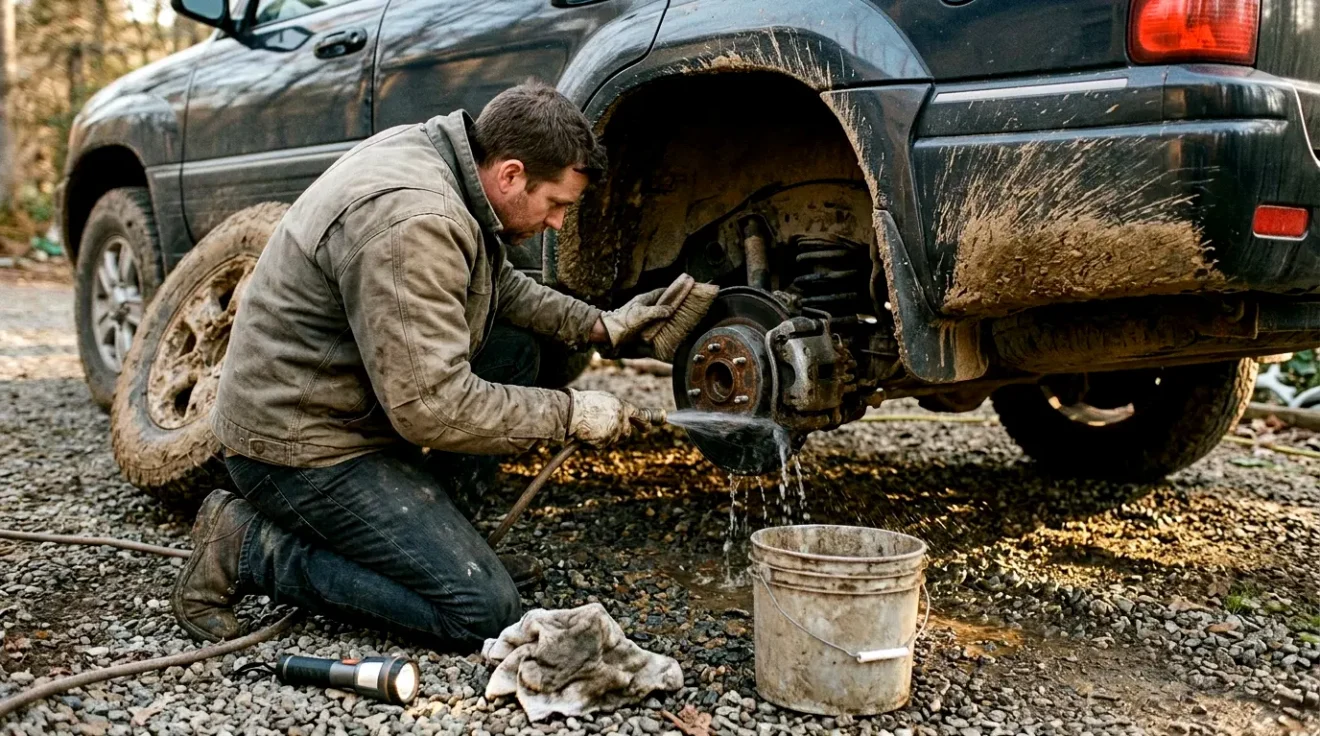
Remove accessible dirt with a soft brush and gentle water flow where the vehicle manufacturer permits it. Avoid directing high-pressure water at bearing seals, brake assemblies, electrical connectors or protective boots. Do not remove wheels or dismantle brake components without the correct equipment, safe support procedures and mechanical competence.
Inspection should also extend to CV-joint boots, ball-joint covers and steering-gear boots. A small tear may initially cause no obvious driving symptom but can allow contaminants into components that depend on sealed lubrication. Check the air-filter housing for contamination where appropriate, following the owner’s manual.
Some problems emerge only after mud dries or normal driving resumes. A next-day check can help identify wheel vibration, steering changes, abnormal braking or suspension noises that were not apparent on the track.
Five checks to complete after a rough-road drive
- Inspect every tyre for cuts, bulges and embedded objects; record any visible damage and the affected wheel.
- Examine accessible underbody areas for impact marks, leaks or trapped debris; note the location of each concern.
- Check visible brake areas and wheel interiors for mud or stones; identify any material that cannot be safely removed.
- Inspect accessible suspension and driveshaft boots for tears or grease leakage; make a written list of suspicious components.
- During a cautious return to normal driving, note any new vibration, steering deviation, braking issue or noise; arrange inspection if a symptom persists.
This routine separates harmless surface dirt from symptoms that could indicate damaged components. An unresolved brake, steering, tyre or suspension concern should be addressed before further driving, rather than postponed until the next scheduled service.
These checks are useful regardless of whether the SUV drives through its front wheels or uses all-wheel drive. Drivetrain choice affects traction, but it does not eliminate the need for inspection.
Front-Wheel Drive or All-Wheel Drive for Mixed Everyday Routes?
Front-wheel drive can be sufficient for maintained gravel roads and firm rural tracks when the SUV has suitable tyres and adequate clearance. All-wheel drive offers an advantage when traction becomes uneven or slippery, particularly during starts and low-speed climbs. However, AWD does not increase ground clearance or guarantee safe progress through deep ruts.
A front-wheel-drive SUV depends on its front tyres to provide both steering and driven traction. On loose surfaces, these tyres may struggle when accelerating uphill or when weight transfers away from the front axle. Electronic traction control can help manage wheelspin, but it cannot create grip where the surface provides very little.
AWD can distribute driving torque between axles, improving the ability to keep moving when one axle has limited traction. The benefit depends heavily on the system’s design, tyre condition and the available grip at each wheel.
Not all AWD systems work in the same way. Some engage the second axle when required, while others drive both axles more continuously. Certain systems can anticipate traction demands through electronic controls; others respond more noticeably after wheelspin begins. The owner’s manual is the appropriate starting point for identifying a particular vehicle’s system and operating restrictions.
AWD ownership also has potential costs. Additional driveline components increase mechanical complexity and may introduce servicing requirements. Weight and fuel consumption can differ from equivalent FWD models, although the size of that difference depends on vehicle design.
The comparison is therefore not simply AWD versus FWD. A well-maintained FWD SUV on appropriate tyres may manage a mild gravel route more effectively than an AWD vehicle with worn or unsuitable tyres. On a genuinely slippery incline, an otherwise comparable AWD vehicle may have a meaningful traction advantage.
Most importantly, AWD improves propulsion, not the basic friction available for braking or cornering. Four driven wheels do not permit drivers to ignore stopping distances, loose gravel or reduced lateral grip.
Choose drivetrain capability according to the difficult conditions encountered regularly, not the appearance of the vehicle or occasional hypothetical adventures.
Whichever drivetrain is fitted, correct tyre inflation remains essential. Pressure directly affects load support, handling and tyre damage risk on both paved and unpaved surfaces.
Normal or Fully Loaded Tyre Pressure: Which Setting Should You Use?
Use the tyre pressure specified by your SUV manufacturer for the vehicle’s actual load, tyre configuration and operating conditions. Normal-load settings generally apply to everyday driving, while a separate fully loaded setting, where provided, accommodates additional passengers or luggage. Check pressures when tyres are cold rather than using the maximum figure printed on the sidewall.
Tyre pressure influences how the tyre supports weight and flexes during operation. Insufficient pressure under heavy load can increase sidewall movement, heat generation and the risk of structural damage. Excessive pressure for the intended operating conditions can reduce compliance and increase vulnerability to certain road impacts.
The manufacturer’s tyre placard is commonly located around the driver’s door opening. The owner’s manual may provide additional load-specific settings, motorway recommendations or different front and rear pressures. Some vehicles have one specified pressure set rather than separate normal and fully loaded values.
The recommended cold inflation pressure is not interchangeable with the tyre sidewall’s maximum pressure. That marking describes a tyre limit, not the pressure the vehicle should automatically use.
Bridgestone‘s Tire Maintenance and Safety Manual explains that inflation, load capacity, heat generation and tyre damage are connected. It recommends following vehicle-specific inflation guidance and checking pressures when cold.
Unpaved driving introduces an important distinction. Some specialised off-road techniques use reduced pressure on particular surfaces to change the tyre’s contact characteristics and flexibility. That does not establish a general recommendation to lower the pressure of a regular SUV on gravel.
Lowering inflation without suitable tyres, wheels, load allowances and manufacturer guidance can increase sidewall flex, heat-related damage and the risk of rim impacts or tyre bead problems. Higher speeds make inappropriate reduced pressures particularly hazardous.
Using a fully loaded pressure setting when the SUV is lightly loaded can also change ride comfort, tyre contact characteristics and wear patterns. The effect on braking and handling is vehicle-dependent, so it should not be described as a guaranteed increase in stopping distance under every condition.
A practical rule is to check the placard before departure, adjust to the actual load where specified, and restore the appropriate settings whenever the load changes. If a specialist off-road pressure adjustment is permitted, follow the vehicle and tyre manufacturers’ instructions, including reinflation requirements.
Correct pressure supports safe operation on the day of the journey. Repeated rough-road use also requires a longer-term maintenance approach to detect accumulating wear.
Key takeaways before setting up a maintenance routine
- Record exposure, not just mileage: a short rocky route may place different demands on components than ordinary road driving.
- Distinguish inspection from replacement: more frequent checks do not automatically mean every service item needs an earlier replacement date.
- Use symptoms and manufacturer guidance together: unusual impacts, contamination and handling changes should inform maintenance decisions.
How to Build a Preventive Vehicle Maintenance Routine?
Build a preventive maintenance routine around three stages: checks before a rough route, inspections immediately afterwards, and scheduled servicing adapted to operating conditions. Follow the vehicle manufacturer’s maintenance requirements, including any severe-duty guidance, and keep records of impacts, loads and emerging symptoms. This approach helps identify damage before it causes further component wear.
Pre-route preparation should be brief but consistent. Check tyre condition and cold pressure, accessible fluid levels, warning lights, visible leaks and the condition of essential recovery equipment. For remote journeys, confirm that the spare tyre or approved puncture-management equipment is serviceable and that the route and return arrangements are known.
Post-route checks target damage caused by the actual journey. A vehicle that crossed sharp gravel deserves attention to tyre sidewalls, while one that travelled through mud needs additional inspection for debris around wheels, brakes and suspension components.
Routine servicing should then reflect how often the SUV encounters demanding conditions. Dusty roads may justify earlier air-filter inspection, while repeated wet or muddy operation may warrant attention to brake components and relevant driveline maintenance guidance. Bushings, joints and protective boots should be inspected when impacts, noise or other symptoms indicate possible damage.
Use the following maintenance structure as an organisational guide rather than a replacement for the owner’s manual:
| Maintenance stage | Priority checks | Action or scheduling principle |
|---|---|---|
| Before each rough route | Tyres, pressures, fluids, warning lights, visible leaks | Correct problems before departure. |
| After each rough route | Underbody, wheel interiors, brakes, tyre damage, protective boots | Remove accessible debris and investigate damage or new symptoms. |
| Regular service inspection | Air filter, suspension joints, bushings, wheel alignment indicators | Increase inspection frequency where exposure or symptoms justify it. |
| Manufacturer-specified servicing | Engine oil, transmission and driveline fluids, other scheduled items | Follow the applicable normal or severe-duty schedule; do not invent shorter intervals. |
| After a significant impact | Steering, suspension, wheels, tyres, underbody and fluid leaks | Arrange a targeted mechanical inspection before further use where damage is suspected. |
A simple maintenance log makes this routine more effective. Record the date, route conditions, approximate distance travelled, passenger or cargo load, tyre-pressure settings and any substantial impacts. Add observations from the post-drive inspection and note repairs or checks performed by a technician.
For example, if a new steering vibration appears after a gravel journey, the record helps a mechanic determine whether to investigate wheel contamination, tyre damage, rim deformation or suspension issues first. It does not establish the cause by itself, but it provides useful diagnostic context.
Avoid shortening every maintenance interval automatically. Some items require more frequent inspection under dusty, muddy or impact-heavy conditions, while others can follow the standard schedule unless the manufacturer’s severe-duty instructions specify otherwise. The appropriate interval is vehicle- and usage-dependent.
Before the next unfamiliar gravel or rutted route, check the owner’s manual, inspect the tyres, verify the vehicle’s clearance and confirm a safe way to turn back. Then keep a short record of the journey and inspect the SUV afterwards. If the track exceeds its capabilities, choose another route rather than relying on momentum or modifications to force progress.
Can a regular SUV drive on gravel roads without off-road modifications?
Yes, many regular SUVs can use maintained, firm gravel roads without modifications, provided the tyres are suitable, the vehicle has adequate clearance and the manufacturer’s operating restrictions are respected. Deep ruts, soft mud and sharp rocks require separate assessment. A gravel surface alone does not establish whether a route is safe.
How can you tell whether an SUV has bottomed out on a track?
A scraping sound, solid impact beneath the vehicle or sudden restriction in movement can indicate underbody contact. Stop safely and inspect accessible areas for damage or leaks. Do not continue if steering, braking or vehicle movement is affected. A professional inspection may be necessary even when no damage is immediately visible.
Should traction control be switched off on loose gravel?
Not as a general rule. Electronic traction and stability systems vary between SUVs, and their settings may be designed for different driving conditions. Some vehicles provide manufacturer-approved modes for loose surfaces. Use the owner’s manual rather than disabling safety systems simply because the road is unpaved.
Is it safe to cross a muddy rut if another vehicle has already passed through it?
Not necessarily. The previous vehicle may have had greater clearance, more suitable tyres or a different drivetrain. Its passage may also have deepened the rut and weakened the surface. Inspect the ground independently and avoid crossing if its depth, firmness or exit cannot be established safely.
When should an SUV be inspected professionally after an unpaved journey?
Arrange an inspection after a significant underbody or wheel impact, visible fluid leakage, tyre or wheel damage, torn protective boots, persistent vibration, abnormal braking, steering changes or new suspension noises. Serious tyre, brake or steering symptoms can make further driving unsafe, so the vehicle may need recovery rather than being driven to a workshop.