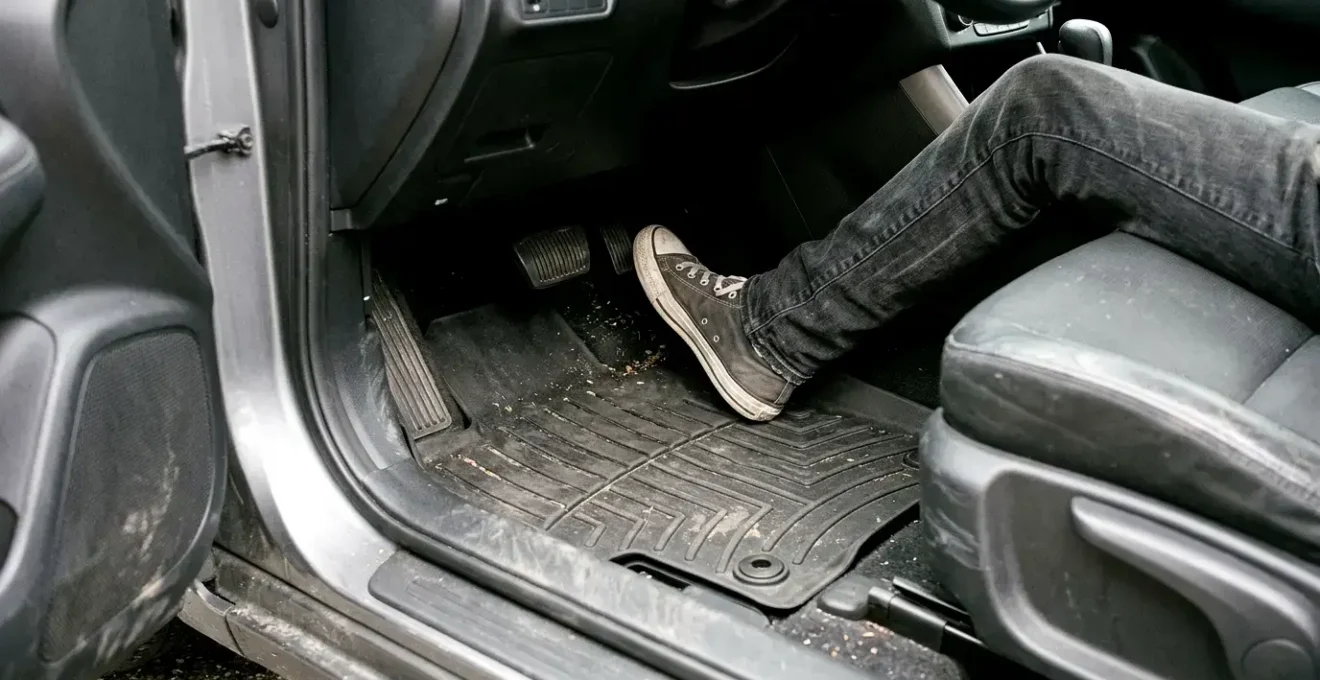
Non-slip car floor mats should protect the vehicle’s interior without moving into the driver’s pedal area. The safest choice is a vehicle-compatible mat that fits the footwell precisely, attaches to the manufacturer’s retention points and leaves every pedal completely unobstructed.
A textured rubber surface or grippy carpet backing may reduce unwanted movement, but neither can replace a properly functioning anchoring system. Even a durable, expensive mat can become hazardous if its edges curl, its attachment holes do not align or its shape allows it to slide underneath the accelerator or brake pedal.
Choosing the right mat therefore requires more than comparing materials and appearance. Drivers should examine the footwell, verify the available retaining hooks, consider wet-weather conditions and check pedal clearance after installation. Routine cleaning and inspection matter just as much, because a securely installed mat can become loose when removed and replaced incorrectly.
Essential rules for choosing secure car floor mats
- Prioritize fit and retention: choose mats designed for the vehicle’s model and model year, with compatible factory anchor points.
- Protect pedal movement: install only one driver-side mat and verify that every pedal moves freely through its full travel.
- Maintain grip and condition: select materials suited to local weather, clean without slippery residues and recheck attachments after maintenance.
- Why Can Loose Car Floor Mats Interfere with Accelerator Pedals?
- How to Install Car Floor Mats Without Blocking Pedal Travel?
- Rubber or Carpet Floor Mats: Which Works Better in Wet Weather?
- Why Stacking Car Mats Creates an Avoidable Driving Hazard
- How to Clean Rubber Floor Mats Without Leaving Them Slippery?
- Why Some Seat and Dashboard Accessories Can Interfere with Airbags
- Why Parking Technology Cannot Replace Direct Observation
- Which Car Accessories Are Actually Useful for Everyday Driving?
Why Can Loose Car Floor Mats Interfere with Accelerator Pedals?
Loose car floor mats can interfere with accelerator pedals when they slide forward, curl upward or become trapped beneath the pedal mechanism. A displaced mat may prevent the accelerator from returning normally when the driver releases it. It can also obstruct brake operation, making secure attachment essential for safe driving rather than merely for interior comfort.
The problem begins with the relationship between the mat’s front edge and the pedal assembly. If a loose mat moves toward the firewall or pedal area, its material may press against the accelerator or become caught around the pedal’s moving components. Depending on the vehicle’s pedal arrangement, this can restrict normal pedal travel or interfere with its return.
The consequences are potentially serious. Toyota‘s 2021 Highlander owner’s manual warns that a displaced driver’s floor mat may interfere with the pedals, potentially causing unexpected acceleration or difficulty stopping. Its instructions require vehicle-specific mats, correctly engaged retaining hooks and a pedal-clearance check before driving.
The retention system is therefore the first purchasing criterion. A mat can have a heavily textured underside yet still move if it lacks compatible eyelets, clips or hooks. Surface friction helps, but proper attachment provides a more dependable way to prevent forward displacement.
Driving technique also influences how forces act on the mat. A driver who keeps their heel planted while operating the accelerator repeatedly applies pressure and friction to the same area of the floor. Someone who lifts their foot more frequently distributes contact differently. Footwear with pronounced tread or an unusually broad sole may further change how the mat is loaded. These effects vary and do not establish that one technique is inherently unsafe, but they explain why the same loose mat may move differently during everyday use.
Before purchasing, examine the original mat’s outline, anchor locations and pedal clearance. Check whether the replacement is explicitly compatible with the vehicle’s model and model year. An aftermarket mat with an extended front edge, excessive thickness or unsuitable anchoring holes deserves particular scrutiny.
Universal-fit mats are not automatically unsafe, but their label does not establish that they match a particular driver’s footwell. Trimming an oversized product may also compromise its intended geometry or attachment positions.
Once a mat has been selected, the next safeguard is installation. Even a correctly designed product cannot provide reliable protection if its retaining clips are left disengaged.
How to Install Car Floor Mats Without Blocking Pedal Travel?
To install car floor mats safely, remove the existing driver’s mat, position the replacement according to the vehicle manufacturer’s instructions and engage all specified retaining hooks or clips. With the vehicle safely stationary and its engine switched off, check that the accelerator, brake and clutch, where fitted, move freely without touching, lifting or catching the mat.
Begin by inspecting the empty footwell. Remove loose dirt and check that the factory retention points are present, intact and accessible. Verify that the replacement mat’s attachment holes match those locations without stretching or distorting the mat.
Position the replacement according to its intended orientation and the manufacturer’s fitting instructions. A properly fitted mat should lie flat, with no raised corners, folded edges or material extending into the pedal movement area. Do not reverse the mat, install it upside down or assume that a passenger-side product can safely replace a driver-side mat.
The location of the anchor holes is as important as the overall dimensions. A large mat cut down to fit may lose its intended attachment arrangement. Likewise, a mat whose front edge appears clear when stationary may still interfere if it shifts under repeated foot pressure.
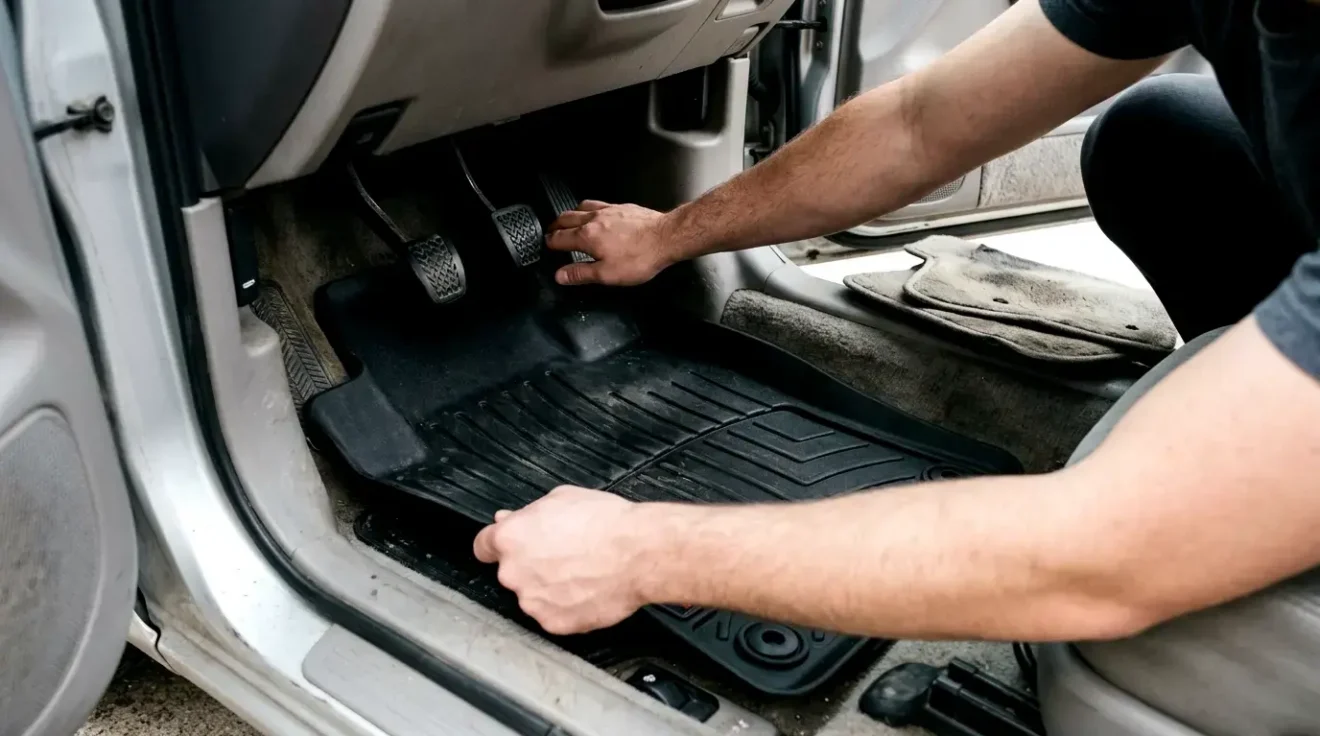
After securing the mat, inspect its position with the driver’s seat adjusted to a normal driving setting. Follow the owner’s manual for the exact pedal-check conditions. For the Toyota Highlander instructions cited earlier, the engine must be stopped and the transmission placed in Park before fully depressing each pedal. Other vehicles, particularly those with manual transmissions or different starting systems, may require different procedures.
Five checks before driving with a new floor mat
- Remove the previous mat: confirm that the driver’s footwell contains only the replacement mat, with no hidden second layer.
- Verify the product fit: compare the mat’s shape and anchor locations with the vehicle instructions; confirm that its edges lie flat.
- Engage every required retainer: visually and physically confirm that each hook, clip or grommet is correctly connected.
- Test movement and clearance: while safely stationary, gently pull the mat toward the pedals and check full pedal travel under the conditions specified by the vehicle manufacturer; confirm that the mat remains secured and unobstructive.
- Record the final condition: confirm that the mat is flat, correctly attached and clear of all pedals before the next journey, and repeat these checks after removal or cleaning.
A gentle pull test is a useful supplementary inspection, not a certified measurement. There is no universal allowable distance a mat may move before it becomes hazardous. If the mat slides noticeably, detaches or approaches the pedals, correct the installation or replace the incompatible product rather than accepting the movement.
With retention and pedal clearance established, material selection becomes the next consideration, particularly where rain, snow and muddy footwear regularly expose the floor to moisture.
Rubber or Carpet Floor Mats: Which Works Better in Wet Weather?
Rubber floor mats generally offer better water containment in wet weather because their raised edges and molded channels can hold water, mud and melting snow. Carpet mats often provide comfortable underfoot traction but can absorb moisture and take longer to dry. The better choice depends on climate, footwear, drainage design and compatibility with the vehicle’s anchors.
Rubber and carpet serve different purposes. Rubber or thermoplastic all-weather liners help separate tracked-in moisture from the vehicle’s original carpet. Their raised lips can prevent water from spreading across the footwell, provided the liner fits properly and its capacity is not exceeded.
However, rubber does not automatically provide superior grip in every condition. Standing water, ice, dirt or incompatible surface treatments can make some rubber surfaces slippery. The tread pattern of the driver’s shoes and the texture of the mat also influence traction.
Carpet mats generally absorb limited amounts of moisture rather than retaining it in visible channels. A suitable textured carpet surface may feel less slippery under certain footwear, but saturated fibers can hold water against the underlying floor, develop odors and require thorough drying. Persistent moisture beneath either material can contribute to interior deterioration and, where water reaches vulnerable metal components, corrosion.
The following comparison helps separate weather protection from the equally important question of pedal safety.
| Selection criterion | Rubber or all-weather liner | Carpet floor mat |
|---|---|---|
| Water management | Contains liquid through channels and raised edges, where provided. | Absorbs moisture until the fibers become saturated. |
| Wet footwear traction | Depends on surface texture, drainage and contamination. | Depends on pile, footwear and moisture saturation. |
| Cleaning and drying | Usually easy to rinse and wipe dry. | Often requires washing, extraction or extended drying. |
| Snow and freezing conditions | Collected water may freeze if left in the vehicle. | Absorbed snowmelt can remain damp and may freeze. |
| Cabin comfort | Practical for dirty or frequently wet footwear. | Often softer and quieter underfoot. |
| Pedal safety | Requires correct shape, secure anchors and clear channels. | Requires correct shape, secure anchors and edges that remain flat. |
For frequently rainy or snowy climates, a correctly fitted all-weather liner is often the practical choice, especially when passengers regularly enter with wet boots. In comparatively dry conditions, carpet mats may provide sufficient everyday protection with a more conventional interior appearance.
A hybrid construction offers another possibility. Carpet-topped mats with moisture-resistant backing can combine a textile surface with some protection against water penetration. Rubber liners with removable carpet inserts may offer seasonal flexibility, but any insert must be expressly designed and secured as part of that mat system. A loose carpet insert creates an additional movement hazard.
Inspect the underside as carefully as the top. A non-slip backing may reduce movement but must not be treated as a substitute for required retaining clips. It is also important to check beneath the mat for trapped moisture, regardless of the material selected.
Cold-weather conditions bring an additional concern. Water held in rubber channels can freeze, while saturated carpet may become stiff or distorted. Both conditions can alter the footwell surface, especially if the mat is poorly positioned near the pedals. Empty collected water and dry wet mats before continuing to use them.
Whichever material suits the climate, it should provide all necessary protection as a single correctly anchored layer. Adding another mat underneath is not an appropriate way to improve insulation or water resistance.
Why Stacking Car Mats Creates an Avoidable Driving Hazard
Stacking car floor mats creates a driving hazard because the upper mat may slide over the lower one and enter the pedal area. Multiple layers also raise the surface beneath the driver’s feet, potentially altering foot position and pedal operation. A single properly fitted and anchored mat is the safer solution for protecting the footwell.
This problem commonly appears when drivers place heavy-duty winter mats directly over their factory carpet mats. The intention is understandable: preserve the original interior while adding protection against road salt, rain and mud. However, the arrangement can defeat the retention system designed for a single mat.
Factory clips often secure only the lower layer. Unless a vehicle manufacturer explicitly provides an approved integrated system, an additional mat placed above it may remain unsecured. Normal changes in foot position can then push the upper layer forward.
Another scenario occurs when the original mat appears permanently integrated into the cabin. Some factory carpet mats fit closely around the seat rails or attach to low-profile hooks, making them look like part of the underlying carpet. Drivers may consequently place the replacement directly on top.
The original fitted mat is not necessarily permanent. Consult the owner’s manual to distinguish a removable floor mat from the vehicle’s fixed carpet covering, and follow the proper removal instructions before installing a replacement.
Extra thickness is not equivalent to better protection. Stacking changes the height of the floor beneath the driver’s heel, potentially affecting the angle of the foot relative to the accelerator or brake. The importance of this effect depends on pedal geometry, driving position and the combined mat thickness; no universal dangerous thickness can be inferred.
The more direct concern remains displacement into the pedal zone. Toyota’s previously cited owner instructions expressly prohibit using two or more floor mats on top of one another. This manufacturer guidance reinforces the importance of keeping the mat securely retained in its intended position.
If one mat does not provide sufficient weather protection, choose a purpose-designed all-weather replacement with suitable raised edges, durable construction and compatible attachment points. A product’s increased thickness is acceptable only where it fits correctly and preserves unobstructed pedal travel.
Once the correct single-layer arrangement is established, keeping the mat clean and dry preserves both its protective function and the driver’s grip.
How to Clean Rubber Floor Mats Without Leaving Them Slippery?
Clean rubber floor mats by removing them from the vehicle, rinsing away dirt, scrubbing with a suitable mild detergent and thoroughly rinsing off the cleaning solution. Allow the mats to dry completely before reinstalling them. Avoid inappropriate dressings that leave a slick coating, and verify both surface grip and secure attachment before driving.
Floor mats are exposed to road grit, shoe oils, spilled liquids and cleaning products. Some contaminants leave a smooth film on the contact surface. Even when a mat appears clean, residue may reduce friction between the driver’s footwear and the rubber.
Cleaning products therefore deserve attention. Tire-shine products and dashboard dressings are often intended to change the appearance of exterior rubber or interior trim, not to preserve traction beneath the driver’s feet. Products that leave a slippery finish should not be applied to the driving surface of a floor mat.
The manufacturer’s own cleaning instructions should take priority because rubber compounds, thermoplastic liners and special coatings can require different treatments.
For example, WeatherTech‘s floor mat cleaning instructions describe removing the mats, rinsing away loose dirt, scrubbing with a medium-bristle brush and using mild detergent with warm water as a cleaning option. The instructions also call for rinsing with fresh water and allowing the mats to dry.
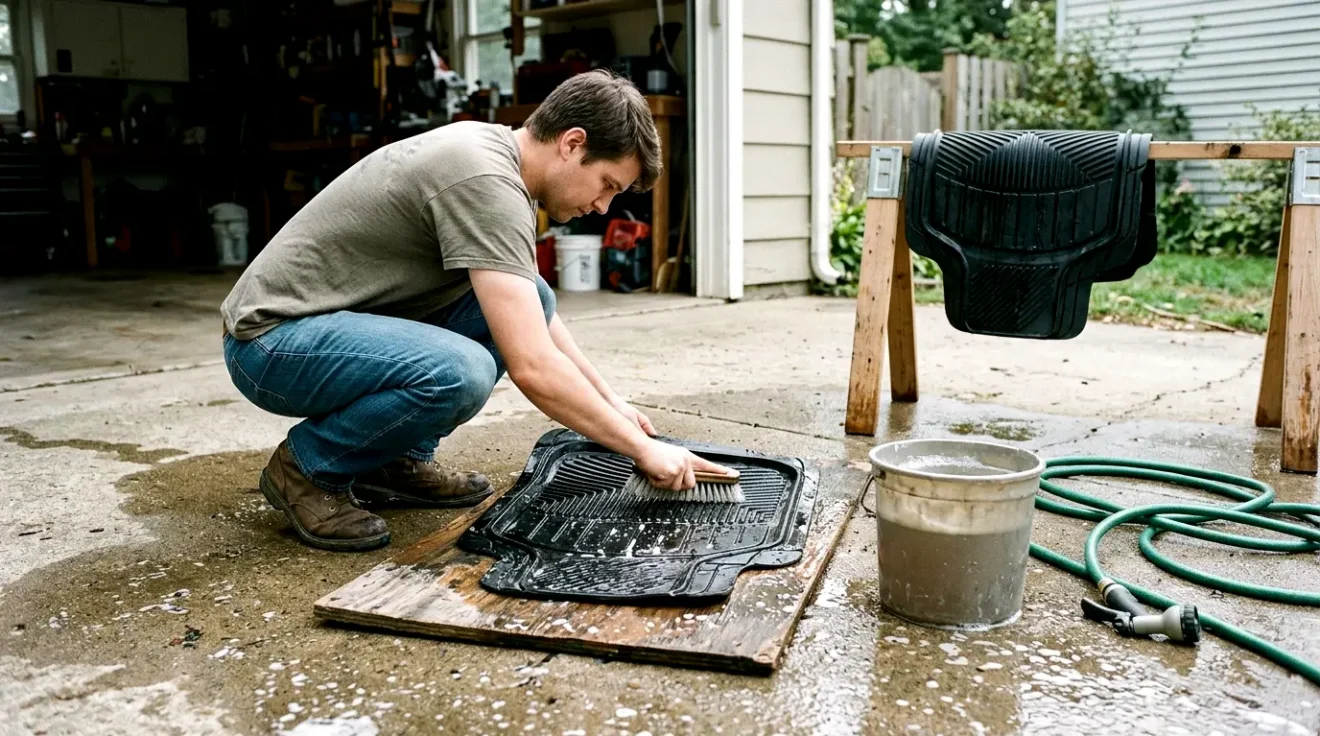
During rinsing, pay particular attention to raised channels and textured areas where detergent can remain trapped. Continue rinsing until visible foam and slippery residue have been removed. Dry the mat in a suitable location rather than immediately returning it to the footwell.
Before reinstallation, a simple practical check is to press a clean, slightly damp shoe sole against the dry mat and assess whether its surface feels unexpectedly slick. This is an informal screening check, not a standardized traction test. If the surface remains noticeably slippery, do not reinstall the mat until the cause has been addressed.
Three avoidable mistakes deserve particular attention:
- Using inappropriate surface dressings: products that leave a glossy or lubricating finish may compromise traction and should be avoided unless specifically approved for the mat’s walking surface.
- Leaving detergent behind: insufficient rinsing can leave a film that affects grip and attracts additional dirt.
- Reinstalling wet mats: trapped water can dampen the factory carpet and may reduce friction between surfaces, particularly where the mat is not correctly retained.
Cleaning also creates an opportunity to inspect the attachment hardware. Examine the mat’s eyelets for deformation or tears and check the factory hooks and clips for damage. Worn retainers should be corrected using components suitable for the vehicle rather than improvised fastening methods.
After drying, reinstall the mat in its intended orientation, reconnect all required retainers and repeat the stationary pedal-clearance inspection. A mat that was secure before cleaning must not be assumed secure after being removed.
The same principle extends beyond floor mats: interior accessories must remain compatible with the safety functions built into the vehicle, even when their primary purpose is cleanliness or comfort.
Why Some Seat and Dashboard Accessories Can Interfere with Airbags
Some seat and dashboard accessories can interfere with airbags when they cover deployment seams, obstruct airbag panels or occupy the space an airbag needs to inflate. The risk depends on the vehicle’s airbag design and the accessory’s placement. Seat covers, dashboard coverings and mounted objects should therefore be checked for compatibility before installation.
Airbags operate very differently from ordinary interior equipment. They must deploy rapidly during qualifying collisions, often through seams or panels designed to open in a controlled manner. An accessory positioned across one of those areas may affect the intended deployment path.
According to NHTSA‘s airbag safety information, frontal airbags can inflate in less than one twentieth of a second, while side-impact airbags inflate especially quickly because of the limited space between an occupant and the striking object.
The speed of deployment helps explain why apparently minor modifications deserve scrutiny. An aftermarket seat cover that crosses a side-airbag opening, for example, may not behave like the vehicle manufacturer’s original upholstery. Similarly, a dashboard cover that overlaps a passenger airbag panel may be unsuitable even if its fabric appears lightweight.
Not every seat cover or dashboard accessory creates this problem. Some products are designed for specific airbag-equipped seats, with construction intended to accommodate deployment. Compatibility must nevertheless be established for the relevant vehicle and accessory rather than inferred from a generic claim.
Three accessory categories warrant particular attention:
- Seat covers: check whether the seat contains a side airbag, identify the marked deployment area and verify that the cover is approved or explicitly compatible with that arrangement.
- Dashboard covers and mounted objects: avoid covering airbag seams or attaching equipment across panels intended to open during deployment.
- Seat-side organizers: confirm that straps, pockets and stored objects do not obstruct designated side-airbag deployment areas.
Before buying a seat cover, look for the relevant AIRBAG marking on the seat and consult the owner’s manual. Check the cover manufacturer’s vehicle-specific fitting information, including any designated airbag seam or opening. The presence of a compatibility claim alone does not establish independent crash-test performance.
Dashboard accessories require the same scrutiny. A non-slip pad, electronic device or decorative covering should not be placed over an airbag panel or allowed to become a loose projectile during sudden braking.
The connection to floor mats is straightforward: both the pedal assembly and the airbag system depend on designated spaces remaining clear. The key question is not merely whether an accessory fits inside the cabin, but whether it preserves the normal operation of safety equipment.
Compatibility also matters for electronic assistance systems. Just as a seat cover must not obstruct an airbag, driving technology must not lead the driver to overlook hazards outside the system’s detection area.
Why Parking Technology Cannot Replace Direct Observation
Parking cameras and sensors cannot replace direct observation because their coverage and detection capabilities are limited. A rear camera shows only part of the surrounding environment, while proximity sensors may not reliably detect every small, low or unusually shaped obstacle. Safe manoeuvring requires drivers to combine electronic assistance with mirrors, direct visual checks and appropriate speed.
A reversing camera provides a useful view behind the vehicle, particularly when obstacles are hidden below the rear window. However, its field of view is determined by the camera’s position, lens and vehicle configuration. Objects approaching from outside that area may not appear until they enter the displayed image.
Parking sensors have different limitations. Ultrasonic systems detect reflected signals, and their response can vary with obstacle size, shape, angle, distance and surface characteristics. Depending on the design, narrow posts, certain kerbs or obstacles positioned between sensing zones may be difficult to detect consistently.
No universal minimum detection distance applies to every parking sensor. Drivers should consult the specific vehicle manual for information about coverage, warnings and operating limitations.
Camera lenses and sensor surfaces also require attention. Mud, snow, road salt or heavy contamination can obstruct visibility or impair performance. Where a system depends on correct alignment or calibration, damage or improper repairs may affect its operation.
The practical safety principle is clearly expressed in NHTSA’s driver assistance guidance: backup cameras supplement, rather than replace, mirrors and turning around to look. That distinction applies regardless of how sharp or wide the camera image appears.
Some vehicles also include rear cross-traffic alerts or additional camera views. These functions may provide information about hazards outside the central reversing image, but they do not eliminate the need for the driver to observe the surroundings.
A useful parking routine combines several actions:
- Survey the intended parking space and surrounding traffic before starting the manoeuvre.
- Check mirrors and look over both shoulders for pedestrians, cyclists and other vehicles.
- Move slowly enough to maintain control and stop promptly when an unexpected hazard or warning appears.
- Use camera images and sensor alerts to supplement direct observation, not as permission to continue without checking.
- Stop and reassess when visibility is incomplete or a warning cannot be explained.
Research into driver assistance often examines how automation can affect attention and monitoring, but the supplied institutional guidance does not quantify a specific reduction in observation caused by parking sensors. It is therefore more accurate to treat overreliance as a risk to guard against rather than assume every driver changes behavior in the same way.
The parallel with floor mats is useful. A product description may indicate that a mat fits the vehicle, just as a camera may display a clear area behind it. Neither replaces the physical check needed to establish that the immediate environment is safe.
The best everyday vehicle accessories follow this pattern: they support safer decisions and reduce practical difficulties without taking over functions that still require the driver’s attention.
Key takeaways before choosing any cabin accessory
- Judge an accessory by the problem it solves and whether it introduces a new obstruction, distraction or maintenance burden.
- Prefer equipment designed for the vehicle’s existing attachment points, safety systems and normal driving environment.
- Make inspection and correct everyday use part of the purchase decision, not an afterthought once the accessory is installed.
Which Car Accessories Are Actually Useful for Everyday Driving?
The most useful everyday car accessories solve a recurring problem without compromising vehicle safety. Properly anchored floor mats protect the interior, suitable phone holders can reduce handheld device use, and practical emergency equipment supports vehicle readiness. The right choice depends on compatibility, secure installation, local requirements and whether the accessory creates additional distraction or obstruction.
A useful buying criterion is simple: does the accessory solve a real problem while preserving the functions already designed into the vehicle?
For floor mats, that means protecting the original carpet without interfering with the accelerator, brake or clutch. For electronic devices, it means providing information without obscuring the driver’s view or encouraging attention to move away from the road. For emergency equipment, it means keeping the item accessible and securely stored.
The following accessories can offer practical value when selected and used appropriately:
- Vehicle-specific all-weather floor mats: protect the cabin from dirt and moisture when they fit the footwell, engage the intended retention points and preserve pedal clearance.
- A securely mounted phone holder: may support lawful, hands-free functions or navigation when placed outside critical sightlines and airbag deployment areas. Drivers must still avoid distracting interactions.
- A first-aid kit and high-visibility vest: can be valuable emergency equipment. Legal carrying requirements differ between countries and jurisdictions, so local rules should be checked.
- A tyre pressure gauge or portable inflator: helps drivers check or restore tyre pressure in accordance with the vehicle manufacturer’s specifications, although it cannot correct tyre damage.
- A properly installed dash camera: may document driving incidents, subject to applicable privacy and recording rules. Its placement and wiring must not obstruct visibility or safety equipment.
Each option also has potential drawbacks. A poorly positioned phone mount can block part of the windscreen. Loose emergency equipment may shift during sudden braking. An incorrectly routed dash camera cable could interfere with interior trim or equipment near an airbag deployment area.
Before buying, ask: Does this accessory create a new risk while solving an old one? A seat cover that obstructs an airbag, a loose object on the dashboard and a second floor mat stacked over the first all fail that test.
Price, appearance and advertised features cannot compensate for an incompatible installation. A basic mat with matching anchors can be more appropriate than a premium product whose shape or attachment system does not suit the vehicle. Likewise, a simple, securely positioned device may be more practical than an elaborate accessory requiring frequent attention.
The strongest approach is to evaluate compatibility in three areas: physical clearance around the pedals, unobstructed operation of safety systems and minimal interference with the driver’s observation and control.
Before the next journey, inspect the driver’s footwell, remove any unnecessary layers, confirm the mat is correctly attached and verify that every pedal moves freely under the vehicle manufacturer’s prescribed test conditions. Applying the same compatibility-first thinking to other accessories helps keep the cabin practical without introducing avoidable hazards.
Are universal car floor mats safe to use?
Universal car floor mats are not automatically unsafe, but their suitability must be established for the specific vehicle. Check the mat’s shape, retaining system and pedal clearance against the manufacturer’s instructions. If the mat lacks the required attachment points, curls into the pedal area or moves out of position, choose a properly compatible alternative.
Can non-slip backing replace factory floor mat clips?
No. A textured or grippy backing may help resist sliding, but it should not replace retaining hooks or clips required by the vehicle manufacturer. Factory attachment points are designed to secure the mat in its intended position. A mat that relies only on friction may move when repeatedly loaded by the driver’s feet.
Should a driver’s floor mat be replaced if its retaining hole is damaged?
A torn, enlarged or distorted retaining hole can prevent the mat from remaining securely attached. Stop using a mat that cannot be reliably secured and follow the vehicle or mat manufacturer’s replacement guidance. Improvised ties, adhesives or additional loose layers should not be used as substitutes for an approved retention arrangement.
How often should car floor mat anchors be checked?
Check the mat’s attachment whenever it has been removed, cleaned or repositioned, and inspect it regularly for movement or wear. The vehicle owner’s manual remains the authority for model-specific instructions. Additional checks are sensible after heavy cleaning, unusual mat movement or any incident that may have disturbed the retaining system.
What should a driver do if a floor mat interferes with a pedal while driving?
If the accelerator becomes stuck, concentrate on maintaining control, apply firm, steady braking and shift into Neutral when possible to disconnect engine power from the wheels. Steer toward a safe stopping location and switch off the engine after stopping. Do not reach down to adjust the mat while the vehicle is moving. Follow the vehicle manufacturer’s emergency instructions, and do not resume driving until the interference has been eliminated.