
A powerful car engine is worth its extra running costs when its performance delivers a benefit the driver can regularly use and genuinely values. Strong overtaking acceleration, effortless motorway cruising and refined power delivery can justify higher expenditure. However, impressive horsepower figures alone rarely establish whether an engine represents good value.
Fuel consumption is only part of the equation. Insurance, servicing, tyres, brakes, engine complexity and potential repairs all influence the ownership budget. A high-output engine that feels exceptional during a short test drive may prove expensive to maintain, particularly when driven hard or modified beyond its original specification.
The most useful comparison therefore concerns accessible performance versus total ownership cost. Engine torque, vehicle weight, gearing, transmission behaviour and everyday driving conditions all matter alongside peak output. Evaluating these factors reveals whether additional power makes a car more enjoyable and practical, or simply more expensive to operate.
Powerful engines: the essential buying considerations
- Usable performance matters more than peak horsepower: power-to-weight ratio, mid-range acceleration and gearbox response determine how effortless a car feels.
- Running costs depend on driving conditions: fuel consumption, thermal stress, servicing and component wear can increase substantially with repeated high-load use.
- Maintenance determines long-term value: a well-maintained performance engine can justify its costs, while neglected faults or aggressive modifications can turn extra power into a financial liability.
- Why More Horsepower Does Not Always Mean Faster Acceleration
- How to Evaluate Engine Torque for Fast Road Overtaking?
- Turbocharged Four-Cylinder or Naturally Aspirated V6 for Driving Enjoyment?
- Why Aggressive Engine Tuning Can Shorten Component Life
- How to Reduce Engine Heat Stress During Track Sessions?
- Why Driving with Repeated Engine Misfires Can Be Expensive
- Motorway or City Driving: Where Does Your Car Use More Fuel?
- Why Is Your Car Engine Losing Power and Responsiveness?
Why More Horsepower Does Not Always Mean Faster Acceleration
Peak horsepower describes the maximum rate at which an engine produces mechanical power, but it does not reveal how quickly a complete vehicle accelerates in every situation. A lighter car with less horsepower can outperform a heavier, more powerful rival, while gearing, traction and the engine’s usable rev range determine how effectively that power reaches the road.
An engine producing its maximum output close to the redline may require frequent downshifts to deliver strong acceleration. Another engine with less peak power but substantial torque across a broad rev range can feel more responsive during ordinary driving. This distinction becomes especially noticeable when accelerating without changing gear.
Power-to-weight ratio provides a better starting point than horsepower alone. Divide the engine’s rated output by the vehicle’s kerb weight, using consistent units, to calculate horsepower per tonne or kilowatts per tonne.
Hypothetical comparison: power versus weight
Consider two illustrative cars, not actual tested models. Car A produces 300 hp and weighs 1,800 kg. Car B produces 250 hp and weighs 1,350 kg.
Car A has approximately 167 hp per tonne, while Car B has approximately 185 hp per tonne. Despite its lower absolute output, Car B has the better power-to-weight ratio. This suggests a potential acceleration advantage, although actual results still depend on gearing, traction, aerodynamic resistance and power delivery.
Factory kerb-weight definitions can differ between markets. Optional equipment also changes the comparison, while passengers and luggage increase the weight both cars must accelerate. Using consistently measured, similarly equipped vehicles makes the calculation more meaningful.
Transmission design introduces further differences. A well-calibrated dual-clutch gearbox may shift rapidly, a torque-converter automatic may provide smooth and decisive kickdowns, and a manual gearbox depends on the driver’s gear selection. Drivetrain losses and traction also influence how much engine output becomes useful acceleration.
Consequently, two vehicles with identical horsepower ratings can produce noticeably different standing-start and rolling-acceleration results. Published acceleration tests, where conducted under comparable conditions, provide a valuable check against specifications.
Higher horsepower can improve acceleration when the engine operates in its effective power range, but it does not automatically make overtaking safer or easier. For that decision, torque delivery and gearbox response deserve closer examination.
How to Evaluate Engine Torque for Fast Road Overtaking?
Evaluate overtaking performance by examining how quickly a vehicle gains speed from normal cruising conditions, particularly in the 50–70 mph (80–113 km/h) range. A broad torque delivery, responsive throttle and appropriately calibrated transmission make acceleration more predictable. Peak torque alone is insufficient: the available wheel torque, selected gear and time needed to respond are equally important.
Engine torque represents rotational force, usually expressed in newton-metres (Nm) or pound-feet (lb-ft). A torque curve shows how that force changes with engine speed. A broad plateau means the engine maintains similar torque across a substantial rev range, reducing the need to select an exact engine speed for useful acceleration.
Turbocharged engines frequently offer strong mid-range torque, although the shape and width of the plateau depend on engine design and calibration. Naturally aspirated engines may develop more of their available performance at higher engine speeds. Neither arrangement is inherently faster in every overtaking situation.
Turbo lag also deserves attention. As described in Garrett Motion’s technical explanation of turbocharging, the delay between accelerator input and torque delivery can arise while the exhaust-driven turbine and compressor accelerate. Modern engineering can reduce that delay without necessarily eliminating it.

A structured test drive should reproduce the conditions in which additional acceleration would actually be useful. Use a suitable, legally permitted road or a controlled test facility, without attempting an unsafe overtaking manoeuvre or exceeding speed limits.
- At a steady cruising speed, observe the current gear and engine speed.
- When safe and legal, increase throttle input and assess the delay before meaningful acceleration begins.
- Notice whether the engine pulls strongly without changing gear or needs a downshift.
- For an automatic, assess kickdown behaviour, including the delay and number of gears selected.
- Compare independently measured rolling-acceleration results where available, particularly for speeds relevant to intended use.
A manual car with tall gearing may feel subdued in sixth gear but accelerate strongly after shifting to fourth. Similarly, an automatic transmission can compensate for limited low-speed engine torque by selecting a lower ratio. The final result depends on the combination of engine and transmission rather than torque figures in isolation.
Predictability matters as much as outright acceleration. An engine that responds consistently allows the driver to judge available performance more confidently, although no acceleration advantage substitutes for sufficient visibility and a safe passing distance.
A strong mid-range engine may deliver everything required for confident road driving without exceptional peak horsepower. The next question is whether its character and mechanical design provide the driving experience the buyer actually prefers.
Turbocharged Four-Cylinder or Naturally Aspirated V6 for Driving Enjoyment?
A turbocharged four-cylinder often suits drivers who want strong mid-range acceleration from a relatively compact engine, while a naturally aspirated V6 may appeal to those who prefer progressive throttle response, a distinctive soundtrack and smooth power delivery. Neither architecture guarantees lower ownership costs or greater enjoyment. The better choice depends on the specific engine, vehicle and driving priorities.
Turbocharging uses exhaust energy to compress incoming air, allowing more fuel to be burned and greater output to be produced from a given displacement. This can create substantial torque at moderate engine speeds, making everyday acceleration feel effortless.
A naturally aspirated V6 develops its power without a turbocharger. Depending on its design, it may offer a more direct relationship between throttle position and engine response, with power building progressively as revs rise. Six-cylinder layouts can also provide attractive smoothness and sound characteristics, although engine configuration, balancing and exhaust design remain important.
The main differences are easier to assess against the intended ownership priorities.
| Criterion | Turbocharged four-cylinder | Naturally aspirated V6 |
|---|---|---|
| Everyday torque | Often strong at low and medium revs | Depends on displacement and calibration; may benefit from higher revs |
| Throttle response | May exhibit boost-building delay | Generally progressive without turbo lag |
| Engine character | Strong mid-range delivery and varied sound quality | Often smoother and more progressive, with a six-cylinder soundtrack |
| Fuel consumption | Potentially economical at modest loads | Can consume more fuel, but actual results depend on vehicle and use |
| Mechanical complexity | Additional turbocharging hardware and associated systems | No turbocharging system, but more cylinders and potentially more ignition components |
| Long-term repairs | Potential exposure to turbocharger and boost-system repairs | Different exposure to cylinder-related servicing and engine-specific faults |
The turbocharged four-cylinder is often the practical starting point when fuel economy, manageable weight and readily available acceleration take priority. Nevertheless, a smaller displacement does not guarantee better fuel economy under sustained boost or aggressive driving.
For drivers who value smoothness, sound and a predictable rise in engine output, the naturally aspirated V6 may justify greater fuel use. Its lack of turbocharging hardware removes certain possible failure points, but this does not establish that every V6 is more reliable or cheaper to service.
Long-term ownership requires a model-specific assessment. Turbochargers, intercoolers, lubrication systems, timing components and emissions equipment can all affect repair exposure. Service records and documented faults for the particular engine family are more useful than assumptions based on cylinder count.
Market availability also matters. Downsizing, turbocharging and hybridisation have reduced the availability of naturally aspirated six-cylinder options in many new-car ranges. Rarity might support enthusiast interest in some models, but limited supply does not guarantee stronger resale values or convenient parts availability.
Choose the engine that delivers the preferred driving experience in standard condition. Attempting to compensate for an unsuitable engine character through extensive tuning can introduce a different set of reliability and cost concerns.
Why Aggressive Engine Tuning Can Shorten Component Life
Aggressive engine tuning can shorten component life because additional boost and torque increase mechanical and thermal demands beyond the operating conditions originally validated for the standard powertrain. Higher cylinder pressures, greater exhaust heat and increased drivetrain loading can reduce reliability margins, especially when cooling, lubrication, fuelling or transmission hardware has not been upgraded to match.
An ECU remap changes how the engine is controlled. Depending on the calibration, it may alter boost targets, ignition timing, fuel delivery and torque limits. Increasing output does not automatically make the engine unreliable, but additional stress and inadequate calibration can accelerate wear or trigger failures.
Pistons, connecting rods, head gaskets and turbochargers may face greater loads. Extra torque also reaches the clutch, gearbox, driveshafts and differential. A tune that produces impressive dyno figures can therefore increase repair exposure across the entire powertrain.
The scale of modification is important. A modest, professionally developed calibration on a healthy engine is not equivalent to an aggressive setup requiring increased turbocharger capacity, upgraded injectors or extensive cooling changes.
| Modification approach | Typical considerations | Ownership implications |
|---|---|---|
| Conservative ECU remap | Moderate changes within existing hardware capabilities, subject to verification | Potentially increased stress and fuel use; warranty and compliance questions remain |
| Higher-boost performance calibration | Greater cylinder pressures, heat output and drivetrain torque | More demanding cooling, maintenance and component durability requirements |
| Extensive hardware and software upgrades | Changes to turbocharging, fuelling, cooling or drivetrain systems | Higher modification expenditure, greater integration complexity and potentially more expensive troubleshooting |
Warranty, insurance and emissions compliance should be checked before any modification. Manufacturers may reject warranty claims where relevant damage is attributable to non-approved tuning; the consequences depend on applicable law, warranty terms and the circumstances of the failure. ECU calibration changes can sometimes be identified during diagnostics.
Insurers may also require performance modifications to be disclosed, with possible effects on premiums or cover. Requirements differ between countries, insurers and policies.
In the United Kingdom, DVSA’s MOT inspection rules for vehicle emissions specify that modified engines must still meet the relevant emissions requirements. This does not mean every remap is prohibited, nor does passing an MOT establish compliance with every other applicable legal requirement. Owners elsewhere should check their local inspection and emissions rules.
Modification costs also extend beyond the engine. More frequent hard acceleration can increase fuel consumption and accelerate tyre and brake wear. Some heavily modified vehicles need additional inspections, revised service intervals and specialist support.
For a buyer seeking predictable running costs, a factory-developed higher-output model with suitable cooling and drivetrain components may be a more coherent option than modifying a lower-output version. Even then, sustained performance use requires careful management of engine temperatures.
How to Reduce Engine Heat Stress During Track Sessions?
Reduce engine heat stress during track sessions by checking fluid levels and cooling-system condition, warming the powertrain progressively, monitoring available temperature readings and allowing controlled cooling between demanding runs. Regular track use may also justify improved cooling hardware and suitable lubricants. The objective is to prevent heat accumulation that exceeds the engine’s intended operating limits.
Circuit driving exposes an engine to extended periods of high load that ordinary road driving rarely reproduces. Repeated acceleration, sustained high revs and reduced airflow through slower corners can increase coolant, oil and intake-air temperatures. Turbocharged engines may face additional exhaust and charge-air heating under prolonged boost.
Engine oil is particularly important because it lubricates moving parts while carrying heat away from components. Coolant removes heat from the engine through a separate circulation system. Both need to remain within appropriate operating conditions, and neither should be judged solely by the dashboard coolant gauge.
A coolant display may remain apparently normal while oil temperatures increase significantly on some vehicles. Where the vehicle provides oil-temperature monitoring, it can offer a valuable additional warning. Manufacturer guidance should determine acceptable ranges and responses to overheating.
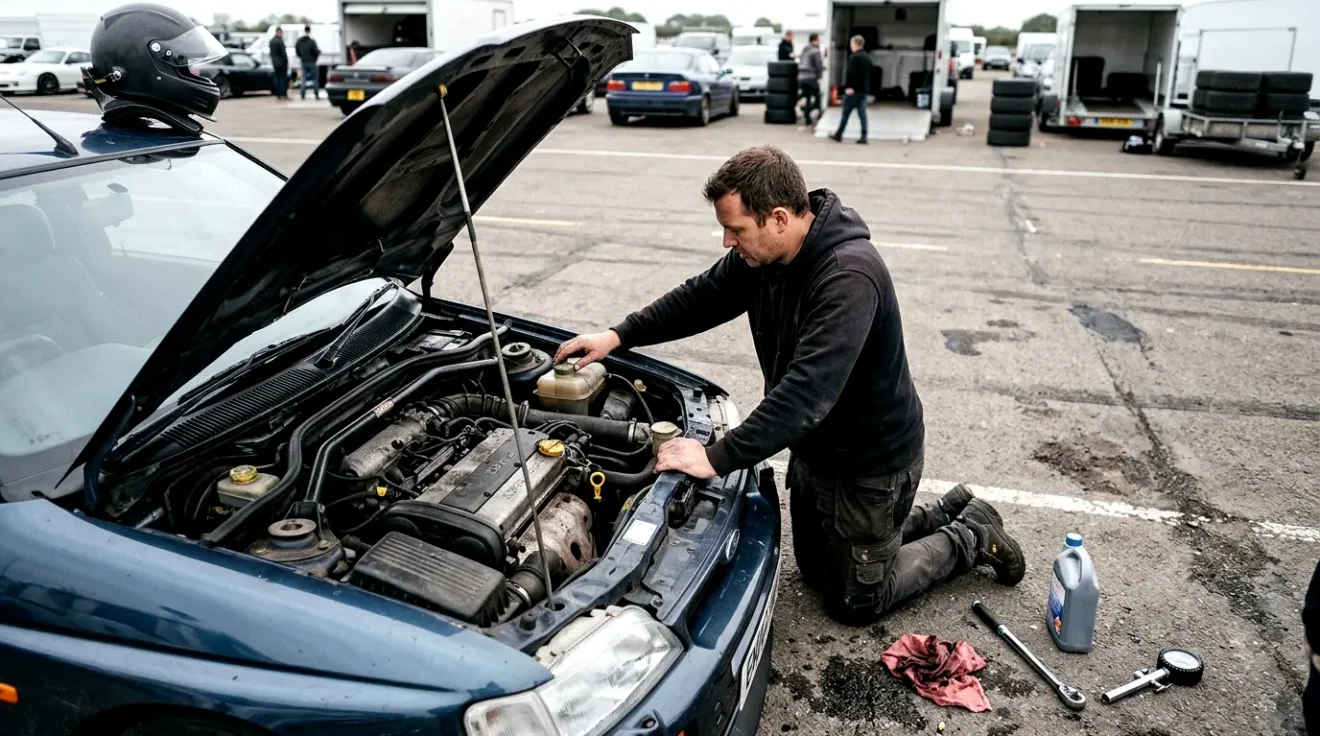
Before entering the circuit, inspect the cooling system for visible leaks or damage. Check coolant level only when the system is sufficiently cool and follow the manufacturer’s procedure; opening a hot pressurised cooling system can cause serious burns. Verify engine oil level, condition and service history, using the specified checking method.
A fresh oil change may be sensible before a demanding event, especially when the existing lubricant is approaching its service limit. Use an oil specification approved for the engine and intended operating conditions rather than assuming that a thicker grade automatically provides better protection.
Five checks before a performance driving session
- Verify engine oil: check the level and approved specification, and record the reading and service date in a preparation log.
- Inspect the cooling system: check cold coolant level, visible hoses and connections, and record any leak or abnormal condition requiring attention.
- Check tyres: measure cold pressures and inspect tread and sidewalls; record the starting pressures for subsequent comparison.
- Assess braking condition: inspect accessible brake components and confirm that brake fluid servicing meets the demands of the event; record any work required before driving.
- Set a monitoring plan: identify available oil and coolant temperature displays, note manufacturer limits where provided, and establish when the session should be interrupted.
During the opening laps, build engine and brake loads gradually. Avoid immediately demanding maximum performance from cold fluids and components. As temperatures rise, monitor the available instruments and reduce load if readings approach the vehicle’s specified limits.
A controlled cool-down lap, where permitted by circuit rules, can help reduce engine and brake temperatures before returning to the paddock. Avoid unnecessary prolonged stationary idling. Turbocharger cool-down requirements vary by design, and some modern vehicles manage thermal conditions automatically after shutdown; follow the manufacturer’s instructions rather than a universal idling rule.
Frequent track users may benefit from an upgraded radiator, appropriately engineered oil cooler, suitable brake fluid or improved ventilation. Such changes should be selected to solve measured limitations, since poorly integrated modifications can introduce new problems.
Thermal control preserves the performance already available and reduces the risk of avoidable failures. The same principle applies when warning signs arise during ordinary driving: continuing to demand power from a malfunctioning engine can make a relatively minor problem substantially more expensive.
Why Driving with Repeated Engine Misfires Can Be Expensive
Repeated engine misfires can become expensive because incomplete combustion may send unburned fuel into the exhaust, potentially overheating and damaging the catalytic converter. What begins as a fault involving a spark plug, ignition coil, injector or another component can develop into a much larger repair. Prompt diagnosis usually offers the best opportunity to contain the damage.
A misfire occurs when combustion fails to take place correctly in one or more cylinders. The engine may idle unevenly, hesitate when accelerating or produce noticeably less power. Fuel consumption can increase as combustion becomes inefficient.
Other warning signs include vibrations under load, an unusual exhaust smell and illumination of the malfunction indicator lamp, commonly called the check-engine light. These symptoms are not exclusive to misfires, so identifying the fault requires appropriate diagnostics.
The catalytic converter is a particular concern on petrol-powered vehicles. If unburned fuel reaches a sufficiently hot converter, additional combustion inside the exhaust system can damage its internal structure. Replacement may be substantially more expensive than repairing an ignition fault, although actual costs depend on the vehicle and underlying cause.
A flashing check-engine light warrants immediate attention. An EPA technical report on onboard diagnostic systems explains that flashing warning indicators can signal faults threatening the catalytic converter. It also cautions that such risks are not always accompanied by a flashing warning.
If the warning flashes, avoid hard acceleration, reduce engine load and stop safely as soon as practicable. Follow the vehicle manufacturer’s guidance and arrange professional assistance. Where the engine is running severely unevenly or another serious symptom is present, continuing to drive may worsen the damage.
A steady warning light also calls for investigation. It does not establish that the car is safe to continue driving. The appropriate response depends on the symptoms and vehicle-specific instructions.
High-output engines deserve particular care because misfires under heavy load can coincide with elevated exhaust temperatures and cylinder pressures. However, engine power alone does not determine how quickly damage occurs; the nature and severity of the fault are decisive.
Diagnostic codes and freeze-frame information can help identify which operating conditions triggered the warning. They provide a starting point rather than conclusive proof that a particular component needs replacement.
Preserving engine reliability is especially important when ownership costs are already elevated by high-performance components. Yet even a perfectly functioning engine can become expensive to operate when the owner’s driving pattern is poorly matched to its fuel-consumption characteristics.
Motorway or City Driving: Where Does Your Car Use More Fuel?
Conventional petrol cars generally consume more fuel per mile in stop-start urban driving than during steady, moderate-speed motorway cruising. Repeated acceleration, idling and braking waste energy that could otherwise maintain motion. However, high motorway speeds increase aerodynamic drag substantially, while hybrids and certain other powertrains can perform relatively efficiently in urban conditions.
Driving conditions often matter as much as engine size. In traffic, a powerful vehicle must repeatedly accelerate its mass from low speeds. A large engine may also consume appreciable fuel while stationary, although automatic stop-start systems can reduce idling consumption.
On an open motorway, a suitable high gear and moderate, consistent speed can reduce engine speed and avoid repeated acceleration. Some powerful engines operate efficiently under light loads, but their additional displacement, internal friction or vehicle weight may still influence consumption.
The apparent motorway advantage disappears progressively as speed increases. Aerodynamic drag rises with the square of vehicle speed, while the power needed to overcome it rises approximately with the cube of speed under otherwise comparable conditions.
15–30%
Estimated reduction in fuel economy associated with aggressive driving at highway speeds in US government guidance. This is a driving-behaviour estimate, not a comparison between particular engine sizes or performance-car models.
U.S. Department of Energy and U.S. Environmental Protection Agency, US government guidance on driving more efficiently.
The same guidance estimates fuel-economy reductions of approximately 10–40% from aggressive driving in stop-and-go traffic. It also reports that fuel economy generally declines rapidly at speeds above 50 mph, although the most efficient speed varies by vehicle. These estimates should not be treated as universal figures for every modern petrol, diesel or hybrid powertrain.
For a performance-oriented buyer, the most useful figure is actual fuel consumption under the intended driving conditions. Official values provide a standardised starting point, but they cannot reproduce every combination of traffic, temperature, terrain and driving style.
Compare the vehicle’s own fuel records against its published figures. WLTP is commonly used for official fuel-consumption reporting in the UK and several other markets, while US EPA ratings use a different testing framework. Cross-market figures should not be compared directly without understanding their test cycles and units.
A practical approach is to record the fuel added at each fill-up and the distance travelled. Divide litres consumed by kilometres travelled and multiply by 100 to obtain L/100 km. Where gallons and miles are used, identify whether the calculation uses US or imperial gallons.
Separating predominantly urban journeys from predominantly motorway journeys helps reveal which conditions dominate the owner’s spending. Individual mixed-use trips may not provide precise category results, so records gathered over repeated, comparable journeys are more reliable.
Fuel use is an ongoing operating expense, but a sudden deterioration in consumption can also signal a developing mechanical issue. Reduced responsiveness, increased fuel demand and abnormal engine behaviour should prompt investigation rather than acceptance as unavoidable consequences of owning a powerful car.
Key takeaways before buying or maintaining a powerful engine
- Judge actual performance: choose the engine and transmission combination that provides useful acceleration at the speeds and loads encountered most often.
- Budget for the complete vehicle: consider potential repairs, specialist servicing, insurance and consumables alongside fuel consumption.
- Protect the original performance: investigate changes in engine response early, since a neglected fault can undermine both driving enjoyment and ownership predictability.
Why Is Your Car Engine Losing Power and Responsiveness?
An engine may lose power because of restricted airflow, ignition problems, inadequate fuel delivery, exhaust restrictions or faults in electronic engine management. Turbocharged engines can also suffer boost leaks or turbocharger control problems. The most effective response is to check basic maintenance items, retrieve diagnostic information and establish the cause before replacing expensive components.
Power loss can develop gradually or appear suddenly. The distinction matters because a vehicle that has become progressively less responsive may have a maintenance-related restriction, while sudden power reduction can indicate an active fault or a protective operating mode.
Common causes worth investigating include:
- Restricted air filter: excessive dirt can reduce airflow. Inspect the filter according to the service schedule and replace it if necessary.
- Worn spark plugs or ignition components: poor ignition performance can cause hesitation or misfires, particularly under load.
- Fuel-delivery problems: injector faults, contamination or insufficient fuel pressure can disrupt combustion. Professional testing may be necessary to establish the cause.
- Restricted exhaust or particulate filter: excessive exhaust back-pressure can limit engine output, with symptoms and repair methods depending on the system.
- Incorrect tyre pressures: underinflated tyres increase rolling resistance and fuel consumption, making a vehicle feel less efficient, although they do not directly reduce engine output.
These possibilities are not a universal ranking of failure likelihood or repair cost. The most probable cause depends on the model, age, maintenance history and symptoms.
Turbocharged engines introduce additional diagnostic possibilities. A damaged intercooler hose, leaking boost pipe or defective boost-control system can prevent the engine from developing its expected intake pressure.
Some turbochargers use variable-geometry mechanisms that can stick or malfunction. Carbon deposits in intake components may also disrupt airflow. Depending on the fault, the engine control unit may limit available torque or boost in a reduced-power mode, often called limp mode, to protect the powertrain.
Read diagnostic trouble codes before replacing parts. An appropriate OBD reader or garage diagnostic system can identify stored faults and relevant operating conditions. However, a code describes a detected condition rather than necessarily identifying the defective component.
For example, an underboost code may be associated with a leak, control fault, sensor issue or turbocharger problem. Replacing the turbocharger without checking the associated systems could create an unnecessary expense.
Maintenance records should form part of the assessment. Verify whether oil changes, spark plugs, air filters and other engine-specific service items were completed at the required intervals. For an expensive performance car, a pre-purchase inspection by a suitably qualified specialist can be particularly valuable.
The extra running costs of a high-output engine are worthwhile when the driving experience justifies them and the owner can comfortably maintain the car to the required standard. Compare real-world acceleration, inspect the service history, estimate fuel expenditure for typical journeys and obtain realistic maintenance and insurance quotations before committing. That process offers a more dependable purchasing decision than choosing the highest horsepower figure available.
Is a powerful engine worth paying more for if most journeys are short?
It depends on how much the driver values performance during those journeys. Short urban trips rarely provide opportunities to use maximum engine output, and frequent cold starts can impose demanding operating conditions. A responsive, moderate-output engine may offer better value, while a powerful engine can still be a reasonable personal preference when its additional costs are affordable.
Does a more powerful engine always cost more to insure?
No. Power can influence insurance pricing, but premiums also depend on factors such as the vehicle model, repair costs, security, driver profile, location and insurer. Two vehicles with similar horsepower may attract different quotations. Obtain insurance estimates for the exact versions being considered rather than assuming a fixed relationship between horsepower and premiums.
Can a powerful engine be economical when driven gently?
Yes. Some high-output engines achieve reasonable fuel consumption during steady, light-load driving, especially when paired with suitable transmission gearing or efficiency technologies. Nevertheless, vehicle weight, engine design and aerodynamic resistance remain important. Gentle driving improves the conditions for efficiency without guaranteeing that a powerful engine will match a smaller alternative.
Is it better to buy a factory performance model than modify a standard car?
A factory performance model may be the more predictable choice when the manufacturer has developed its engine calibration, cooling, brakes and drivetrain as an integrated package. An appropriately engineered modification can also perform well, but its overall cost should include installation, supporting components, maintenance, insurance and potential warranty implications. The specific vehicles and modification quality determine the better option.
How can buyers estimate the long-term cost of a used performance car?
Start with annual mileage and realistic fuel consumption, then add insurance quotations, scheduled servicing, expected tyre and brake replacement, applicable taxes and a repair contingency. Review model-specific maintenance records, inspect the vehicle for modifications and commission a specialist inspection where justified. Use actual quotations and documented service requirements rather than generic assumptions about performance-engine reliability.