
Making everyday mobility more sustainable does not necessarily mean buying an electric vehicle or giving up driving altogether. For many commuters, the most practical improvements come from changing how frequently they use a car, combining journeys, choosing alternative transport for suitable trips and keeping existing vehicles efficient.
The challenge is finding a balance between environmental impact, affordability and everyday responsibilities. A city commuter with reliable public transport has different options from a rural household managing shift work or school journeys. Similarly, replacing an older car may make sense for someone driving long distances, but not necessarily for someone covering only a few miles each week.
A useful starting point is to examine actual travel patterns rather than focus exclusively on vehicle technology. The number of journeys, their length, the alternatives available and the lifetime impacts of a vehicle all influence the outcome. Small, repeatable changes can provide a practical foundation for lower-impact mobility without making daily life unnecessarily complicated.
Sustainable everyday mobility: the essentials
- Reduce unnecessary short car journeys and combine errands to avoid repeated cold starts and excess fuel consumption.
- Compare walking, cycling, public transport and car sharing against actual household travel needs and costs.
- Evaluate vehicle replacement and electric driving using lifecycle emissions, annual mileage and realistic charging requirements.
- Why Are Repeated Short Trips Particularly Inefficient for Cars?
- How to Combine Cycling and Public Transport for a Daily Commute?
- Car Sharing or Ownership: Which Makes Sense for Occasional Drivers?
- Why Replacing a Working Car May Not Immediately Help the Environment
- How to Reduce Dependence on a Second Family Car?
- Why Tailpipe Figures Alone Can Distort Environmental Comparisons
- How to Plan Weekly EV Charging Around a Daily Commute?
- How to Evaluate a Car’s Carbon Footprint Beyond Exhaust Emissions?
Why Are Repeated Short Trips Particularly Inefficient for Cars?
Repeated short journeys are particularly inefficient for petrol and diesel cars because their engines and emissions-control systems frequently operate before reaching normal working temperatures. Cold engines generally consume more fuel, while catalytic converters may initially remove pollutants less effectively. Combining short errands or replacing suitable journeys with walking and cycling can therefore reduce environmental impacts without changing vehicles.
During a cold start, engine oil is less fluid, internal components experience different operating conditions, and the engine-management system may adjust fuel delivery to support warm-up. Catalytic converters also need to reach an effective operating temperature. Consequently, a substantial proportion of a very short journey may take place before the vehicle reaches efficient operation.
The exact warm-up period depends on the vehicle, engine design, ambient temperature and driving conditions. Trips under three miles are a useful category to examine, but three miles is not a universal technical threshold.
Up to twice as much fuel
Several cold-start journeys can use twice as much fuel as one longer multipurpose journey covering the same distance. This is a possible comparison, not a fixed multiplier for every vehicle or journey.
Based on FuelEconomy.gov’s advice on planning and combining trips, published by the U.S. Department of Energy and Environmental Protection Agency.
To identify opportunities, record a typical week of journeys under three miles. Note each trip’s purpose, distance, timing and whether carrying passengers or heavy items makes a car necessary. Separate journeys that could disappear entirely from those that could be combined.
Trip elimination means removing a car journey altogether, perhaps by walking to a nearby shop. Trip chaining means completing several errands during one outing, reducing repeated cold starts and potentially avoiding unnecessary mileage.
Repeated short cold-engine operation can also contribute to issues such as fuel dilution of engine oil under certain operating conditions. Frequent starting and limited running time may affect the starter battery’s ability to recover its charge. These risks depend on vehicle design, condition and usage, so occasional short journeys should not automatically be treated as damaging.
Following the manufacturer’s maintenance schedule remains important, particularly where short-trip use is classified as demanding operation.
Once unnecessary journeys are reduced, the next opportunity is replacing some regular car trips with transport combinations that remain practical throughout the working week.
How to Combine Cycling and Public Transport for a Daily Commute?
Combining cycling with public transport can replace a daily car commute when the journey to a station is manageable, bicycle storage or carriage is practical, and the final destination is accessible. The most reliable arrangement addresses both ends of the journey and includes a fallback for poor weather, disrupted services or days requiring additional luggage.
Start by dividing the commute into three segments: home to the first station or stop, the public transport journey, and the final connection to work. Cycling is particularly useful where walking the first or last segment takes too long but driving the entire route is unnecessary.
Three factors determine whether the combination works consistently:
| Commuting situation | Practical option | What to verify |
|---|---|---|
| Short ride from home to a station | Regular bicycle parked at the station | Secure parking, lighting and theft risk |
| Additional cycling needed after the train | Folding bicycle | Operator rules, storage space and carrying requirements |
| Occasional last-mile cycling | Rental or shared bicycle | Availability near the destination and pricing |
| Convenient stations at both ends | Walk plus public transport | Connection reliability and total journey time |
A regular bicycle is often straightforward when secure station parking exists. A folding bicycle may offer greater flexibility when cycling is needed at both ends, although operators can impose restrictions even on folded bicycles. Bike-sharing services reduce storage requirements but introduce availability and rental-cost considerations.

Before committing, check the transport operator’s published bicycle policy. Full-size bikes may be prohibited during peak hours, require reservations or be allowed only on particular services. These rules differ between networks and countries and can change.
A hybrid commuting strategy is usually more sustainable as a habit than an inflexible rule. Define when driving remains reasonable, such as severe weather, unusually heavy loads, inaccessible connections or exceptionally early shifts. A planned fallback prevents one difficult day from ending the experiment.
For an accurate cost comparison, calculate actual weekly fares, bicycle parking or rental charges, and any remaining car expenses. Compare these with the fuel, parking and other avoidable driving costs. Insurance and depreciation may continue even when the car is used less frequently.
If multimodal commuting substantially reduces vehicle use, the next question is whether continued private car ownership still represents good value.
Car Sharing or Ownership: Which Makes Sense for Occasional Drivers?
Car sharing can make more financial sense than ownership for occasional drivers when rental charges remain below the fixed and variable costs of keeping a personal vehicle. There is no universal annual mileage threshold. The outcome depends on local availability, journey frequency, booking duration, insurance, parking costs and how much flexibility the household requires.
Ownership involves expenses even when the car remains parked. Depreciation, insurance, registration-related charges, parking and maintenance can represent a substantial annual commitment. Car sharing replaces some of these fixed expenses with charges linked to vehicle access and actual use.
The relevant calculation is:
Annual ownership cost = annual depreciation + insurance + parking + applicable taxes or registration charges + maintenance + fuel or electricity.
Annual sharing cost = membership fees + booking charges + time-based and distance-based fees + applicable extras + any separately charged energy, insurance or parking.
Record annual mileage alongside the number, duration and timing of car journeys. Two drivers covering identical annual distances may face very different sharing costs if one books a car for several long weekends and another needs one briefly every working day.
Car-sharing arrangements also differ. The Department of Energy’s overview of ridesharing and carsharing distinguishes round-trip station-based services, one-way station-based services and free-floating models. Their collection and return arrangements affect convenience and cost.
| Model | Typical arrangement | Main consideration |
|---|---|---|
| Round-trip car sharing | Collect and return the car to the same designated location | Suitable for planned errands, but rental time may include periods when the car is parked |
| One-way or free-floating sharing | Finish the journey at another eligible location | Parking zones, vehicle supply and operator restrictions |
| Peer-to-peer rental | Book a vehicle supplied through an owner-based platform | Collection arrangements, insurance terms and individual vehicle availability |
| Private ownership | Keep a vehicle available for household use | Ongoing fixed costs, maintenance and depreciation |
Insurance and included services require careful inspection. Some operators incorporate insurance, fuel or parking into their prices, while others charge separately or impose excesses and eligibility conditions. Peer-to-peer arrangements have their own contractual structures.
There are also non-financial trade-offs. Ownership provides spontaneous access, familiar child-seat arrangements and immediate capacity for unplanned journeys. Sharing may instead provide access to a van or a larger vehicle when genuinely needed, without owning that vehicle year-round.
The environmental assessment should cover the whole household travel pattern. Giving up a car may encourage cycling, public transport and fewer unnecessary trips, but additional taxi journeys, delivery services or complicated vehicle collection trips can offset some benefits.
Before replacing an existing car with either a newer model or a shared arrangement, it is equally important to understand the environmental consequences of producing another vehicle.
Why Replacing a Working Car May Not Immediately Help the Environment
Replacing a working car does not automatically produce an immediate environmental benefit because manufacturing its replacement creates emissions before the new vehicle is driven. A more efficient vehicle may compensate for those emissions over time, but the result depends on annual mileage, the efficiency difference, electricity or fuel production, vehicle size and the remaining life of the existing car.
Manufacturing a vehicle requires materials, industrial processing, component production and assembly. Battery production adds a significant manufacturing stage for electric vehicles. These impacts form part of the vehicle’s lifecycle footprint, alongside operation and eventual disposal or recycling.
A replacement can reduce emissions during use while increasing emissions associated with manufacturing. The relevant question is whether the operational savings over the remaining comparison period outweigh the additional production impacts.
A conceptual environmental payback calculation is:
Additional manufacturing emissions attributable to replacement ÷ annual operational emissions saved = approximate payback period.
This simplified calculation assumes positive annual savings and comparable system boundaries. A robust assessment must also account for the existing car’s remaining useful life, what happens to it after resale, and any differences in future maintenance or end-of-life impacts.
Consider two explicitly hypothetical situations. A driver covering substantial annual mileage in an inefficient petrol vehicle may achieve large annual operational savings with a more efficient replacement. Another driver covering only occasional short journeys may save far less each year, making the additional manufacturing footprint harder to recover during the relevant period.
Resale introduces a further complication. Selling a usable car does not necessarily remove it from circulation. A second owner may continue driving it, so the environmental effect on the vehicle fleet can differ from the emissions reported for the original owner’s household.
Drivers with reliable existing vehicles can first prioritise lower-impact operation: maintaining tyre pressures to vehicle specifications, addressing mechanical faults, avoiding unnecessary idling, driving smoothly where safe and reducing avoidable journeys. These actions do not require a new vehicle purchase.
Conversely, keeping a highly inefficient car indefinitely is not automatically preferable. High mileage, increasing repair needs or a substantial efficiency improvement may favour replacement. The appropriate comparison includes both continued ownership and replacement at a realistic end-of-life point.
For multi-car households, reducing the number of vehicles owned may offer another route to lower costs and resource use without immediately changing the remaining vehicle.
How to Reduce Dependence on a Second Family Car?
Reducing dependence on a second family car starts with identifying when both vehicles are genuinely needed at the same time. A two-week household travel log can distinguish unavoidable transport requirements from routines that could change. Coordinated schedules, alternative school journeys, occasional rentals and public transport may reduce the need for a second vehicle without compromising essential mobility.
Record every journey made by the second car over two representative weeks. Include departure and arrival times, purpose, passengers, distance, parking needs and available alternatives. Mark overlapping journeys that make simultaneous vehicle access necessary.
Pay particular attention to school runs, shift work, medical appointments and caregiving responsibilities. These activities may have fixed timing or accessibility requirements that make replacing the car difficult. Other journeys, including routine shopping or leisure trips, may offer more flexibility.
Possible household adjustments include coordinated working hours, walking or cycling school arrangements where routes are safe, public transport passes, grocery delivery and short-term car rental for occasional journeys requiring two vehicles.
The comparison should also distinguish avoidable costs from costs that remain. Selling a second car can remove its future depreciation exposure, insurance and certain registration or parking expenses, but replacement transport introduces new costs.
A practical worksheet should list the following annual amounts:
| Cost category | Keep the second car | Reduce or remove it |
|---|---|---|
| Depreciation and financing | Estimated annual cost | Avoidable cost, accounting for any financing settlement |
| Insurance and applicable taxes | Actual annual charges | Charges eliminated or retained |
| Maintenance and servicing | Recent spending and expected requirements | Potential savings |
| Fuel, electricity and parking | Recorded annual expenditure | Reduced driving expenses |
| Replacement transport | Current alternatives already purchased | Additional transit, rental, taxi or delivery expenses |
| Time and reliability | Current convenience | New scheduling constraints and contingency needs |
Financial savings alone do not settle the decision. Rural locations, inaccessible transit networks, irregular shifts and caregiving responsibilities can make retaining two vehicles a reasonable choice. In such cases, reducing usage of the second car may be more realistic than removing it.
Five steps to test whether your household needs two cars
- Record every journey for two representative weeks and produce a dated household trip log.
- Identify simultaneous vehicle requirements and create a list of genuinely non-substitutable journeys.
- Match flexible journeys with realistic alternatives and produce a weekly replacement transport schedule.
- Calculate annual ownership costs and expected alternative travel expenses in a household comparison worksheet.
- Test the revised schedule while retaining both vehicles and document delays, additional costs and unmet transport needs before making a final decision.
Testing the arrangement before selling a vehicle reduces the risk of discovering that an apparently optional car supports an essential household activity. A trial may also reveal that sharing one car between adults works on certain days but not others.
Once household travel demand is understood, comparing the environmental performance of the vehicles still required becomes more meaningful.
Why Tailpipe Figures Alone Can Distort Environmental Comparisons
Tailpipe emissions describe pollutants or greenhouse gases released directly from a vehicle’s exhaust, but they do not capture the full environmental impact of driving. Manufacturing, producing fuel or electricity, transporting energy and managing vehicles at the end of their lives also create impacts. Fair comparisons therefore require lifecycle boundaries, comparable vehicle sizes and realistic operating conditions.
A battery-electric vehicle produces no exhaust emissions while driving. However, electricity generation and vehicle manufacturing can still produce greenhouse gases. Petrol and diesel vehicles create direct exhaust emissions alongside impacts from fuel extraction, processing and distribution.
The Alternative Fuels Data Center’s explanation of electric-vehicle emissions distinguishes direct emissions, well-to-wheel emissions and cradle-to-grave lifecycle emissions.
These terms describe different assessment boundaries:
- Tailpipe emissions: direct emissions released during vehicle operation.
- Well-to-wheel emissions: emissions associated with producing, distributing and using the fuel or electricity required to drive.
- Cradle-to-grave emissions: a broader assessment including energy production, vehicle and battery manufacturing, use, recycling and disposal.
Electricity generation changes the result substantially. An EV charged on a relatively low-carbon electricity system generally has lower electricity-related operating emissions than the same model charged on a more emissions-intensive grid. The comparison also changes as electricity generation evolves.
For international comparisons, the country or regional electricity mix matters more than the language in which the vehicle specifications are published. An emissions estimate prepared for one market should not automatically be applied to another.
Vehicle size introduces another source of distortion. Comparing a large electric SUV with a compact petrol car solely through tailpipe figures ignores differences in manufacturing requirements, mass and energy use. That does not establish which specific model has the lower lifetime footprint; it establishes why the comparison requires more information.
Official consumption figures need similar scrutiny. Check whether test results use WLTP, EPA or another testing procedure. Different cycles and reporting conventions are not automatically interchangeable. Real-world driving conditions, temperature, speed and payload can also produce different consumption from certified values.
A useful comparison should specify vehicle segment, manufacturing assumptions, estimated lifetime distance, energy consumption, electricity or fuel pathway, and geographic context. Published lifecycle assessments are most valuable when these assumptions are transparent.
For drivers who already use an electric vehicle, the next practical consideration is how to organise charging around ordinary commuting needs.
How to Plan Weekly EV Charging Around a Daily Commute?
Weekly EV charging is easiest to manage by calculating actual commuting distance, estimating energy consumption and scheduling enough charging to maintain a comfortable range reserve. Most drivers do not need to charge to full capacity every day. The appropriate routine depends on vehicle efficiency, battery capacity, charging access, weather conditions and occasional longer journeys.
Begin with the complete return commute, including regular detours. Multiply that distance by the number of commuting days to estimate weekly mileage. Add predictable non-work journeys rather than assuming commuting represents all driving.
Next, convert distance into an energy estimate using the vehicle’s observed consumption. A car reporting consumption in kWh per 100 kilometres can be assessed using:
Weekly energy required (kWh) = weekly driving distance (km) × actual consumption (kWh/100 km) ÷ 100.
If consumption is reported in miles per kWh, divide weekly mileage by that efficiency figure instead. Allow additional charging energy for charging losses and a range reserve for unexpected journeys.
Heating, air conditioning, hills and heavy loads can reduce available driving range. Cold weather may also affect battery efficiency and charging performance. The appropriate buffer depends on the model and conditions rather than a universal percentage.
For an explicitly hypothetical calculation, consider an EV driven 200 km per working week with observed consumption of 18 kWh/100 km. Its estimated driving energy requirement would be 36 kWh for that week, before charging losses, additional journeys and contingency requirements.
The number of charging sessions depends on how much usable energy each session restores. Compare that requirement with the vehicle’s recommended charging limits, available charger power and actual charging time. A single longer home session may be sufficient for some drivers, while others benefit from shorter sessions spread through the week.
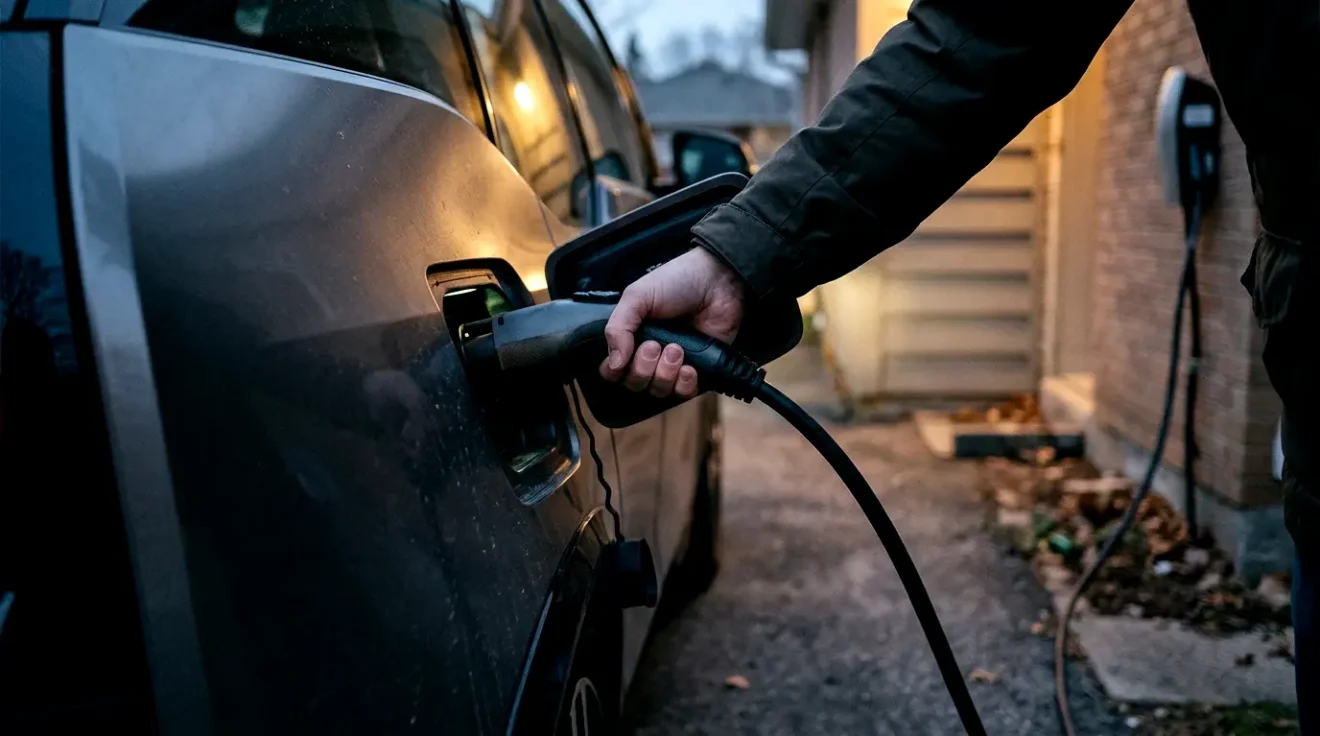
Home charging can be convenient because the car is parked for extended periods. Where an electricity tariff provides cheaper overnight rates, scheduling charging accordingly may reduce costs. However, off-peak pricing and the carbon intensity of electricity do not necessarily follow the same pattern. Lower prices at night do not automatically mean lower emissions.
Public rapid charging works well as a contingency or for longer journeys, but relying on it for routine commuting may introduce higher costs, detours and uncertainty about charger availability.
Battery management also matters. Many vehicles allow drivers to set a routine charging limit below full capacity. Avoiding prolonged periods at very high states of charge may help reduce degradation for some battery chemistries, but the correct everyday setting depends on the vehicle and manufacturer’s guidance. Regular charging is not inherently harmful, and charging to full capacity can be appropriate before a longer journey.
Build contingency arrangements for three common disruptions: unusually long trips, reduced cold-weather range and unavailable chargers. Check compatible charging locations before travelling, maintain a realistic reserve and identify an alternative charging option where possible.
Charging habits influence operating costs and emissions, but a complete sustainability assessment must also include the vehicle’s production, lifespan and total distance travelled.
Key takeaways before assessing your vehicle’s full footprint
- Measure real travel activity first: weekly journey frequency, annual distance and energy consumed provide a stronger basis than generic driver averages.
- Compare vehicles using consistent lifecycle boundaries, realistic service lives and electricity or fuel assumptions relevant to where they operate.
- Evaluate changes against what would actually happen otherwise, including continued use of an existing vehicle and the transport alternatives a household can sustain.
How to Evaluate a Car’s Carbon Footprint Beyond Exhaust Emissions?
Evaluating a car’s carbon footprint requires adding the emissions associated with manufacturing, fuel or electricity production, driving, maintenance and end-of-life treatment over a defined service life. Actual annual mileage and energy consumption make the assessment more useful than generic vehicle ratings. The best decision depends on how long the car will be used and which realistic alternatives are available.
A practical assessment begins by defining the comparison. Is the objective to estimate the footprint of a car already owned, choose between prospective replacements or decide whether to drive less? Each question requires a slightly different treatment of manufacturing emissions and future vehicle use.
For an existing vehicle, distinguish emissions already produced during manufacturing from emissions expected during continued operation. Past manufacturing emissions remain part of its historical lifetime footprint, but they cannot be undone by keeping or replacing the vehicle.
For a new purchase comparison, include the manufacturing impacts of the proposed replacement alongside the operational emissions over a common future period.
A simplified lifetime calculation is:
Estimated lifetime emissions = vehicle and battery manufacturing emissions + lifetime fuel or electricity supply and use emissions + estimated maintenance and end-of-life emissions.
Use published lifecycle data where credible figures are available, keeping the assumptions consistent. Maintenance and end-of-life estimates may be uncertain or grouped differently between studies; identify such gaps rather than assigning unsupported precision.
The steps are straightforward:
- Record annual distance from odometer readings or travel records.
- Estimate the intended remaining service life and future mileage.
- Calculate annual fuel or electricity use using actual consumption records.
- Apply geographically relevant emissions factors to energy consumption, including upstream effects where available.
- Incorporate credible manufacturing, maintenance and end-of-life estimates using consistent lifecycle boundaries.
- Compare alternative decisions over the same period and identify the largest avoidable sources of future emissions.
Usage intensity changes the interpretation. A vehicle driven frequently distributes its manufacturing footprint across more kilometres, although its total operational emissions also increase. Keeping a car for longer can avoid or delay another manufacturing event, but an inefficient vehicle driven substantial distances may accumulate enough operational emissions to make a replacement preferable.
The following decision grid illustrates which factors can shift the comparison. It is a qualitative framework, not a ranking of specific models.
| Vehicle choice | Relevant strengths | Important limitations and variables |
|---|---|---|
| Small petrol car | Vehicle size and modest manufacturing requirements may favour some comparisons | Petrol combustion and upstream fuel emissions continue throughout use |
| Full hybrid car | Can reduce petrol consumption, especially in suitable stop-start driving conditions | Still consumes fuel; actual savings depend on driving conditions and model efficiency |
| Battery-electric car | No tailpipe emissions and potentially substantially lower operational greenhouse-gas emissions | Battery and vehicle manufacturing, electricity mix, vehicle mass and lifetime mileage affect results |
These choices should be assessed within comparable vehicle categories wherever possible. A compact vehicle fulfilling daily requirements may have a different environmental profile from a substantially larger alternative, regardless of propulsion technology.
The final step is translating the assessment into decisions. A driver with many avoidable short journeys may gain most by reducing trips. Someone living near reliable public transport may benefit from replacing certain commutes with cycling and transit. A high-mileage driver using an inefficient vehicle may find that vehicle efficiency or replacement timing deserves greater attention.
Rather than chasing a single carbon figure, identify the two or three changes with the greatest realistic potential under the household’s financial, geographic and time constraints. Reassess when annual mileage, commuting arrangements or vehicle condition changes.
Start with a week of actual journeys and an annual vehicle-cost estimate. Use those records to choose one manageable travel change, test it under normal conditions and then decide whether more substantial changes to car ownership or vehicle technology are justified.
Is driving less always better than buying a more efficient car?
Reducing unnecessary car journeys generally avoids the emissions associated with those trips without requiring another vehicle to be manufactured. However, the best overall decision depends on annual mileage, existing vehicle efficiency and replacement alternatives. Drivers covering substantial distances may also benefit from a more efficient vehicle. Both strategies can complement each other.
Does working from home automatically reduce transport emissions?
Working from home can eliminate commuting journeys, but the overall impact depends on travel otherwise undertaken, additional household energy consumption and any new non-work journeys. A hybrid working schedule may also change vehicle ownership needs. Compare the commuting activity genuinely avoided with additional energy and travel demands rather than assuming the same savings for every household.
How should drivers compare transport costs across different countries?
Use local electricity and fuel prices, public transport fares, insurance quotations, parking charges and applicable vehicle taxes. The United States, United Kingdom, Canada, Australia and other English-speaking markets have different transport systems and regulatory arrangements. Compare annual household expenditure in one consistent currency, including fixed ownership costs and the charges introduced by alternative transport.
Can a household reduce transport emissions without reliable public transport?
Yes. Combining errands, carpooling where practical, reducing unnecessary journeys, maintaining vehicles efficiently and coordinating household schedules can reduce driving without requiring a reliable transit network. Walking or cycling may help for safe, manageable local trips. Where distances, accessibility or employment schedules make alternatives impractical, improvements in vehicle efficiency and long-term ownership decisions become more important.
How often should a household review its sustainable travel choices?
A review is useful whenever circumstances materially change, such as a new job, relocation, altered school arrangements, rising parking costs or major vehicle repairs. Comparing recent travel records with actual expenses can reveal whether an earlier decision still works. Periodic checks also help households avoid making major purchases based on outdated commuting patterns.