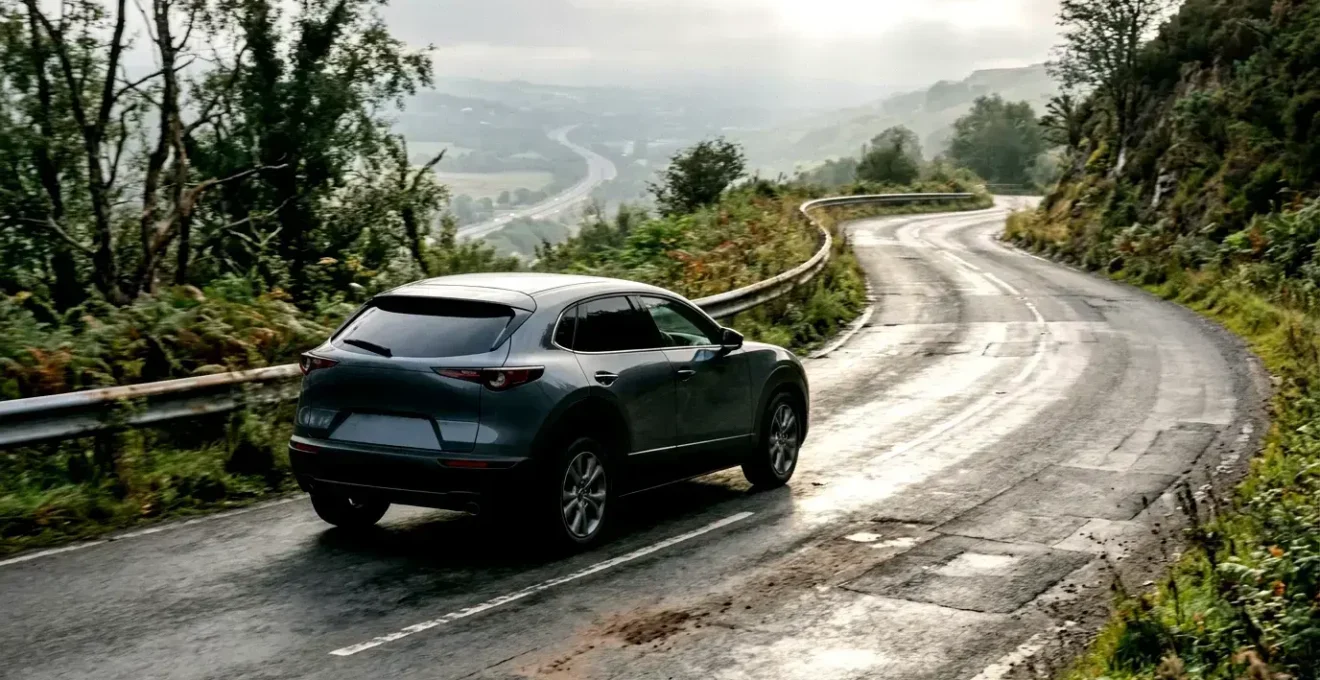
The best car for mixed driving is not necessarily the largest SUV, the most powerful hatchback or the vehicle with the most sophisticated all-wheel-drive system. It is the one that combines predictable handling, comfortable suspension, suitable tyres and manageable running costs across the roads its driver actually uses.
A family hatchback may feel more composed through bends and easier to park, while a compact crossover can offer better visibility, easier access and useful ground clearance. An estate car may provide motorway comfort and luggage capacity without the extra height of an SUV. Each has advantages, but those advantages depend on wheel size, suspension tuning, drivetrain and the journeys being made.
For drivers moving between congested streets, fast motorways, narrow country lanes and occasional rough tracks, the deciding factor is how consistently the car performs when conditions change. Understanding the compromises before arranging a test drive can prevent a seemingly ideal vehicle from becoming tiring, expensive or inconvenient in everyday use.
What matters most when choosing a car for mixed roads
- Balanced handling beats body style: compare steering response, manoeuvrability, stability and ride comfort rather than assuming an SUV or hatchback is automatically superior.
- Tyres and suspension deserve close attention: appropriate tyres and sensible wheel sizes often matter more than extra driving modes or all-wheel drive.
- Test the complete journey: include city obstacles, motorway cruising, winding roads and uneven surfaces before deciding which compromises are acceptable.
- Why Can a Compact SUV Feel Less Agile Than a Family Hatchback?
- How to Test a Multipurpose Car on Different Roads in One Drive?
- Front-Wheel Drive or All-Wheel Drive for Mixed Everyday Routes?
- Why All-Purpose Tyres May Struggle in Extreme Weather
- When Should You Change Driving Modes on a Modern SUV?
- Small or Large Wheels: Which Give a Smoother Ride on Rough Tarmac?
- Why Do High-Riding SUVs Still Get Stuck on Uneven Tracks?
- How to Test Drive a Car Properly Before Making an Offer?
Why Can a Compact SUV Feel Less Agile Than a Family Hatchback?
A compact SUV can feel less agile than a family hatchback because its higher centre of gravity, potentially greater mass and taller body create different responses during cornering and rapid direction changes. However, agility depends on the complete vehicle design. A short-wheelbase crossover with responsive steering may still be easier to manoeuvre through tight city streets.
When a vehicle turns, lateral acceleration transfers load between its tyres and causes the body to roll according to the suspension’s stiffness and geometry. A higher centre of gravity generally increases the potential for lateral load transfer, all else being equal. Suspension designers can counteract some of the resulting body movement, but firmer settings may compromise comfort over broken surfaces.
Mass matters too. A heavier vehicle requires greater forces to accelerate, brake and change direction. Its yaw response also depends on how that mass is distributed around the vehicle. Wheelbase, track width, steering calibration and suspension geometry influence how quickly the car responds to a steering input. Body rake, or the difference between front and rear ride heights, can be part of the overall geometry, but is not a reliable standalone indicator of agility.
Perceived agility is not the same as measured manoeuvrability. A high seating position can make a crossover feel more controllable because the driver sees kerbs and approaching junctions clearly. Conversely, a family hatchback may feel sharper through successive bends because its body movement is more restrained.
Compare the two on three everyday manoeuvres:
- A tight urban U-turn, noting how much space each vehicle requires.
- A narrow roundabout, assessing steering response and visibility.
- A sequence of bends, observing whether the car settles promptly after each direction change.
Some short-wheelbase urban SUVs have smaller turning circles than longer hatchbacks or saloons. Equally, a sporty hatchback may offer greater cornering precision without being easier to park. The vehicle’s published turning-circle measurement and overall width should therefore be considered alongside driving impressions.
If narrow streets and repeated direction changes are routine, compact dimensions may be decisive. If motorway cruising dominates, refinement and straight-line stability can deserve greater weight. A structured test drive reveals how these qualities coexist.
How to Test a Multipurpose Car on Different Roads in One Drive?
Test a multipurpose car on a route that combines urban manoeuvres, motorway cruising, winding country roads and rough surfaces. Each stage should assess a different characteristic: low-speed comfort, acceleration, stability, steering response and suspension control. Use the same route for competing vehicles and record specific observations rather than relying on an overall first impression.
A useful illustrative route starts with ten minutes of city driving, followed by a motorway section, approximately five kilometres of winding country road and a short stretch of degraded tarmac. The exact distances can change according to local conditions, speed limits and the dealer’s arrangements.
Before departure, adjust the driving position and mirrors, confirm the controls are accessible and check outward visibility. Where permitted and practical, carry the passengers or luggage normally present during everyday journeys. A fully loaded car can respond differently to bumps, acceleration and braking than an empty one.

Rather than treating the drive as a single experience, associate each road with a defined observation.
| Road section | What to assess | What to record |
|---|---|---|
| City streets — around 10 minutes | Turning circle, parking visibility, speed bumps and low-speed ride | Manoeuvring difficulty, jolts and suspension noise |
| Motorway — suitable permitted speed | Joining acceleration, lane stability, wind noise and cruising comfort | Engine effort, steering corrections and cabin noise |
| Country road — approximately 5 km | Steering accuracy, body control and confidence through bends | Body movement, visibility and driver workload |
| Uneven tarmac | Tyre noise, damping, steering feedback and suspension behaviour | Harsh impacts, vibrations and unusual sounds |
On a motorway where 110 km/h is legal and conditions permit, for example, assess how settled the vehicle feels during normal lane changes. There is no need for aggressive manoeuvres. On rough ground, distinguish ordinary road feedback from repeated harsh impacts or mechanical clunks.
The RAC test-drive checklist recommends driving over bumpy roads, listening for unusual suspension noises, checking acceleration and gear changes, and assessing steering and braking behaviour safely. These checks complement a mixed-road route rather than prescribing its exact duration.
The principal mistake is allowing a short urban drive to determine the purchase. A car that feels responsive at low speed may reveal excessive road noise, uncomfortable seats or tiring steering characteristics after prolonged motorway use.
Keep a brief written scorecard for each candidate, ideally immediately after the drive. The results will also help determine whether additional traction equipment is genuinely necessary.
Front-Wheel Drive or All-Wheel Drive for Mixed Everyday Routes?
Front-wheel drive is generally a practical choice for mixed urban, motorway and paved country-road journeys. All-wheel drive becomes more valuable when drivers regularly encounter slippery inclines, loose surfaces or demanding traction conditions. AWD can improve the ability to accelerate, but it does not inherently shorten braking distances or compensate for unsuitable tyres and excessive speed.
Front-wheel drive sends propulsion through the front wheels, reducing drivetrain complexity compared with many all-wheel-drive systems. On regularly maintained roads, suitable tyres and modern electronic stability systems allow FWD vehicles to handle a wide range of everyday conditions.
AWD distributes driving torque between axles, either continuously or when the system detects a need. This can improve traction when pulling away on snow, climbing a slippery slope or accelerating on inconsistent surfaces. It may also influence corner-exit stability, although the result depends on the system and prevailing grip.
AWD improves access to available traction; it does not create additional tyre-road friction. Braking and cornering remain fundamentally constrained by tyre grip, surface conditions, vehicle dynamics and driver inputs.
The U.S. Department of Energy analysis of all-wheel-drive vehicles explains that AWD and 4WD systems can improve traction and handling, particularly in adverse weather, while additional drivetrain components can increase weight and mechanical friction. The resulting fuel-economy disadvantage varies with the technology used.
For a clearer decision, compare the alternatives against actual conditions.
| Driving requirement | Front-wheel drive | All-wheel drive |
|---|---|---|
| Urban commuting and motorway journeys | Usually sufficient with appropriate tyres | Additional traction capability may see limited use |
| Occasional winter weather | Can work well with suitable winter-rated tyres | Helps acceleration but still requires suitable tyres |
| Frequent slippery rural inclines | May struggle when traction is limited | Often offers a useful advantage when setting off |
| Occasional light unpaved routes | Suitable for some firm, accessible tracks | Can assist on loose surfaces, subject to clearance |
| Running-cost priorities | Generally simpler drivetrain arrangement | Potentially higher fuel use and servicing complexity |
Between these options are on-demand AWD systems that reduce rear-axle drive when not required, traction-control programmes for slippery surfaces and FWD cars equipped with appropriate seasonal tyres. For towing, check the precise vehicle’s approved towing capacity, stability provisions and manufacturer guidance rather than assuming AWD alone determines suitability.
Ownership costs also require attention. Depending on design, AWD systems can introduce additional differentials, coupling units or transfer components needing inspection and maintenance. Repairs may be expensive, particularly when servicing has been neglected.
For many drivers, investing in suitable tyres offers more practical value than selecting a more complicated drivetrain. The next decision is whether one tyre specification can realistically cope with the local climate.
Why All-Purpose Tyres May Struggle in Extreme Weather
All-purpose, or all-season, tyres can struggle in extreme weather because their rubber compounds and tread designs balance competing requirements. A tyre designed for moderate temperatures, rain and occasional snow cannot necessarily match a specialised summer tyre in very hot conditions or a dedicated winter tyre on persistent snow and ice. Performance varies substantially between individual tyre models.
Tyres depend on rubber flexibility, tread-block behaviour and the ability to clear water or slush from the contact area. Cold temperatures alter rubber properties, while high road temperatures increase demands on tread stability and heat management. Manufacturers use different compound technologies to broaden the usable temperature range, so there is no single temperature threshold at which every all-season tyre becomes unsuitable.
The Three-Peak Mountain Snowflake (3PMSF) marking provides a more meaningful indication of tested snow performance than an all-season marketing label alone.
As explained in Continental‘s explanation of the EU tyre label, both winter and all-season tyres can display the 3PMSF pictogram when they satisfy defined snow-grip requirements. The marking does not establish equivalent performance on ice, in heavy rain or across every winter condition. Tyre-labelling obligations also differ between countries.
3PMSF
The Three-Peak Mountain Snowflake symbol identifies tyres that meet defined severe-snow performance requirements. It is not a universal guarantee of winter grip.
Technical explanation: Continental Tires, EU Tire Label.
Choosing a tyre strategy should reflect the climate and the frequency of demanding journeys:
- Predominantly mild conditions: quality all-season tyres may provide a practical compromise, provided their performance and local requirements suit the journeys.
- Regular severe winter conditions: dedicated winter tyres may offer a more appropriate solution, particularly where snow, ice and sustained cold are frequent.
- Hot summers and demanding winters: separate summer and winter sets can offer more specialised seasonal performance, at the expense of storage and changeover costs.
Wear complicates the decision. As tread depth decreases, a tyre generally loses capacity to evacuate water, increasing aquaplaning risk in relevant conditions. Snow and slush performance can also deteriorate. It is therefore misleading to assume that a partially worn all-season tyre retains the same balanced capabilities it demonstrated when new.
Check remaining tread depth, tyre age, pressures and damage regularly. Legal minimum tread depths and winter-tyre requirements vary across English-speaking jurisdictions, so local rules must be checked separately.
Tyres establish much of the available grip. Driving modes can help a vehicle manage that grip more effectively, but they cannot replace it.
When Should You Change Driving Modes on a Modern SUV?
Change a modern SUV’s driving mode when road conditions, traction requirements or driving priorities genuinely change. Comfort or Normal usually suits routine journeys, while Eco can soften power delivery and Sport can sharpen responses. Dedicated snow, gravel or off-road settings may help on specific surfaces, but their functions vary by manufacturer and vehicle specification.
A driving mode is generally a collection of electronic settings rather than a mechanical transformation. Depending on equipment, selecting a mode may alter throttle mapping, automatic gearbox behaviour, steering assistance, adaptive damping, stability-control calibration or torque distribution.
For example, Sport mode might make the accelerator more responsive without increasing the engine’s maximum power. On vehicles with adaptive suspension, it may also increase damping firmness. Such changes can improve perceived control on smooth roads but make a car less comfortable over potholes. Excessively firm behaviour on uneven surfaces can also affect how consistently tyres maintain contact with the road.
Different situations call for different priorities:
- Motorway entry: Normal is usually adequate, though a more responsive powertrain setting may help when prompt acceleration is needed.
- Wet or slippery roads: use an appropriate manufacturer-recommended traction mode where available, while reducing speed and increasing following distance.
- Heavy loading: check tyre pressures and any dedicated load or towing settings specified by the manufacturer.
- Long descents: select an appropriate lower gear or engine-braking strategy when recommended, and use hill-descent control only where suitable and fitted.
- Uneven tracks: consider the designated terrain setting, if equipped, after checking whether the vehicle can safely negotiate the surface.
Manufacturer instructions matter more than mode names. Land Rover‘s documented terrain systems, for instance, distinguish settings for gravel, snow, mud, sand and rocky ground. Those specialised functions should not be assumed to exist on every crossover.
During a test drive, compare modes on the same appropriate stretch of road. Observe differences in accelerator progression, gear changes, suspension response and steering weight. Only adjust controls when it is safe to do so, and avoid assuming a setting necessarily improves available grip.
The most comfortable mode can still be undermined by an unsuitable wheel-and-tyre combination. That physical choice often has a larger everyday impact than the dashboard setting.
Small or Large Wheels: Which Give a Smoother Ride on Rough Tarmac?
Smaller-diameter wheels generally offer a smoother ride on rough tarmac when they allow taller tyre sidewalls at a similar overall tyre diameter. The additional sidewall can absorb minor impacts before they reach the suspension. Larger wheels with lower-profile tyres may improve steering response, but often transmit sharper impacts and increase vulnerability to pothole damage.
A tyre is part of the vehicle’s suspension system. Its sidewall flexes under load, helping absorb small irregularities and influencing the way forces reach the cabin. When a manufacturer offers larger alloy wheels while keeping the overall tyre diameter approximately constant, the tyre sidewall usually becomes shorter.
That lower-profile construction can provide a more immediate steering feel, partly because there is less sidewall deformation. However, the trade-off can be a firmer response to broken tarmac, bridge joints and sharp-edged potholes. Larger wheel assemblies can also affect unsprung mass, although actual weight depends on their construction.
Ride comfort and steering precision are different characteristics. A car may feel exceptionally direct on smooth roads while becoming unsettled on damaged surfaces. Conversely, a taller tyre sidewall may slightly soften initial steering response without making the vehicle unsafe or imprecise.
Wheel size also influences ownership costs:
- Larger wheel options frequently require more expensive tyre sizes.
- Low-profile tyres offer less protective sidewall depth against sharp pothole impacts.
- Less common tyre dimensions may restrict replacement choice or availability.
- Wear rates can differ with tyre compound, width, alignment and driving conditions; wheel diameter alone does not establish tyre life.
Consider a hypothetical comparison between two versions of the same vehicle: one fitted with a smaller factory-approved wheel and a taller-profile tyre, the other with a larger wheel and a lower-profile tyre. On identical damaged tarmac, the first may deliver a more rounded impact response, while the second may feel more direct during steering inputs. Suspension specification and tyre model can alter the outcome, which is why both should be tested.
For frequent rough-road driving, start with the smallest manufacturer-approved wheel option that accommodates the brakes and meets load and speed requirements. Check the approved winter fitments before selecting an optional wheel package, particularly if seasonal tyre changes are expected.
Wheel size also affects how a vehicle behaves away from good tarmac, but an SUV’s raised suspension and large wheels are no substitute for genuine off-road capability.
Why Do High-Riding SUVs Still Get Stuck on Uneven Tracks?
High-riding SUVs can become stuck because ground clearance is only one element of off-road ability. Approach, departure and breakover angles determine whether the body clears obstacles, while suspension articulation, tyre grip and drivetrain design influence whether the vehicle can keep moving. A tall crossover with road tyres may therefore struggle on terrain that a purpose-built off-road vehicle can negotiate.
Ground clearance describes the space beneath a vehicle at a specified point or according to a manufacturer’s measurement method. It does not reveal how easily the front bumper will strike a slope, whether the vehicle will ground its underside across a crest or whether the rear bodywork will clear an obstacle.
Three geometric measurements are especially useful:
- Approach angle: the steepness of an obstacle the front of the vehicle can approach without contacting it.
- Breakover angle: the ability to pass over a crest without grounding between the axles.
- Departure angle: the steepness of an obstacle the rear can clear when leaving it.
A vehicle’s wheelbase, bumper overhangs, underbody protection and suspension travel all influence these limitations. Drivetrain equipment matters as well. An SUV with AWD but limited wheel articulation and road-biased tyres may lose useful traction on a deeply rutted surface. A more specialised 4×4 may incorporate low-range gearing, differential-locking technology and suspension designed for uneven terrain.
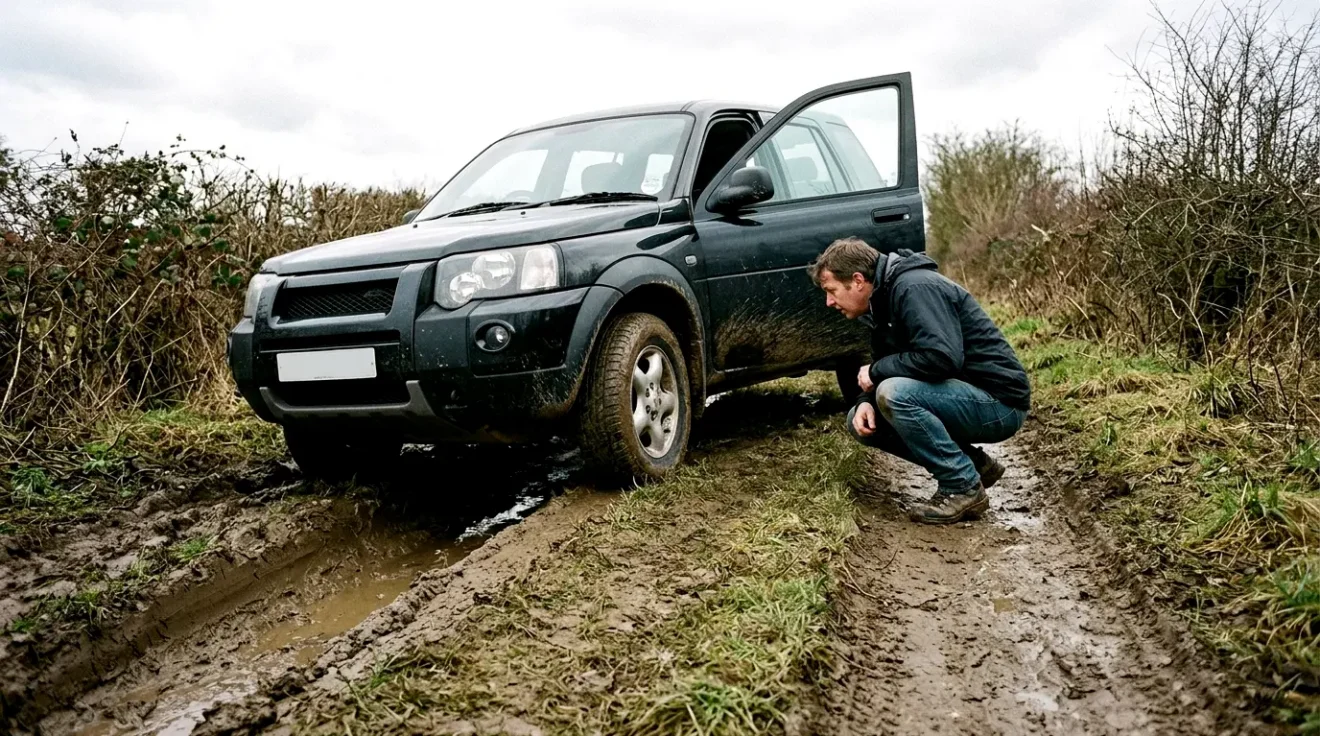
Common problems include deep ruts that lift wheels away from firm ground, raised track centres that threaten underbody clearance and muddy slopes where road-pattern tyres cannot generate sufficient traction. Even an apparently modest crest can be problematic for a long-wheelbase vehicle with a limited breakover angle.
Land Rover’s off-road driving advice explains how terrain-specific settings adapt vehicle responses and why factors such as suitable gearing, traction management and clearance beneath the vehicle matter on challenging surfaces. Its guidance describes technologies fitted to particular vehicles, not universal equipment across all SUVs.
Before entering an unfamiliar track, assess visible obstacles from a safe position. If exposed rocks, deep mud, substantial ruts or a sustained steep incline are present, consult the exact model’s clearance and off-road specifications rather than relying on its appearance. Avoid entering terrain where recovery would be unsafe or uncertain.
For occasional gravel lanes, a road-focused SUV may be entirely adequate. When genuinely difficult surfaces are routine, off-road capability should be evaluated as a specific requirement before the final purchase decision.
Key takeaways before making an offer
- Decide which weaknesses are acceptable on your regular routes, rather than trying to find a vehicle that excels equally everywhere.
- Separate faults requiring repair from inherent design compromises, such as firm suspension or limited rear visibility.
- Bring real luggage, familiar equipment and a written assessment sheet to the final test drive so the decision reflects everyday ownership.
How to Test Drive a Car Properly Before Making an Offer?
Test drive a car properly by checking its condition, ergonomics and behaviour across the roads you regularly use before discussing the final price. Assess steering, braking, suspension, visibility, controls and passenger comfort systematically. Record mechanical concerns separately from personal preferences, then use verifiable defects and realistic repair information to support any price negotiation.
Begin while the vehicle is stationary. Confirm that the seat and steering wheel provide a comfortable driving position, mirrors cover the necessary areas and the pillars do not create unacceptable visibility problems. Check whether commonly used controls can be reached intuitively without distracting from the road.
Modern driver-assistance features warrant particular attention. If the vehicle has adaptive cruise control, test its behaviour in suitable traffic and within the manufacturer’s operating conditions. Check how clearly it communicates its status and whether disengagement is understandable. These systems remain driver-assistance features, not substitutes for attention or control.
Practical suitability should also be verified. Place an actual suitcase or routinely carried object in the boot. If a child seat is relevant, check its compatibility and installation using the appropriate instructions while the vehicle is stationary. Assess access to rear seats and the usefulness of storage compartments.
During the drive, use the mixed-road observations developed earlier. Listen for unexplained mechanical noise, evaluate whether the car brakes smoothly and straight under safe conditions, and pay attention to steering effort, gear changes and suspension behaviour. A used car showing unusual vibrations, steering play or repeated mechanical clunks needs further investigation rather than an immediate assumption about repair cost.
Five checks to complete before making an offer
- Confirm driving ergonomics: adjust the seat, mirrors and steering wheel, then write down any visibility or comfort limitations.
- Complete the mixed-road route: record one observation each for urban manoeuvring, motorway stability, country-road handling and uneven-surface comfort.
- Verify everyday practicality: test your usual luggage and relevant passenger equipment, producing a short list of fit or access problems.
- Document mechanical concerns: note the conditions under which unusual noises, vibrations, braking behaviour or steering problems occur, and request appropriate inspection.
- Prepare a reasoned offer: separate confirmed faults from preferences and obtain repair estimates where necessary, creating a written basis for the proposed price or requested repairs.
Where available, an extended test drive or a 24-hour loan can help expose issues that a brief appointment misses. Seat fatigue, persistent tyre noise, infotainment frustrations and real-world energy or fuel consumption may become more apparent over longer journeys. Any consumption reading should be interpreted in light of traffic, temperature, speed and driving conditions, not treated as a controlled measurement.
For a used vehicle, combine the test drive with service-history checks and an independent inspection where appropriate. Do not assign a precise monetary deduction to an unexplained defect without evidence of its nature and repair cost. A seller may agree to repairs, provide documentation or negotiate a price adjustment, but none of those outcomes should be assumed.
Before committing, compare your recorded observations with the routes and responsibilities the car will face each week. Choose the vehicle whose strengths match those conditions, investigate unresolved defects and negotiate only once the practical and mechanical evidence is clear.
Is an estate car a better all-round choice than an SUV?
An estate car can be an excellent all-round choice when luggage space, motorway refinement and predictable road handling matter more than elevated seating or extra clearance. An SUV may be preferable for drivers who value easier entry, a higher driving position or occasional access to uneven surfaces. Compare individual models rather than assuming either body style is always superior.
Should motorway stability matter more than city manoeuvrability?
The priority depends on journey frequency, duration and driver workload. Frequent long-distance motorway travel makes noise levels, straight-line stability and seating comfort particularly important. Daily driving through narrow urban streets places greater emphasis on visibility, turning circle and overall dimensions. A suitable mixed-use car should meet an acceptable standard in both environments.
Are hybrid cars suitable for a combination of city and motorway driving?
Hybrid vehicles can suit mixed journeys, particularly where regular stop-start driving allows regenerative braking and electric assistance to contribute. Their motorway efficiency depends on the hybrid architecture, vehicle size, speed and operating conditions. Plug-in hybrids additionally require realistic consideration of charging access and how frequently the battery will be charged.
How important is ground clearance for occasional rural journeys?
Extra clearance can be useful on uneven entrances, raised track centres and damaged access roads, but it is not necessary for every rural journey. On properly surfaced country roads, appropriate tyres, manageable dimensions and comfortable suspension may matter more. Challenging tracks require consideration of vehicle geometry, traction and the specific manufacturer’s limitations.
Can one set of tyres handle every road and season?
One quality all-season tyre set may be practical in a relatively moderate climate, but no tyre performs optimally across every temperature, road surface and weather condition. Severe winters, prolonged heat and demanding road use may justify dedicated seasonal tyres. Check the precise tyre’s performance information, winter markings where relevant and the legal requirements of the countries in which the vehicle is driven.