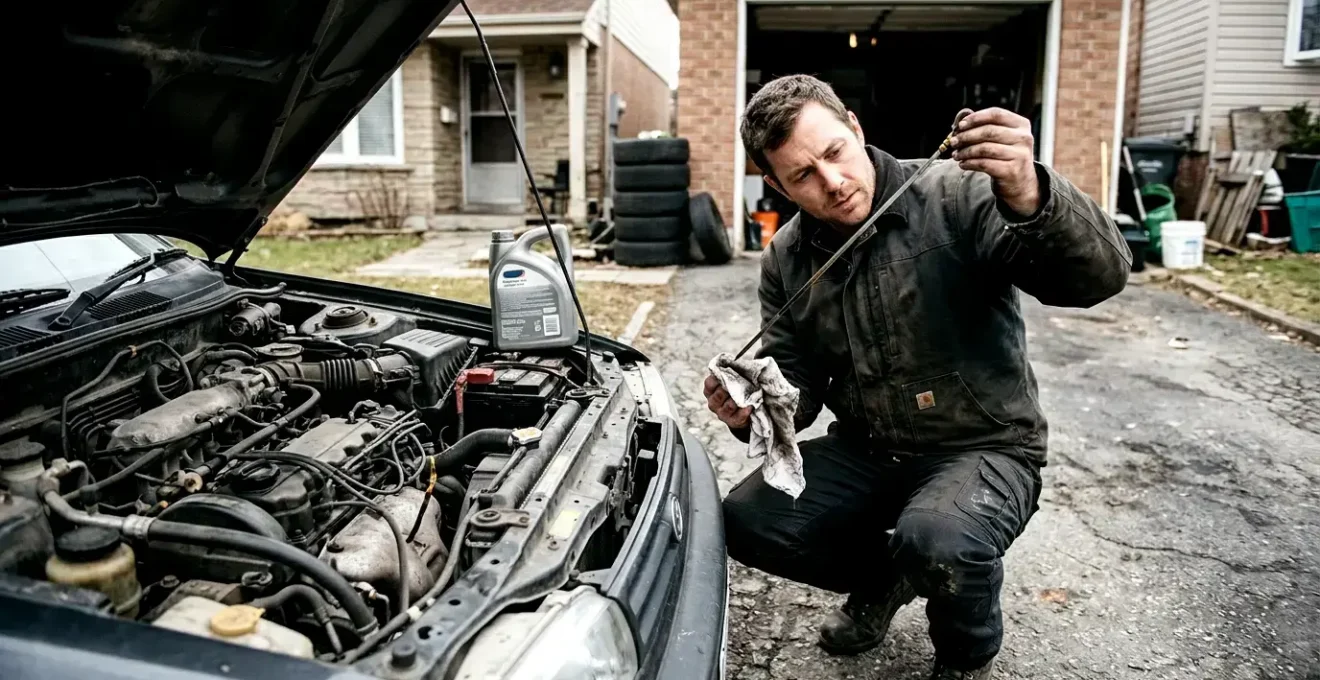
Engine oil does more than keep moving parts slippery. It maintains a protective film between components, carries heat away from critical surfaces, suspends combustion residues and helps prevent corrosion. As the oil ages, these functions can deteriorate even when the dipstick shows a perfectly normal level.
Using engine oil beyond its effective service life increases the risk of sludge formation, accelerated component wear and restricted lubrication. Fuel dilution or coolant contamination can make the situation considerably more serious. However, dark oil alone does not establish that an engine is in danger, and not every creamy deposit means a failed head gasket.
The practical approach is to distinguish normal oil ageing from signs of contamination, follow the correct maintenance interval and replace oil that is no longer fit for service. Used oil must then be collected and recycled responsibly, rather than poured into a drain or discarded with household waste.
Engine oil degradation: what drivers need to know
- Correct level does not mean healthy oil: additives deteriorate, contaminants accumulate and viscosity can change throughout the service interval.
- Investigate unusual warning signs: a rising oil level, strong fuel smell, persistent milky oil or falling coolant level can indicate contamination requiring diagnosis.
- Complete the maintenance cycle: replace overdue or unsuitable oil with the manufacturer’s specified product and take the collected waste to an approved collection facility.
- Why Does Engine Oil Lose Protection Even When the Level Is Correct?
- How to Identify Possible Fuel or Coolant Contamination in Engine Oil?
- Dark Engine Oil or Milky Oil: What Do These Signs Mean?
- Why Pouring Waste Motor Oil into Drains Causes Lasting Damage
- Where Can Drivers Safely Dispose of Used Engine Oil?
- Why Does Engine Oil Approval Matter More Than Brand Reputation?
- Why Following the Wrong Service Interval Can Damage Your Car
- How to Use the Correct Fresh Engine Oil Without Harming Your Engine?
Why Does Engine Oil Lose Protection Even When the Level Is Correct?
Engine oil can lose its protective properties even when the dipstick indicates the correct level because oil quality and oil quantity are different measurements. Heat, oxidation, contamination and additive depletion change the lubricant’s chemistry over time. The engine may therefore contain enough oil while receiving less effective protection against friction, corrosion and deposits.
Fresh engine oil combines a base oil with carefully formulated additives. Detergents help control deposits on hot engine surfaces, while dispersants keep fine soot and other insoluble contamination suspended until the oil is replaced. Anti-wear additives, including formulations containing zinc and phosphorus compounds, help protect loaded metal surfaces when the lubricating film becomes extremely thin.
These additives do not remain unchanged indefinitely. Oxidation can produce acidic compounds and increase viscosity, while mechanical shearing can reduce the effectiveness of certain viscosity-improving polymers. Fuel contamination may thin the lubricant, whereas excessive soot can make some oils thicker.
Oil degradation is not determined by mileage alone. Repeated cold starts, short journeys, stop-and-go traffic and high-temperature operation expose lubricant to different stresses. Two cars covering the same distance may consequently reach very different oil conditions.
This also explains why topping up does not replace an oil change. Adding fresh oil introduces some new additives, but it only dilutes the existing degraded oil and contaminants. It does not reliably restore the original formulation or eliminate accumulated wear particles and oxidation products.
A manufacturer-maintained oil level should therefore be treated as one essential check, not a complete assessment of lubrication health. Maintenance records, operating conditions and the recommended change interval remain important.
When oil deterioration is accompanied by an unexpected change in level, smell or appearance, the next question is whether another fluid has entered the lubrication system.
How to Identify Possible Fuel or Coolant Contamination in Engine Oil?
Fuel or coolant contamination may be suspected when engine oil develops a noticeable fuel odour, becomes persistently milky or rises above its previous level without being topped up. These observations are warning signs rather than definitive diagnoses. Fuel can reduce oil viscosity, while coolant and water can interfere with lubrication and contribute to harmful deposits.
Fuel dilution occurs when unburned fuel reaches the crankcase instead of remaining within the combustion process. Possible contributing factors include leaking injectors, repeated short journeys that prevent sufficient evaporation and mechanical wear affecting combustion sealing. Some engines may also experience fuel dilution associated with their operating or emissions-control strategies.
As fuel mixes with engine oil, it can reduce the viscosity needed to maintain a protective film between bearings, camshaft surfaces and other loaded components. Excessive dilution can therefore increase wear without producing an immediate dashboard warning.
Coolant contamination has different causes. A damaged cylinder-head gasket, cracked engine component or defective seal in a system where oil and coolant are separated can allow coolant to reach the lubricant. Water and coolant constituents can promote corrosion, emulsification and deposit formation.
The DEUTZ technical circular on engine oil diagnostics describes how oil analysis can identify fuel, coolant, soot and wear-related abnormalities. Its diagnostic principles are informative, although its specified procedures and limits relate to DEUTZ engines rather than every passenger car.
Drivers can perform several preliminary checks with the vehicle parked safely, the engine switched off and the manufacturer’s inspection instructions followed:
- Smell: a pronounced petrol or diesel odour on the dipstick may suggest fuel dilution. Avoid placing the oil close to the nose or inhaling vapours deliberately.
- Appearance: creamy deposits beneath the filler cap or cloudy oil on the dipstick may indicate moisture or coolant contamination.
- Oil level: an unexplained increase can indicate fluid entering the sump, although measurement conditions must first be checked.
- Coolant reservoir: recurring coolant loss without an obvious external leak warrants investigation, particularly when oil abnormalities are also present.
- Odour changes: an unusual sweet smell may accompany coolant-related problems, but it is not a reliable standalone test.
Where contamination is suspected, a mechanic may recommend laboratory oil analysis, cooling-system pressure testing or combustion-related diagnostics. Compression and leak-down tests can help investigate particular sealing faults, but they do not independently identify every source of contamination.
If the oil appears extensively emulsified, the level has risen substantially or the engine also overheats or loses oil pressure, avoid continued driving and arrange professional assessment. An oil change alone will not repair the underlying leak.
Appearance nevertheless remains one of the first things drivers notice, making it important to distinguish ordinary darkening from genuinely abnormal oil.
Dark Engine Oil or Milky Oil: What Do These Signs Mean?
Dark engine oil is not automatically degraded or unsafe. Its colour often changes as detergents and dispersants manage soot and combustion residues. Milky or creamy oil, however, indicates that moisture has mixed with the lubricant. This may result from ordinary condensation during short journeys or from a coolant leak that requires mechanical repair.
In a working engine, detergents and dispersants help control contamination. Diesel engine oil, in particular, can darken relatively quickly as it suspends soot. Darkening can therefore be a sign that the oil is performing part of its cleaning function, rather than proof that it has reached the end of its service life.
Conversely, oil that still looks clean is not necessarily healthy. Some degradation mechanisms, including additive depletion and viscosity changes, are difficult to assess visually. Oil colour alone cannot establish whether the lubrication system is protected.
More concerning observations include visible metallic particles, unusual thick deposits, a pronounced burnt smell or oil that appears markedly thicker than expected at the appropriate inspection temperature. These may indicate contamination, overheating or abnormal wear, although none provides a conclusive diagnosis by itself. Avoid rubbing used oil between bare fingers; inspect samples using suitable protection.
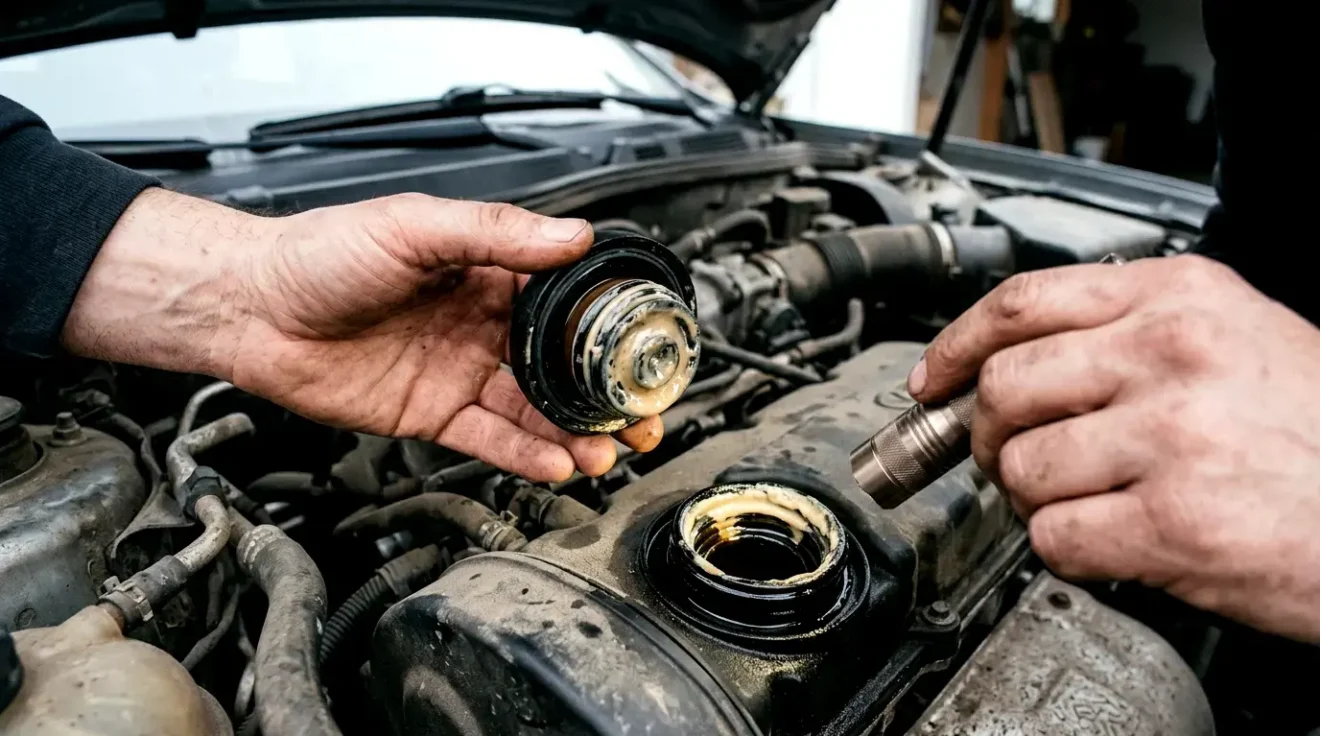
A limited creamy deposit beneath the oil filler cap may develop when repeated short journeys prevent the lubricant from reaching temperatures sufficient to evaporate accumulated moisture. A Mitsubishi technical bulletin on cloudy engine oil troubleshooting, hosted in the NHTSA document database, describes this condensation mechanism and notes that a sufficiently long drive can resolve cloudiness in the circumstances covered by the bulletin.
That finding should not be interpreted as permission to drive with suspected coolant-contaminated oil. The bulletin addresses a particular condensation phenomenon, not every possible cause of milky lubricant.
A useful distinction is whether the symptom is limited to a small residue under the cap or appears throughout the oil, and whether there are additional signs of a cooling-system fault.
| Observation | Possible explanation | Appropriate response |
|---|---|---|
| Uniformly dark oil | Normal suspension of combustion residues or oil ageing | Check service history and interval; do not rely on colour alone |
| Small creamy deposit under the filler cap | Condensation associated with repeated short journeys | Check coolant level and other symptoms; reassess under normal operating conditions if safe |
| Milky oil throughout the dipstick sample | Significant water or coolant contamination | Avoid driving and arrange diagnosis |
| Visible metallic particles or heavy sludge | Possible abnormal wear or deposit accumulation | Seek mechanical inspection before further operation |
If the only finding is minor cap residue, coolant levels remain stable and the vehicle otherwise operates normally, a proper operating-temperature journey may help distinguish condensation, provided the manufacturer permits it and there are no warning signs. Persistent residue or recurrent symptoms still justify inspection.
By contrast, widespread emulsification, unexplained coolant loss, overheating or an oil-pressure warning should be treated as reasons to stop and investigate, not as a reason to attempt a longer drive.
Once oil has been identified as unsuitable and the cause of any contamination has been addressed, its removal creates a separate responsibility: preventing environmental pollution.
Why Pouring Waste Motor Oil into Drains Causes Lasting Damage
Pouring used motor oil into drains can cause lasting environmental damage because petroleum-based lubricants do not dissolve readily in water and can persist in soil and aquatic environments. Used oil may also contain metals and other contaminants accumulated during engine operation. Even a relatively small discharge can create pollution that is difficult to contain or remove.
Engine oil changes chemically and physically while circulating through an engine. It may collect soot, fine metallic wear particles, water, combustion by-products and other impurities. Depending on the engine, fuel, oil formulation and operating conditions, used oil can contain potentially harmful chemicals and metals.
When released into water, oil can spread across the surface, interfere with oxygen transfer and coat aquatic organisms or surrounding habitats. In soil, it may persist and move with water through permeable ground, creating risks for vegetation, wildlife and water resources.
1 million US gallons
The approximate quantity of freshwater that the US Environmental Protection Agency says used oil from one oil change can contaminate. This is an illustrative environmental estimate, not a fixed contamination ratio for every oil change or every litre of oil.
US Environmental Protection Agency, used oil management guidance.
The EPA recommendations on managing and recycling used oil describe used motor oil as persistent, slow to degrade and potentially contaminated with toxic substances and heavy metals.
The amount poured away does not determine whether disposal is acceptable. A small quantity can still pollute, and dilution does not make the contaminants disappear. Stormwater drains may discharge into local waterways, while wastewater systems are not designed to receive uncontrolled motor-oil waste.
Putting oil into household rubbish, pouring it onto land or burning it in unsuitable equipment can also create environmental and safety problems. Requirements for handling used oil differ between countries and local authorities, but unauthorised dumping can result in enforcement action or penalties.
For individual drivers, the practical solution is straightforward: collect the oil during servicing, prevent spills and transfer it to an appropriate waste-oil collection service.
Correct collection becomes considerably easier when drivers know which facilities accept motor oil and how the waste should be packaged.
Where Can Drivers Safely Dispose of Used Engine Oil?
Drivers can usually dispose of used engine oil through designated recycling centres, household hazardous waste facilities or participating garages and automotive retailers. Available services vary by country and municipality, so acceptance should be confirmed before travelling. Oil should be transported in a sealed, leak-proof container and kept separate from other automotive fluids.
Common collection options across English-speaking countries include local-authority recycling centres, municipal waste-oil programmes, participating vehicle maintenance workshops and certain automotive parts stores. Some locations accept household quantities without charge, while others impose quantity limits, fees or residency requirements.
Terminology also varies. UK drivers may find facilities listed as household waste recycling centres, while US and Canadian programmes may use terms such as household hazardous waste sites or used-oil collection centres. In Australia and New Zealand, local council or community recycling facilities may provide appropriate options.
Before leaving home, check whether the site accepts used motor oil from private vehicles, whether an appointment is required and whether it takes oil filters separately.
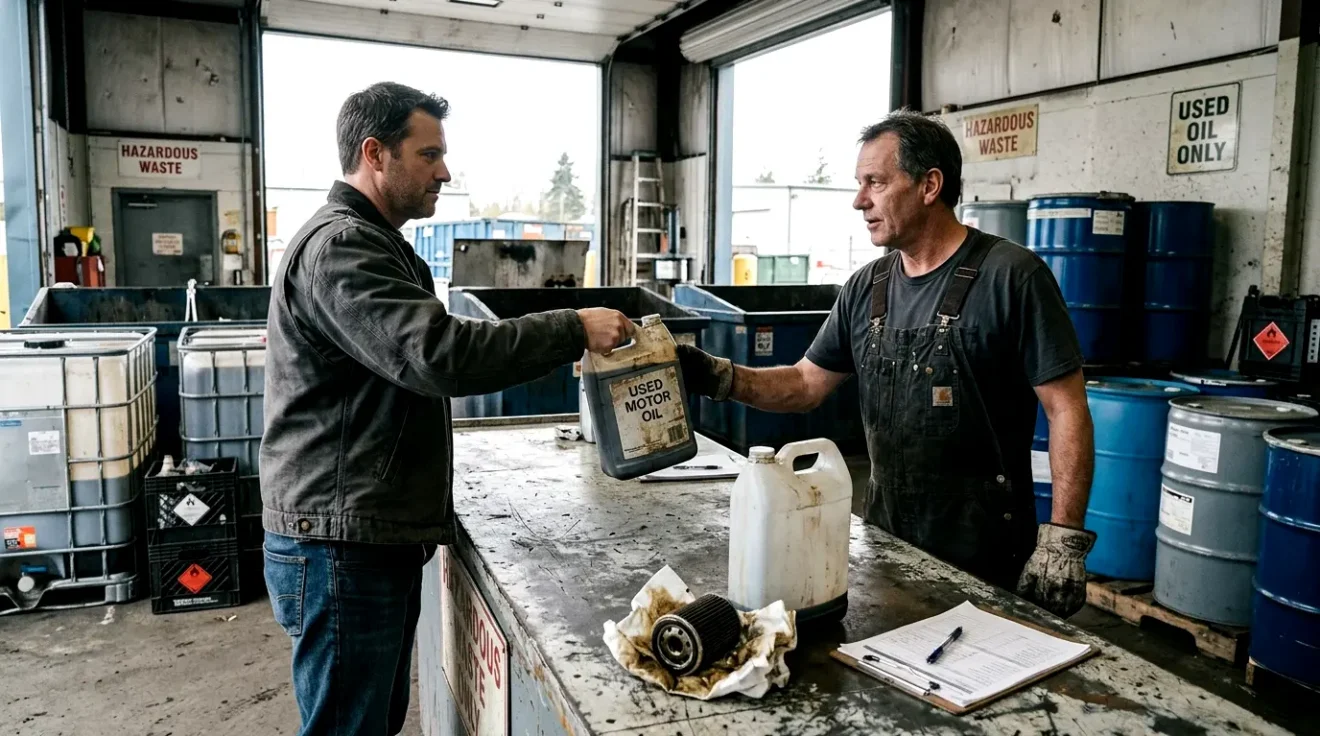
Suitable storage is important because uncontaminated used oil can often be re-refined or otherwise recovered. Mixing it with coolant, brake fluid, solvents, paint or other waste can prevent acceptance through ordinary used-oil recycling channels and require specialised handling.
Use a clean, chemically compatible, leak-proof container with a secure cap, ideally the original oil container if it is suitable for reuse. Label it clearly as used engine oil, keep it upright and protect it from damage or leakage during transport. Never use beverage bottles or food containers.
Oil filters also retain used lubricant. Many collection programmes accept drained filters for appropriate processing, but their acceptance rules vary. Oil-soaked rags and absorbent materials may need a separate waste stream; do not assume they can go into the oil container or ordinary household rubbish.
Five checks before taking used engine oil for recycling
- Identify the collection facility: save the name and address of a local service that explicitly accepts household used motor oil.
- Confirm its acceptance rules: record the opening hours, permitted quantity and whether oil filters are accepted.
- Secure the collected oil: prepare one labelled, leak-proof container with its cap fully tightened and no visible leakage.
- Separate other waste: set aside the used filter, contaminated rags and any other automotive fluids according to the facility’s instructions.
- Complete the handover: deliver the waste to the designated collection point and retain any receipt or record provided.
With waste oil accounted for, the next preventive decision is selecting replacement lubricant that meets the engine’s actual technical requirements.
Why Does Engine Oil Approval Matter More Than Brand Reputation?
Engine oil approval matters more than brand reputation because compatibility depends on measurable technical requirements, not how familiar or expensive a product appears. An oil must satisfy the viscosity and performance specifications required by the vehicle manufacturer. A respected brand may offer excellent lubricants, but not every product in its range is suitable for every engine.
Engine oils use several overlapping classification systems. The American Petroleum Institute (API) defines service categories and associated certification marks. The European Automobile Manufacturers’ Association (ACEA) publishes performance sequences commonly referenced by European vehicle manufacturers. Individual manufacturers may also require their own specifications or formal product approvals.
The API guide to engine oil classifications and certification marks explains the API Certification Marks and Service Symbol used to communicate oil quality categories. These markings are useful, but an API category does not automatically replace a particular ACEA requirement or vehicle-manufacturer approval.
Oil containers may show markings such as SAE 5W-30, an API service category, an ACEA sequence or a manufacturer-specific approval code. Each conveys different information.
| Label element | What it identifies | What to verify |
|---|---|---|
| SAE viscosity grade | Viscosity behaviour under specified temperature conditions | The grade permitted for the engine and operating conditions |
| API service category | Defined engine oil performance requirements | The applicable category specified or permitted by the manufacturer |
| ACEA sequence | European engine oil performance classification | The precise sequence required by the vehicle |
| Manufacturer-specific specification | Additional requirements for particular engines or vehicle groups | The exact code and whether the product has the required formal approval |
A practical verification begins with the owner’s manual, followed by the oil container’s technical information. Match the required specification and viscosity grade exactly, including any permitted alternatives or model-specific conditions.
Also distinguish wording such as “approved” from broader statements like “recommended for” or “suitable for”. The latter may reflect a supplier’s compatibility claim rather than formal manufacturer approval. Where the manual requires an approved product, confirm that status rather than relying on a marketing description.
This matters particularly in modern engines with turbochargers, exhaust aftertreatment systems, specialised valve mechanisms or tightly controlled lubricant requirements. An oil with an inappropriate additive formulation or performance specification may contribute to deposits, emissions-system problems or accelerated wear.
Products marketed as universal should therefore be assessed against their listed specifications, not their breadth of advertised applications. The correct approval and permitted viscosity take priority over brand familiarity.
Even a correctly approved oil must still be replaced at an appropriate interval, because its performance cannot be assumed to remain unchanged indefinitely.
Why Following the Wrong Service Interval Can Damage Your Car
Following the wrong engine oil service interval can cause damage when lubricant remains in use longer than its formulation and operating conditions allow. Heat, contamination and additive depletion may eventually promote sludge, corrosion and wear. However, changing oil much earlier than required is not automatically beneficial; the correct interval depends on the manufacturer’s guidance and the vehicle’s actual use.
Service schedules frequently distinguish ordinary operating conditions from severe-service conditions. Depending on the manufacturer, severe use may include repeated short journeys, heavy towing, extended idling, dusty environments, extreme temperatures or sustained high engine loads.
These conditions matter because distance alone does not measure every stress experienced by the oil. A vehicle covering relatively few miles through repeated cold starts may experience considerable moisture and fuel accumulation, while a car covering longer distances at stable operating temperatures may face a different contamination profile.
Oil that is left in service beyond its effective life can develop an increasingly unfavourable combination of oxidation products, depleted additives and suspended contamination. Under certain conditions, deposits and sludge can accumulate around engine components or obstruct narrow lubrication passages.
Restricted oil flow is especially concerning for components dependent on reliable lubrication, including turbocharger bearings and some variable valve timing mechanisms. Severe contamination or insufficient oil pressure can eventually turn an ordinary maintenance requirement into a major mechanical repair.
However, the opposite approach—replacing oil at arbitrarily short intervals regardless of the manufacturer’s instructions—can waste lubricant, filters, labour and money without demonstrated additional benefit for a properly maintained engine.
The sensible approach is to work from the vehicle’s specified schedule rather than applying a universal distance-based rule. If the manufacturer provides separate normal and severe-service schedules, use its definitions to identify the appropriate one.
For example, consider two hypothetical cars that each cover the same annual distance. One makes frequent short urban journeys, while the other mainly travels on longer routes. Their oil may experience different thermal and contamination conditions, so identical mileage does not necessarily imply identical lubricant condition.
Track both elapsed time and distance travelled. Where the service schedule specifies a mileage or time limit, the relevant limit reached first normally determines when servicing is due, subject to the vehicle’s prescribed maintenance system.
Do not extend an interval simply because the oil looks clean or because the engine runs normally. If the maintenance history is uncertain, a professional can help establish a suitable service starting point.
Once replacement is due, avoiding damage also depends on the practical details of draining the old oil, fitting the filter and refilling the engine correctly.
Key takeaways before replacing your engine oil
- Check the exact oil specification, permitted viscosity and required quantity in the vehicle documentation before opening a new container.
- If the old oil shows signs of fuel or coolant contamination, arrange diagnosis rather than treating a routine oil change as a complete repair.
- Prepare the correct filter, sealing components, tools and used-oil collection container before starting the replacement.
How to Use the Correct Fresh Engine Oil Without Harming Your Engine?
Fresh engine oil protects the engine when it meets the manufacturer’s requirements, is added in the correct quantity and is installed without introducing leaks or contamination. Overfilling, using an unsuitable specification or incorrectly fitting the drain plug and filter can cause damage even when the oil itself is new. Accurate servicing is therefore as important as timely replacement.
Start by checking the owner’s manual or manufacturer service information for the required specification, approved viscosity, refill quantity and servicing procedure. Oil capacity can differ depending on the engine version and whether the filter is replaced.
For a full oil change, follow the manufacturer’s prescribed drain and refill sequence. The basic process is:
- Prepare the vehicle safely. Park on a suitable level surface, secure the vehicle and allow hot components to cool enough for safe handling. If underneath access is required, use approved lifting and support equipment; never work beneath a vehicle supported only by a jack.
- Drain the old oil. Position an appropriate collection container, remove the specified drain plug and allow the oil to drain according to the service procedure.
- Replace the filter and required seals. Confirm the correct filter is fitted, remove the old filter gasket and replace the drain plug washer or sealing component where specified. Lubricate the new filter seal if instructed.
- Secure the components correctly. Tighten the drain plug and filter using the manufacturer’s specified method and torque where applicable.
- Refill and verify. Add the specified fresh oil, initially allowing for final level adjustment. Follow the manufacturer’s procedure for checking the level, starting the engine, inspecting for leaks and rechecking after the required settling period.
Overfilling must be avoided. Excess oil may contact rotating crankshaft components and become aerated, compromising reliable lubrication. Depending on engine design, excessive oil can also contribute to crankcase ventilation problems, oil carryover or leakage.
The opposite mistake—starting an engine with insufficient oil following a drain—can rapidly damage bearings and other lubricated components. Confirm the refill quantity and indicated level before the initial start, then follow the prescribed post-service checks.
During routine top-ups between services, use oil meeting the same required specification as the lubricant already installed, preferably the same product where practical. Add small quantities and recheck using the manufacturer’s dipstick or electronic-level procedure. Mixing different approved products is not necessarily harmful, but combining incompatible specifications or unsuitable formulations should not be treated as a routine solution.
Several common workshop errors deserve particular attention:
- Over-tightening a drain plug: may damage the sump threads or sealing surfaces.
- Under-tightening a drain plug: can produce leaks or, in severe cases, allow the plug to loosen.
- Leaving the old filter gasket in place: can create a double-gasket condition and cause substantial leakage.
- Reusing a single-use sealing washer: may prevent the drain plug from sealing as intended.
- Failing to inspect after startup: can allow an incorrectly sealed filter or drain plug to leak unnoticed.
After servicing, ensure the oil-pressure warning behaves normally according to the vehicle instructions. If the warning remains illuminated, a serious leak appears or unusual mechanical noises occur, shut the engine off promptly and investigate. Do not continue running it to see whether the problem disappears.
A professional oil change is the safer option when the correct specification cannot be confirmed, access requires equipment that is unavailable, the drain plug is damaged or the vehicle has unexplained lubrication or cooling-system symptoms.
The next practical step is to compare the oil container with the vehicle’s service requirements, arrange a proper change if the oil is overdue or unsuitable, and confirm that every litre of removed oil reaches an appropriate collection facility. This completes the maintenance process without transferring the engine’s waste problem to the environment.
Can an engine be damaged before the oil warning light comes on?
Yes. An oil-pressure warning generally relates to lubrication-system pressure rather than directly measuring additive condition, oxidation or contamination. Oil can deteriorate while the engine still maintains apparently normal pressure. Routine servicing and checking for abnormal symptoms remain essential. If an oil-pressure warning appears while driving, stop safely and switch off the engine as directed by the vehicle manufacturer.
Does synthetic engine oil last indefinitely if the car is rarely driven?
No. Synthetic oil can offer strong resistance to certain degradation processes, but it is not immune to oxidation, moisture contamination or additive changes. A rarely driven vehicle may also accumulate condensation during short operating periods. Follow the manufacturer’s time-based service limit even when annual mileage is low.
Can an engine flush remove all the sludge caused by neglected oil changes?
No. An engine flush cannot guarantee removal of all deposits or repair components already damaged by inadequate lubrication. Loosened deposits may also create problems in certain contaminated engines. Where substantial sludge is suspected, professional inspection is preferable to adding a chemical cleaner without confirming that the procedure is suitable for the engine.
Should oil be changed immediately after a suspected coolant leak is repaired?
If coolant entered the engine oil, contaminated lubricant needs to be removed as part of the repair process. The workshop should also follow the manufacturer’s instructions for any additional cleaning, filter replacement or follow-up checks. Simply adding fresh oil without confirming that the leak has stopped does not eliminate the risk of repeated contamination.
Can used engine oil be stored at home until a recycling centre is open?
Temporary storage is generally practical when used oil is kept in a suitable, securely sealed, clearly labelled container protected from spills, heat and unauthorised access. Keep it separate from other chemicals and out of reach of children and animals. Follow local storage requirements and take the waste to an accepting collection point as soon as reasonably possible.