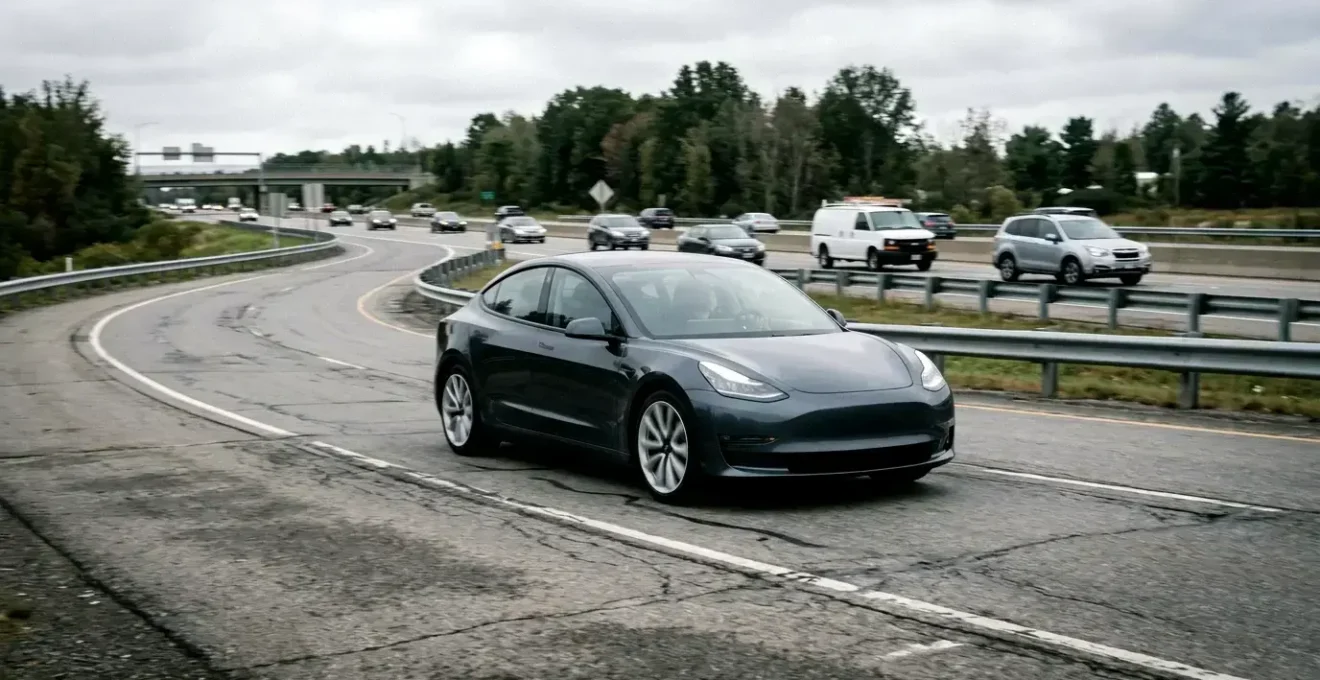
Electric vehicle performance changes with battery charge, temperature, driving speed, powertrain configuration and the demands placed on the vehicle. An EV that accelerates strongly during a short test drive may respond differently after a long motorway journey, during freezing weather or after several demanding acceleration events.
The distinction matters because advertised horsepower and 0–60 mph times describe only part of an electric drivetrain’s capabilities. Real-world performance also includes overtaking response, sustained power delivery, energy consumption, traction and the ability to reproduce acceleration under changing conditions.
Electric motors can deliver substantial torque from low rotational speeds, but the battery and power electronics determine how much electrical power remains available. Thermal management and vehicle software further influence that delivery. Consequently, two EVs with similar published acceleration figures may behave differently during ordinary driving.
Evaluating an EV therefore requires more than comparing specifications. It means examining how consistently the vehicle performs across realistic battery levels, weather conditions and driving situations, while considering whether its charging arrangements support those demands.
Real-world EV performance at a glance
- Acceleration can weaken when battery charge is low, the battery is cold or the drivetrain reaches thermal limits. The effects vary by vehicle.
- Overtaking acceleration, repeatability and everyday energy consumption provide a more useful comparison than 0–60 mph times alone.
- Battery preparation, suitable charging habits and realistic range margins help maintain predictable driving performance.
- Why Can an Electric Car Feel Slower With a Low Battery?
- How to Compare EV Overtaking Performance on Real Roads?
- Single-Motor or Dual-Motor EV: Which Suits Everyday Driving?
- Why Can Repeated Hard Acceleration Reduce EV Power Output?
- How to Prepare an EV Battery for Driving in Cold Weather?
- How to Plan Weekly EV Charging Around a Daily Commute?
- How to Test Driver Assistance Features Without Overestimating Their Abilities?
- Is an Electric Vehicle Practical Without a Home Charger?
Why Can an Electric Car Feel Slower With a Low Battery?
An electric car can feel slower at low battery charge because its battery management system may restrict the electrical power available to the motors. Lower battery voltage, voltage sag under load and temperature-related limits can reduce acceleration. Separately, efficiency-focused driving modes may deliberately soften throttle response even when the battery could deliver more power.
A lithium-ion battery supplies electrical energy through cells whose voltage varies with their state of charge. During demanding acceleration, current draw creates an additional voltage drop across the battery’s internal resistance. At low charge, the system may have less voltage margin before reaching protective cell limits.
The battery management system can respond by restricting discharge current, reducing the power available to the inverter and electric motors. The result may be weaker acceleration, particularly at higher speeds where substantial power is needed to overcome aerodynamic resistance.
Battery protection and driver-selected acceleration settings are different mechanisms. A reduced-power driving mode can change accelerator sensitivity or maximum output without the battery being physically unable to deliver additional power.
The Tesla Model 3 acceleration-mode documentation illustrates this distinction. It describes selectable acceleration settings, efficiency trade-offs and circumstances in which battery warming is needed before higher acceleration capability becomes available. These are vehicle-specific operating characteristics, not universal EV thresholds.
To understand a particular EV, compare its response at approximately 80%, 30% and 10% charge using the same driving mode and comparable battery temperatures. This should be a qualitative comparison on public roads, using only normal, lawful acceleration. Instrumented acceleration testing belongs on a closed course.
Record whether the vehicle displays reduced-power warnings, changes accelerator response or limits its available power. The comparison is only meaningful when environmental conditions are sufficiently similar.
There is no established charge percentage at which every EV suddenly becomes slower. The onset and severity of power restrictions depend on battery chemistry, temperature, vehicle design and control software.
The driving implication is straightforward: avoid relying on advertised peak acceleration when entering fast-moving traffic or considering an overtake with a nearly depleted battery. Available power matters more than the vehicle’s theoretical maximum, which makes real-road acceleration measurements the next useful comparison.
How to Compare EV Overtaking Performance on Real Roads?
EV overtaking performance is best compared using independently measured acceleration within realistic road-speed ranges, rather than relying exclusively on 0–60 mph results. Measurements such as 30–50 mph and 50–70 mph help reveal how quickly a vehicle gains speed once moving. Battery charge, driving mode, temperature and repeated acceleration also affect whether those results remain available.
A standing-start acceleration figure rewards strong launch traction and immediate torque delivery. Overtaking places different demands on the drivetrain because the vehicle is already moving and aerodynamic drag rises rapidly with speed.
For example, accelerating from 50 to 70 mph may be more relevant to a motorway merge or permitted passing manoeuvre than reaching 60 mph from rest. Independent 80–120 km/h measurements can provide a comparable reference in markets using metric speed units, although the speed intervals are not identical.
Higher-speed performance can vary considerably between vehicles with similar headline horsepower. Motor speed limits, available battery power, inverter characteristics and power-delivery calibration all influence acceleration.
The following comparison framework separates useful measurements from specifications that can be misleading when viewed alone.
| Criterion | What to examine | Why it matters |
|---|---|---|
| 30–50 mph acceleration | Independent moving-start measurements | Indicates response at moderate road speeds. |
| 50–70 mph acceleration | Elapsed time under documented test conditions | Helps compare acceleration at higher cruising speeds. |
| Driving mode | Whether maximum output requires Sport or another setting | Shows which performance level is routinely accessible. |
| Battery conditions | State of charge and battery temperature during testing | Helps determine whether comparisons are equivalent. |
| Repeated acceleration | Consistency across successive controlled runs | Reveals whether the initial result is sustainable. |
| Temporary boost | Activation requirements and operating restrictions | Separates special performance modes from normal driving. |
Launch control and temporary boost functions should not be treated as representative overtaking performance. Some require specific preparation, operating conditions or activation procedures that are impractical during routine driving.
When reviewing independent test results, prefer measurements obtained using comparable procedures and similar battery conditions. A single impressive result recorded under optimal circumstances does not establish consistent acceleration throughout a journey.
A road test can also reveal how promptly the accelerator responds in the vehicle’s usual driving mode. The relevant question is not simply how much power is available, but whether the driver can access predictable acceleration without changing settings or invoking a special performance function.
These measurements help establish whether a vehicle has sufficient everyday responsiveness. Choosing between single-motor and dual-motor configurations then becomes a question of how much additional power and traction the driver genuinely needs.
Single-Motor or Dual-Motor EV: Which Suits Everyday Driving?
A single-motor EV often suits drivers who prioritise efficiency, purchase cost and predictable daily transportation. A dual-motor configuration may provide stronger acceleration, additional traction and model-dependent towing benefits. The better choice depends on local weather, road conditions, driving demands and the efficiency differences between the specific vehicles being compared.
In many electric platforms, a single motor drives either the front or rear axle, while a dual-motor configuration can power both axles. All-wheel drive can distribute propulsion torque between axles to improve traction under suitable conditions.
That additional capability does not eliminate tyre grip limitations. In winter, appropriate tyres remain essential regardless of the number of driven axles. All-wheel drive can help a vehicle accelerate on slippery surfaces, but it does not inherently shorten braking distances or overcome poor tyre grip while cornering.
Dual-motor configurations may also introduce additional mass, mechanical components and electrical losses. However, a dual-motor EV does not always consume more energy than a single-motor version in every driving condition. Some vehicles can reduce the contribution of one motor during efficient cruising, and different motor technologies have different efficiency characteristics.
Compare the actual variants instead of assuming a universal range penalty.
| Driving requirement | Single-motor EV | Dual-motor EV |
|---|---|---|
| Daily commuting | Often sufficient, with potentially lower cost | Additional output may be rarely needed |
| Energy efficiency | Can benefit from lower weight and reduced complexity | Depends on motor design and axle management |
| Snow and slippery surfaces | Capable with suitable winter tyres | Can improve acceleration traction with suitable tyres |
| Frequent passing | Depends on available moving-speed power | May provide stronger acceleration |
| Towing | Depends on approved towing rating | May offer higher approved capacity on some models |
| Ownership cost | Often a lower purchase price | Potentially higher purchase and maintenance costs |
For drivers in mild climates with mainly urban and motorway journeys, the performance of a well-specified single-motor EV may already exceed what everyday driving requires. Regular travel on steep, slippery roads or a need for stronger acceleration may make dual-motor traction more worthwhile.
Drivers who tow should check manufacturer-approved towing capacity, vehicle weight limits and real-world energy consumption under load. A second motor does not automatically guarantee superior towing suitability.
There is also an important limitation: additional motors cannot compensate for insufficient available battery power. A dual-motor EV may experience substantial output restrictions at low charge or unfavorable battery temperature, just as a single-motor vehicle can.
Before paying for the higher-performance configuration, compare its efficiency, real-world acceleration and power availability at partial charge. The most useful specification is the capability that remains accessible during normal use.
Neither configuration is universally superior. For demanding drivers, the remaining question is whether its performance persists when the powertrain is repeatedly stressed, rather than merely during one acceleration event.
Why Can Repeated Hard Acceleration Reduce EV Power Output?
Repeated hard acceleration can reduce EV power because the battery, inverter and electric motors generate heat while delivering high electrical current. As component temperatures approach their operating limits, thermal-management software may restrict output to protect the drivetrain. This thermal derating is distinct from low-charge power restrictions, although both effects can occur simultaneously.
During high-power acceleration, electrical resistance generates heat in the battery and power electronics. Motors also produce heat through winding resistance and other internal losses. Repeated high-load operation increases the cooling system’s workload.
Liquid cooling, coolant pumps, heat exchangers and refrigerant-based thermal systems help control component temperatures. However, their capacity is finite. If heat generation exceeds the system’s ability to remove it, protective software can reduce the maximum power available.
This behavior may become noticeable during demanding mountain climbs, track driving or successive high-load acceleration events. A car might initially deliver strong acceleration and then provide less power as temperatures rise.
Thermal derating and low state-of-charge restrictions have different causes. The former is driven by component temperatures; the latter can result from battery voltage and discharge limitations. Both are managed electronically, and their effects may overlap.

When component temperatures fall sufficiently, the vehicle can restore additional power. Recovery depends on cooling-system design, ambient temperature, recent driving intensity and battery condition. Recharging may coincide with recovery, but charging is not itself a guarantee of immediate full-power restoration.
An instrumented test on a closed course can examine performance consistency. Record the initial battery charge, ambient conditions and battery temperature where the vehicle makes that information available. Then compare successive acceleration measurements using the same validated procedure and appropriate cooling intervals.
The important result is not simply whether performance falls, but how quickly it falls, how much output is lost and whether the vehicle subsequently recovers. These results should never be inferred from a single acceleration run.
Ordinary motorway exits and public roads are not appropriate places to perform repeated maximum-acceleration tests. Legal speed limits, traffic conditions and stopping distances take priority over data collection.
Comparisons with combustion-engine cars also require care. Petrol and diesel powertrains experience thermal limitations, even though their cooling and protection systems operate differently. Sustained capability must be measured rather than assumed from propulsion type.
A vehicle that maintains predictable power across changing conditions may be more suitable than one with a stronger but less repeatable initial result. Temperature affects this consistency in another important situation: starting a winter journey with a cold battery.
How to Prepare an EV Battery for Driving in Cold Weather?
The most effective general winter preparation is to precondition the EV’s battery and cabin while the vehicle is connected to a charger, where the model supports this feature. Preconditioning can improve battery operating conditions and reduce the energy needed from the battery after departure. Drivers should also allow extra range margin and check model-specific charging behavior.
Cold weather changes lithium-ion battery behavior. Lower temperatures generally increase internal resistance and reduce the battery’s immediate ability to deliver or accept high electrical current. Consequently, power availability, regenerative braking and fast-charging performance may be restricted until the battery warms.
Winter range reduction also reflects the energy used to heat the passenger compartment, battery and other components. Cabin heating demand can be particularly noticeable during short journeys, when energy spent warming the vehicle is distributed over relatively few miles.
These effects should not be confused with permanent battery degradation. Much of the temperature-related reduction in accessible energy and power is reversible when the battery returns to a suitable operating temperature. Battery aging is a separate process.
The U.S. Department of Energy winter EV recommendations advise using preconditioning while connected to a charger and starting cold-weather journeys with sufficient battery charge.
Preconditioning while plugged in can draw energy from the electrical supply rather than relying entirely on stored battery energy. Actual energy flow depends on the vehicle, charger output and heating demand, so it does not guarantee zero battery consumption.
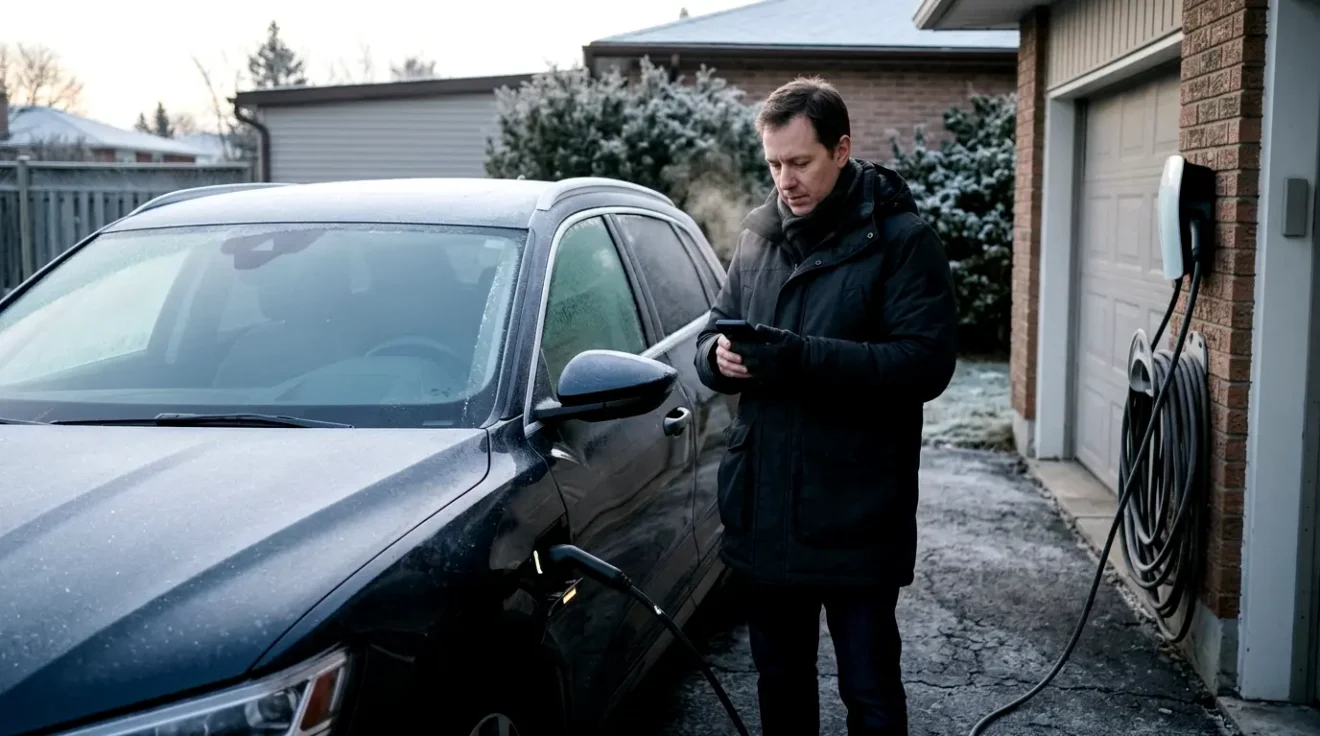
For vehicles with scheduled departure functions, configuring preconditioning around the usual departure time can make winter preparation more convenient. Drivers should verify whether their vehicle heats the battery, cabin or both, since manufacturers implement these functions differently.
Battery preconditioning for DC fast charging is another distinct feature. Some EVs can warm their batteries when a compatible rapid charger is entered as the navigation destination. Others require manual activation or do not provide the same functionality.
Estimated range should also be interpreted cautiously. Dashboard predictions may account for recent energy use, temperature and selected destinations, but the algorithms differ between vehicles. A reduced winter estimate does not, by itself, quantify permanent battery capacity loss.
Five checks before a cold-weather EV journey
- Check the forecast: record the expected temperature and weather conditions for departure and arrival.
- Confirm your starting charge: write down the planned distance and battery charge needed, including a weather-adjusted reserve.
- Schedule preconditioning: verify the departure setting and whether battery heating is supported while plugged in.
- Review charging stops: identify suitable chargers and confirm whether navigation-triggered battery preparation is available.
- Check vehicle readiness: inspect the displayed range, tyre condition, warning messages and available regenerative-braking indications before departure.
Winter preparation is most effective when it forms part of an overall charging strategy. The next consideration is how to maintain enough usable battery capacity and reliable performance across an ordinary working week.
How to Plan Weekly EV Charging Around a Daily Commute?
Weekly EV charging is best planned around measured energy consumption, expected journeys and a practical minimum battery reserve. Rather than charging on a fixed day regardless of circumstances, drivers can estimate how much energy their commute requires and recharge before the remaining battery level becomes inconvenient. Seasonal conditions and the manufacturer’s charging recommendations should guide the chosen buffer.
Start with the energy the vehicle actually consumes in daily use, expressed in kWh per 100 miles or kWh per 100 km. Dashboard trip records or charging logs can provide a useful starting point, although energy delivered by a charger may include charging losses.
A simple planning calculation is:
Weekly driving energy (kWh) = weekly distance × measured energy consumption per distance unit.
For measurements expressed in kWh per 100 miles, divide the weekly mileage by 100 before multiplying by the consumption figure. The same method applies to kilometres when consumption is recorded per 100 km.
Consider a purely hypothetical commuter who drives 200 miles in a working week and records an average consumption of 30 kWh per 100 miles. Their estimated driving energy requirement would be 60 kWh before accounting for additional journeys, climate-related variability and charging losses.
This is an illustrative calculation, not a claim about typical EV consumption. The driver’s recorded energy use should replace the example values.
A useful charging trigger depends on the expected distance before the next reliable charging opportunity. It should leave enough reserve to avoid arriving at inconveniently low charge or encountering reduced power availability.
However, there is no universally optimal daily charging percentage. Battery chemistry and manufacturer guidance matter. Some vehicles recommend regular charging to a specified upper limit, while others provide different instructions, including periodic full charging for battery calibration or particular battery configurations.
Remaining at very high charge for extended periods can accelerate certain battery-aging processes, particularly under unfavorable temperatures. Conversely, repeatedly approaching an extremely low charge can make journeys less convenient and may expose drivers to power restrictions.
Frequent partial charging can be practical when home or workplace charging is readily available. Occasional higher charging targets may be appropriate before longer journeys, provided they follow the vehicle manufacturer’s recommendations.
Charging costs also influence the schedule. A driver with overnight electricity tariffs may prefer regular charging during cheaper periods, while someone relying on public infrastructure may find fewer, longer sessions more convenient.
To establish a reliable weekly routine, compare consumption across normal and cold-weather weeks, then define a reserve that accommodates the next commute and an unexpected diversion. Recalculate when the commute, vehicle or charging access changes.
Predictable charging reduces uncertainty about available range and battery conditions. A similarly evidence-based approach is useful when evaluating another aspect of modern EV ownership: the reliability and limitations of driver assistance technology.
How to Test Driver Assistance Features Without Overestimating Their Abilities?
Driver assistance features should be evaluated progressively under permitted operating conditions, with the driver remaining responsible for vehicle control. Begin by understanding the system’s intended functions, then observe how it responds to ordinary road conditions, lane markings and surrounding traffic. Successful operation during a few journeys does not demonstrate reliable performance in every environment.
Advanced driver assistance systems include adaptive cruise control, lane-centering assistance, lane-departure prevention and automatic emergency braking. These functions address different driving tasks and should not be treated as equivalent capabilities.
Many systems rely on cameras, radar or other sensors to interpret road markings, vehicle positions and traffic conditions. Their performance can change when rain, snow, poor visibility, dirty sensors or deteriorated road markings interfere with detection.
The IIHS research overview on advanced driver assistance explains the operating limitations of these systems and distinguishes driver support from higher levels of automation. It also identifies the risk that drivers can become overly confident in partial driving automation.
Level 2 automation still requires continuous driver supervision. A system that controls steering and speed under defined conditions does not relieve the driver of responsibility for monitoring the road and responding when necessary.
A sensible evaluation begins with the vehicle’s manual, including supported roads, speed ranges, driver monitoring requirements and restrictions during adverse weather.
During ordinary journeys on suitable roads, drivers can observe whether the system maintains consistent lane positioning, handles normal traffic-flow changes appropriately and provides understandable status information. Observation should never involve deliberately creating hazards or provoking an emergency response.
Record the conditions under which any limitation appears. Useful observations include whether lane markings were clearly visible, whether warnings occurred and whether the system disengaged unexpectedly.
Automatic emergency braking should not be deliberately tested against pedestrians, vehicles or obstacles in live traffic. Controlled testing requires appropriate facilities, equipment and trained personnel.
It is also important to separate individual collision-avoidance functions from sustained driving automation. The effectiveness of one feature does not establish the reliability of every other feature fitted to the same vehicle.
Real-world performance evaluation therefore extends beyond acceleration and battery efficiency. A vehicle may have a capable electric drivetrain but driver assistance systems that operate inconsistently in the conditions its owner encounters most frequently.
Technology should be judged against the conditions in which it will actually be used. The same principle applies to charging access, particularly for drivers who cannot recharge their EV at home.
Key takeaways before choosing an EV
- Establish how much range and available power remain after a normal commuting week, not just immediately after charging.
- Check whether the charging opportunities on the journeys you already make provide dependable access and suitable charging speeds.
- Include charging time, energy prices and seasonal battery preparation when comparing practical ownership options.
Is an Electric Vehicle Practical Without a Home Charger?
An electric vehicle can be practical without a home charger if reliable public or workplace charging fits the driver’s normal travel pattern. The key considerations are charger availability, connector compatibility, charging time, actual energy consumption and total electricity cost. Drivers should also assess whether their charging arrangements leave enough battery reserve for routine journeys and unexpected travel.
Without private charging, convenience depends less on the total number of public chargers than on access to specific, usable locations. A charger that regularly requires a substantial diversion may be less practical than one located near a workplace, supermarket or other frequent destination.
Begin by mapping charging opportunities around home, work and regular journeys. Identify which stations can deliver suitable power to the vehicle, including any connector or adapter requirements.
Connector standards vary by market. For example, charging equipment and compatibility arrangements in North America differ from those commonly used in the United Kingdom, Europe and Australia. Compatibility must be checked against the particular vehicle and charging station rather than inferred from the charger’s advertised power.
Availability is equally important. A station may appear on a charging map but be occupied, temporarily unavailable or restricted to certain users. Check current network information, access hours and recent reliability reports where available.
Next, evaluate charging duration. The maximum power advertised for a rapid charger does not guarantee that the vehicle can maintain that rate. Actual charging speed depends on the EV’s charging curve, state of charge, battery temperature and station conditions.
Public charging also introduces costs beyond the energy itself. Depending on the operator, the total may include per-kWh charges, time-based fees, session charges, subscription costs or idle fees.
For an individualized comparison, calculate the expected monthly charging expense using the tariffs of the stations likely to be used. Add the time and distance required for charging-related diversions. Compare that figure with the applicable home-electricity costs only where a relevant home-charging alternative exists.
Another consideration is battery preparation. Drivers without a home charger may have fewer convenient opportunities to precondition while plugged in, particularly before early winter departures. This can increase reliance on battery energy for heating and make cold-weather planning more important.
However, lack of home charging does not automatically reduce an EV’s driving performance. A driver who has access to reliable workplace or public charging can maintain adequate battery levels and prepare for longer journeys effectively.
What matters is whether the available charging schedule allows the battery to remain sufficiently charged for expected journeys without unnecessary time pressure or repeated very-low-charge operation.
Public charging is therefore a practical ownership option for some drivers and a significant inconvenience for others. The difference emerges from the actual route, access conditions, pricing and required charging frequency, not from a universal rule about EV ownership.
For a realistic purchase decision, map the charging locations used during an ordinary week, verify their compatibility and prices, and compare the resulting time and energy costs with a measured commuting requirement. That assessment provides a more dependable basis for choosing an EV than headline range or acceleration figures alone.
Does an EV always deliver its advertised horsepower?
No. Advertised peak output describes a capability under specified conditions, not necessarily continuous power availability. Battery charge, temperature, operating software and thermal limits can affect the output available during a particular journey. Some vehicles also require specific driving settings to access their highest performance.
Can an EV lose acceleration performance even when the battery is nearly full?
Yes. A high battery charge does not eliminate temperature-related or software-defined power restrictions. A cold battery may initially have limited discharge capability, while repeated high-load driving can cause thermal derating. A nearly full battery can also have restricted regenerative braking, although that is different from reduced acceleration power.
Does regenerative braking work equally well in all conditions?
No. Regenerative braking depends on the battery’s ability to accept charging current. Cold temperatures and high states of charge can restrict energy recovery. The amount of regeneration available also varies with vehicle speed, traction and manufacturer calibration. Drivers should follow the vehicle’s braking guidance and not assume that lifting the accelerator will always produce identical deceleration.
Is motorway driving less efficient than urban driving in an EV?
Often, particularly at sustained high speeds. Aerodynamic resistance increases substantially with speed, raising the power required to maintain motorway cruising. Urban driving may benefit from lower aerodynamic losses and regenerative braking, although stop-and-go conditions, short journeys and heating demands can also increase consumption. Actual efficiency depends on the vehicle, speed, terrain and weather.
What should drivers prioritize when comparing real-world EV performance?
Prioritize independent moving-speed acceleration measurements, consistent power delivery, measured energy consumption and predictable operation at ordinary battery levels. Then consider seasonal range requirements, charging access, traction and driver assistance limitations. The strongest choice is the EV whose usable capabilities match the driving conditions encountered most often, rather than the one with the most impressive isolated specification.